





















Written by the AgileFever editorial team. Facts checked on November 5, 2026 against the official pages of the organizations named in this post. AgileFever sells training for some of the topics covered here, and we say so wherever it applies. Course names, hours, prices and batch dates are from AgileFever’s own product pages on that date. Metric definitions are from the Kanban Guide.
Department heads and L&D leads often ask where to begin with corporate Kanban training. The answer is not a course name. It is a sequence: which teams go first, which roles take which course, what you measure, and when you widen the rollout. This post gives that sequence. If you are still choosing between Kanban and SAFe for the whole organisation, read Corporate Kanban and SAFe training: choosing the framework first. If you need a board to practise on, see Kanban board examples and our Kanban board template.
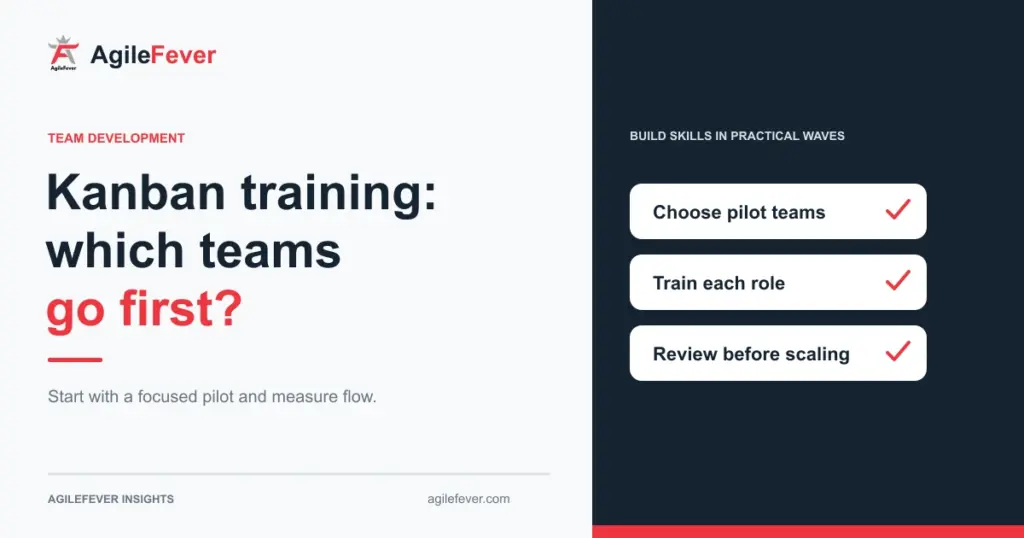
Corporate Kanban training: how to choose the first teams
The first teams set the tone for every team after them. A good first team shows a result inside a quarter. A poor choice starts an argument about whether Kanban works, and that stalls corporate Kanban training everywhere. Score each candidate team from 1 to 5 on four things.
| Criterion | Scores 5 when | Scores 1 when | Why it counts |
|---|---|---|---|
| Work type | Requests arrive continuously and finish in days or weeks: support, operations, maintenance, platform requests, content | One large project with fixed scope and a single delivery date | Kanban manages flow of many items. Few, large items give you almost no flow data. |
| Flow problem | Work waits in queues, dates slip, people juggle many items, and nobody can say where work is stuck | Work already moves smoothly and the team is satisfied | A visible pain gives the team a reason to change and gives you a before-and-after to measure. |
| Sponsor | A named manager attends reviews and will protect the team from new work during the pilot | Nobody senior owns the outcome | WIP limits fail the first time urgent work arrives. Someone has to back the team when it happens. |
| Team stability | The same people for the next six months | Half the team rotates or is about to move | You train people once. If they leave, the habit goes with them and your baseline is meaningless. |
Add the four scores for a total out of 20. The table below shows four invented teams so you can see how the scoring plays out.
| Candidate team (illustrative) | Work type | Flow problem | Sponsor | Stability | Total of 20 |
|---|---|---|---|---|---|
| IT support desk | 5 | 5 | 4 | 4 | 18 |
| Platform operations | 4 | 4 | 3 | 4 | 15 |
| Product squad on one release | 2 | 3 | 4 | 3 | 12 |
| Newly formed data team | 3 | 2 | 2 | 1 | 8 |
The teams and scores are examples for this post, not data from any company.
Our rule of thumb: pilot the two highest scorers, and treat a 1 on sponsor or stability as a stop sign whatever the total says. Here the support desk and platform operations go first, and the new data team (8) waits until its roster settles. Pilot two teams, not one, so a single unlucky quarter does not decide the question for the organisation.
What each audience needs, mapped to AgileFever’s Kanban courses
Corporate Kanban training needs different depth for different roles. A team member must run the board. A team lead must design it. A manager must read the flow data and act on it. All of these are Kanban University courses that we deliver, and the table gives the hours, listed price and next batch from our product pages on November 5, 2026. Rupee prices are before the 18% GST we add at checkout for buyers in India.
| Audience | Course | Length | Listed price | Next listed batch |
|---|---|---|---|---|
| Team members | Team Kanban Practitioner (TKP) | 8 hours | $550 / ₹14,000 | Nov 6, 2026 |
| Team members on Scrum teams | Scrum Better With Kanban (SBK) | 8 hours | $550 / ₹14,000 | Nov 19, 2026 |
| Team leads and board owners | STATIK Workshop | 1 day | $300 / ₹10,000 | Nov 12, 2026 |
| Team leads who design the system | Kanban System Design (KSD) | 16 hours | $1,100 / ₹27,000 | Nov 9 to 11, 2026 |
| Leads and managers across several teams | Kanban Systems Improvement (KSI) | 16 hours | $1,100 / ₹27,000 | Nov 16 to 18, 2026 |
| Managers and service delivery managers | Flow Manager | 2 days | $1,100 / ₹27,000 | Dec 1 to 2, 2026 |
| Internal Kanban leads | Kanban Management Professional (KMP) | 32 hours | $2,200 / ₹54,000 | Nov 9 to 18, 2026 |
| Coaches and maturity assessors | Kanban Maturity Model (KMM), Kanban Coaching (KC), Kanban Coaching Professionals (KCP) | 16, 16 and 32 hours | No priced batch listed | Ask for a private quote |
| Product owners and analysts working on upstream design | Kanban for Design and Innovation (KDI) | 16 hours | No priced batch listed | Ask for a private quote |
Source: AgileFever product pages, read on November 5, 2026. Prices are the listed public per-seat prices in US dollars and rupees. KMP is KSD plus KSI taken together, which is why its price equals the two added. Private cohorts are quoted separately.
Additional discounts are available. Contact us to know more.
Three points about this mapping. First, the 8-hour TKP is the right first course for most team members: Kanban practices and board design, with no prior knowledge needed. Second, team leads who will design the first board get more from the STATIK Workshop or KSD, because STATIK is the method for introducing Kanban to a service. Read STATIK, the systems thinking approach to introducing Kanban for the steps, and our Kanban system design guide covers the design side. Third, the Flow Manager course is the one we list for managers who need to improve flow beyond a single team. To compare the credentials, see TKP, KMP, KMP1 and KMP2 compared.
Coaches are the last role to train. A coach needs real boards to coach. The Kanban Maturity Model courses suit the person who will assess how mature each team is and plan what comes next.
A 90-day rollout for the first two teams
Pull start and finish dates for the last 60 to 90 days of finished items from your tracker. Record cycle time, throughput, work in progress and blocked time. Train the two team leads in STATIK or KSD.
Train the team members (TKP). With a representative group from the team, map the workflow as it runs today, not as the process document says it should. Write down policies for each column.
Set the first limits close to the current work in progress, then lower them step by step. The first time urgent work arrives, the sponsor decides what happens and the board records it.
Train the managers (Flow Manager). Run a weekly review of work item age and a monthly review of cycle time and throughput against the baseline. Ask why old items are old.
Compare results with the baseline. Score the next candidate teams with the table above. Let the pilot leads help the next wave, and book the next cohorts.
Here is what the pilot costs at the listed public seat prices: 12 team members on TKP, 2 team leads on KSD and 4 managers on Flow Manager.
| Role | Seats | Course | Per seat (USD) | Total (USD) | Total (INR, before GST) |
|---|---|---|---|---|---|
| Team members | 12 | TKP | $550 | $6,600 | ₹1,68,000 |
| Team leads | 2 | KSD | $1,100 | $2,200 | ₹54,000 |
| Managers | 4 | Flow Manager | $1,100 | $4,400 | ₹1,08,000 |
| Pilot total | 18 | $13,200 | ₹3,30,000 |
Multiplication of the listed public prices on November 5, 2026. A private cohort for one team is quoted per cohort, so the figure for your organisation will differ.
Additional discounts are available. Contact us to know more.
What to measure before and after training
Measure before anyone attends a class. Corporate Kanban training without a baseline leaves you unable to say whether it changed anything. Without it you cannot tell whether training changed anything, and the corporate training page describes the same logic: programs start with a baseline assessment and a capability report compares it with results afterwards. For flow, use the four measures the Kanban Guide from Kanban University defines (version 2025.5, updated May 1, 2025), and add blocked time as a fifth.
| Measure | Definition | How to read it | Misuse to avoid |
|---|---|---|---|
| Cycle time | The elapsed time between when a work item started and when it finished (Kanban Guide) | Look at the spread across items, for example the time within which 85% of items finish. One average hides the slow items. | Setting an average as a target. People then split or reclassify items. |
| Throughput | The number of work items finished per unit of time (Kanban Guide) | A count of finished items per week. It is the base for forecasting how much fits in a period. | Comparing teams whose items differ greatly in size. |
| Work item age | The elapsed time between when a work item started and the current date (Kanban Guide) | Applies to unfinished items. It shows which items are at risk now, before they finish late. | Looking only at finished work and missing the old items still on the board. |
| Work in progress | The number of work items started but not finished (Kanban Guide) | A rising count with flat throughput means work is queuing. | Reading WIP as a measure of how busy people are. |
| Blocked time | Time an item spends flagged as blocked. Not defined in the Kanban Guide, so define it in your own policies. | Shows how much elapsed time is waiting, not working. | Counting blocked time differently on each team. |
The Guide also defines a service level expectation: a forecast of how long it should take a work item to flow from started to finished, with a period and a probability. With a few months of cycle time data, that is the number to give stakeholders. For each measure in depth, read Kanban metrics and how to track them and key flow metrics.
Delivery formats: public class, private class and team coaching
The format changes what in-house Kanban training can do. Our corporate training page describes three: seats in scheduled live cohorts for 2 to 9 people, a private cohort for one team or role, and an enterprise program that covers several roles and cohorts. Live sessions are instructor-led, virtual or on-site, and cohorts are capped at 20 people. Live and self-paced learning can be combined. The table adds team coaching, which we list as expert-guided mentoring.
| Public class | Private class | Team coaching | |
|---|---|---|---|
| Who attends | 2 to 9 people from your company, alongside others | One team or one role, with colleagues only | The team working on its own board |
| Best for | Pilot leads, managers and anyone who needs one seat | A whole team that must agree one way of working | Teams that finished training and now run real boards |
| Content | Fixed course outline | Labs and examples adapted to your tools and domain | Based on the team’s actual board and data |
| Pricing | Per seat, as listed | Quoted per cohort | Ask for a quote |
For a first pilot, mix them. Send the two team leads and the managers to public classes, and run the 12 team members as a private class on their own board. See In-house vs public cohort training explains the cost trade-off, and the corporate training vendor checklist lists the questions to ask any provider, us included.
A sample cohort plan for a 120-person delivery group
The chart spreads training over six months: pilot first, then waves of teams, with managers and coaches added once boards exist. A 24-person month is two sessions, since cohorts are capped at 20.
An example plan, not data from any company. Assumes a 120-person group of eight teams, with 12 people in each pilot cohort.
Illustrative plan. Months 1 and 2 match the pilot costed above. Totals: 120 team members, 12 team leads, 8 managers, 4 coaches.
The plan trains no more than 41 people in any month. Managers join after the first boards exist, and coaches arrive once there is something to coach.
Mistakes organisations make with Kanban training
Training everyone at once
Train a hundred people in one month and you get a hundred people with no working board and no one nearby who has run one. The lessons fade before anyone uses them. Waves make the pilot teams your internal examples and let you fix the approach before you repeat it.
Putting targets on the metrics
Targets turn measures into games. Review flow with the people who do the work and keep the numbers out of appraisals.
Buying the tool first
A Jira or Azure DevOps board with default columns copies the old process, delays and all. Map the real workflow first, then configure the tool. Our guide to creating a Kanban board in Jira is easier to follow once you have the map.
Training managers last or never
Teams can limit work in progress, but only managers can stop new work arriving. Without them, the first WIP limit breaks when someone senior asks for an urgent item.
Where AgileFever fits
We sell the Kanban courses in the table, so weigh our view accordingly. Our corporate training page states that we run live, instructor-led programs for teams, in US and India time zones, with private cohorts, seats in scheduled cohorts and enterprise programs, invoiced in USD or INR with GST for INR. It also states that programs start with a baseline assessment and that a pilot cohort for a single team is available before a wider rollout. For the needs analysis that comes before any of this, read our training needs assessment framework.
Questions people ask
Which teams should get Kanban training first?
For corporate Kanban training, pick two teams with continuous, service-like work, a visible flow problem, a named sponsor and a stable roster. Score candidates from 1 to 5 on each of the four, and treat a 1 on sponsor or stability as a reason to wait.
How long does a corporate Kanban rollout take?
A pilot takes about 90 days from baseline to review: baseline, first board, WIP limits, metrics review and a decision on the next wave. Later waves repeat the steps with the pilot leads helping.
Do managers need Kanban training for teams to work?
Yes, and it is the step companies skip most. Team members run the board, but managers decide what enters the workflow and how to respond when WIP limits meet urgent requests. Our Flow Manager course is a two-day course aimed at managers who improve flow beyond one team.
What should we measure before and after Kanban training?
Measure cycle time, throughput, work item age and work in progress, which the Kanban Guide defines, plus blocked time, which you define yourself. Record them for the 60 to 90 days before training, then compare at the 90-day review.
Is a private class better than a public class?
Neither is better for every case of corporate Kanban training. A public class suits one to a few people, such as team leads or managers. A private class suits a whole team that must agree one way of working and wants labs built on its own workflow.
Is GST added to the rupee prices?
Yes. AgileFever adds 18% GST at checkout for buyers in India, and rupee prices on course pages are before GST.