
AI BootCamps (7 Courses)
























 Course Category
Course Category
Course Category

Google Rating

Professionals Upskilled

Live Cohorts Delivered

Enterprise Teams Trained
The Claude Certified Architect Foundations is a 60-question exam with a passing score of 720/1000. It is not a tutorial-and-pass certification; every question puts you in a real production scenario where three of four answers look valid.
Over 16 hours of live instruction, you cover all 5 exam domains: agentic loop design and multi-agent orchestration (27%), MCP tool integration (18%), Claude Code configuration and CI/CD workflows (20%), prompt engineering and structured output (20%), and context management and reliability (15%).
You will not just study patterns, you will build them. Four hands-on lab projects run throughout the program, resulting in a personal GitHub repo of production-ready agentic systems you keep long after the exam day.
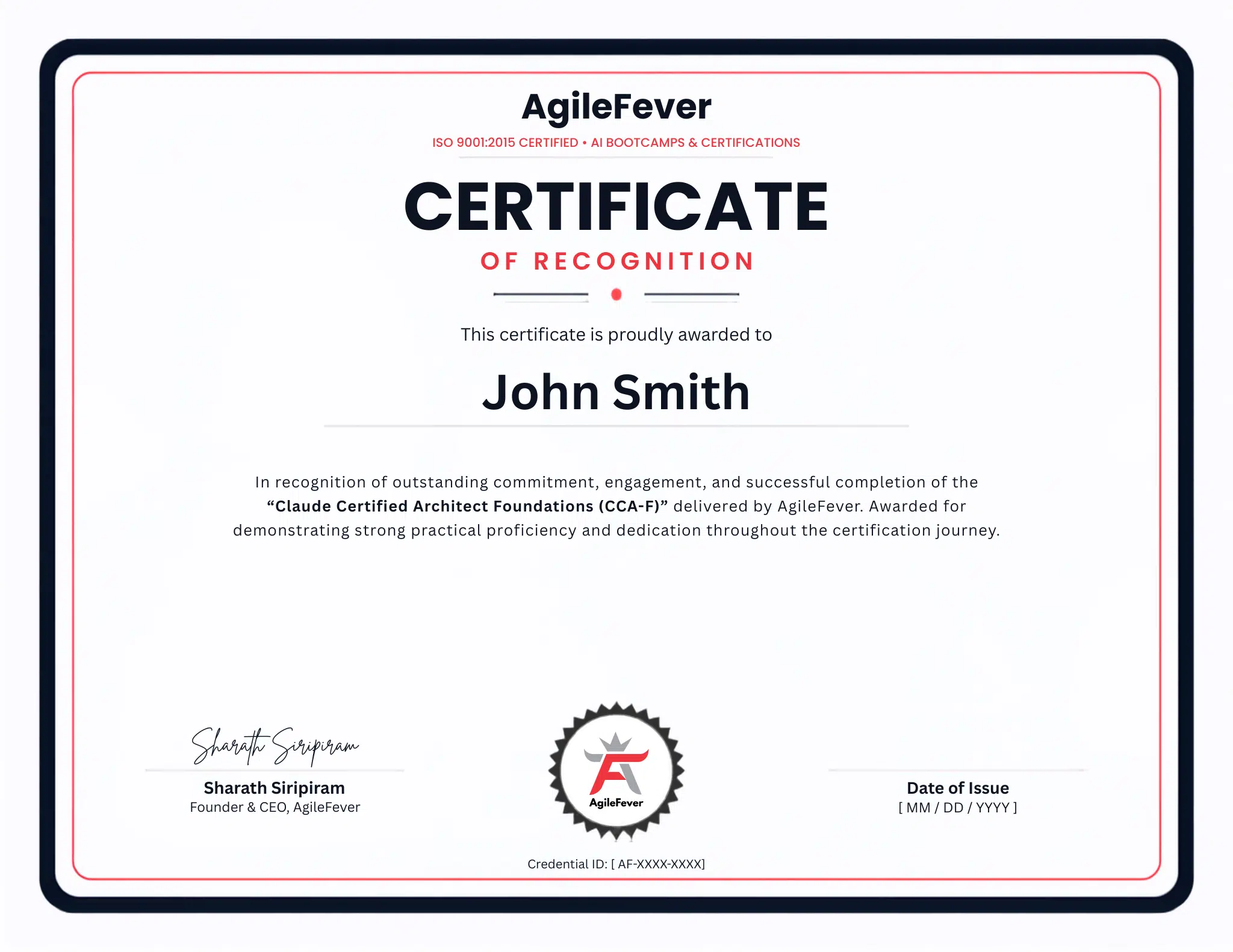
By the end, you have domain-wise assessment scores that reveal your weak areas, an AgileFever certificate of completion, and the architectural judgment to sit the exam with confidence.
Get fully prepared to sit for the Anthropic Claude Certified Architect Foundations exam.
4 hands-on lab projects that go into your GitHub as proof of production-level capability.
Ability to build, configure, and deploy production-grade agentic systems using Claude Agent SDK, MCP, and Claude Code.
Scenario-based instruction that mirrors the actual exam format including why the wrong options are wrong.
Certificate of completion from AgileFever with domain-wise assessment scores.
Prefer to learn at your own pace?Take Claude Certified Architect Foundations (CCA-F) self-paced on AgileFever Academy

For CCA-F Exam:
Step 1: Go to Anthropic Academy, login or create an account with your company partner email not with your personal email.
Step 2: Complete the Claude Certified Architect – Foundations Program Access Request and attestation. This unlocks the access to the official exam.
Step 3: Before diving in, take the practice exam. It’s unproctored, untimed and gives real exam question feel. Check this to see the gaps in your knowledge.
Step 4: Fill those gaps using the exam guide. It is included with the practice exam.
Step 5: When you are ready take the official CCAF exam and you will have 2 hours and it’s proctored. This requires you to install ProctorFree on your computer. Instructions are provided before the exam. Study materials are available as download links on the exams page.
These are required for the official exam by the Claude.














I enrolled in the CCA-F certification to better understand how Claude can be used for enterprise AI solutions. The course explained the concepts in a structured way, with practical examples that made them easy to relate to real projects. I particularly liked the sections on prompt architecture, workflows, and responsible AI practices. It gave me a much better foundation for designing AI-powered applications. I would definitely recommend this certification to architects and technical professionals working with enterprise AI.
I wanted a deeper understanding of Claude beyond basic prompting. The CCA-F certification helped me understand how to design AI solutions that are reliable, scalable, and aligned with business needs. The sessions were practical, and the trainers explained every concept with relevant examples. I now feel much more confident discussing AI architecture with engineering teams and identifying where Claude fits into our product strategy.
It focused on practical knowledge and the examples made it easier to understand how Claude can be applied in enterprise environments. I found the content well organized, and the instructors were patient in answering questions throughout the program. This certification has given me more confidence when advising clients on AI architecture and implementation. It was definitely a worthwhile investment.
The timing works in your favor. The certification launched in March 2026 backed by Anthropic’s $100M Partner Network — Accenture, Cognizant, and Deloitte are already training tens of thousands of professionals on Claude. Getting certified early puts you ahead of the wave, not behind it. The proctored format also gives it real credibility with hiring managers who have seen too many self-paced completion badges.
Yes — regular Claude users fail this exam. The questions are scenario-based, and in each one, three of four options are architecturally plausible. Passing requires knowing which pattern is correct for a given production context and why the others are anti-patterns. This is exactly the gap live, instructor-led training closes.
Prior Claude API exposure helps but is not required. You do need to be comfortable reading and writing Python or JavaScript, making REST API calls, working with JSON schemas, and using the terminal. This program is for experienced IT professionals — not beginners to software development.
60 scenario-based multiple-choice questions in 120 minutes. Passing score is 720 out of 1000. The exam is proctored online — no Claude, no documentation, no external tools. It draws from 4 of 6 possible real-world scenarios selected randomly, so strong coverage across all 5 domains is essential.
The certification program covers all exam content comprehensively. Experienced AI developers typically need 2–4 weeks of total focused study; those newer to Claude development may need longer. We recommend a short self-study window after the program to consolidate the lab work before sitting the exam. This training program gets you exam-ready — a light review period locks it in.
Access is through the Claude Partner Network, which any organization can join for free. The first 5,000 partner company employees get early access at no cost; beyond that, the exam fee is $99. You register through Anthropic’s official Skilljar portal. AgileFever guides enrolled students through the access process.
The Model Context Protocol is the open standard that connects Claude to external tools, databases, and services — increasingly the universal layer for enterprise Claude deployments. The exam covers it because how you design MCP servers, scope tool access, and handle errors has real production consequences. It is not theoretical knowledge; it is infrastructure design.
Yes — backend developers are the strongest candidates for this certification. You already have the foundation: APIs, JSON, terminal, Git, programming fluency. This course adds the agentic architecture layer on top: multi-agent orchestration, context management at scale, and structured output design. Paired with the CCA credential, it is a credible and fast path into AI Solutions Architect and Senior AI Engineer roles.
Domain 1, Agentic Architecture and Orchestration, carries 27% of the exam weight and is the most commonly underestimated. Domains 3 and 4 each carry 20%. Domain 5, Context Management, is only 15% but its concepts bleed into every other domain — missing it costs you points across the whole exam. Our program weights instruction accordingly.
This is live instruction with 4 hands-on lab projects — not pre-recorded content. You build working agentic systems during the training, keep the code in your GitHub, and leave with domain-wise assessment scores. The goal is exam readiness and real capability, not a completion badge.