
AI BootCamps (7 Courses)

























 Course Category
Course Category
Course Category

Google Rating

Professionals Upskilled

Live Cohorts Delivered

Enterprise Teams Trained
The AI Blueprint - Understand AI. Evaluate AI. Apply AI is a 4-hour course that gives every professional, regardless of role or technical background, a complete mental model of the AI landscape. Across 7 modules, we cover Machine Learning, Generative AI, Prompt Engineering, Agentic AI, MLOps, and LLMOps, all taught through plain language and an end-to-end capstone project, with no code, no Python, and no prerequisites required.
You leave knowing how the full AI stack connects, how to write prompts that produce specific and useful outputs, what AI is, what it is not, how it shapes your career, and how to critically evaluate AI tools and proposals at work.
4 hours, 7 modules - the complete AI landscape with no code required
Prompt engineering included - immediately applicable to ChatGPT, Claude, and Copilot from day one
Both Gen AI and Agentic AI covered - you understand the full spectrum, not just the basics
An end-to-end capstone project showing what AI, ML, Gen AI, Agentic AI and MLOps means which helps you to understand the full stack of AI
Objective:
Understand the full AI vocabulary in one session — where every term fits, what every layer does, and why the technology matters right now for every professional.
Topics:
Objective:
Understand how machines learn from data, conceptually and practically, so you can work confidently alongside ML-powered systems without needing to build them yourself.
Topics:
Objective:
Understand how Generative AI works at a conceptual level so you can use it confidently, evaluate its outputs critically, and explain it clearly to others.
Topics:
Objective:
Master the prompting principles that separate specific, useful AI outputs from generic, unusable ones — the single skill that makes every other AI capability more powerful.
Topics:
Objective:
Understand the shift from using AI as a tool you prompt to deploying AI agents that work continuously on your behalf — and what this means for every professional role.
Topics:
Objective:
Understand how AI models go from a promising experiment to a reliable system running in production at scale — and why every professional working near AI needs to understand this pipeline.
Topics:
Objective:
Connect every concept from the course into a single coherent mental model so you can navigate the AI landscape confidently, understand where each technology fits, and know what to learn next.
Topics:

No prior prerequisits for this course is required.
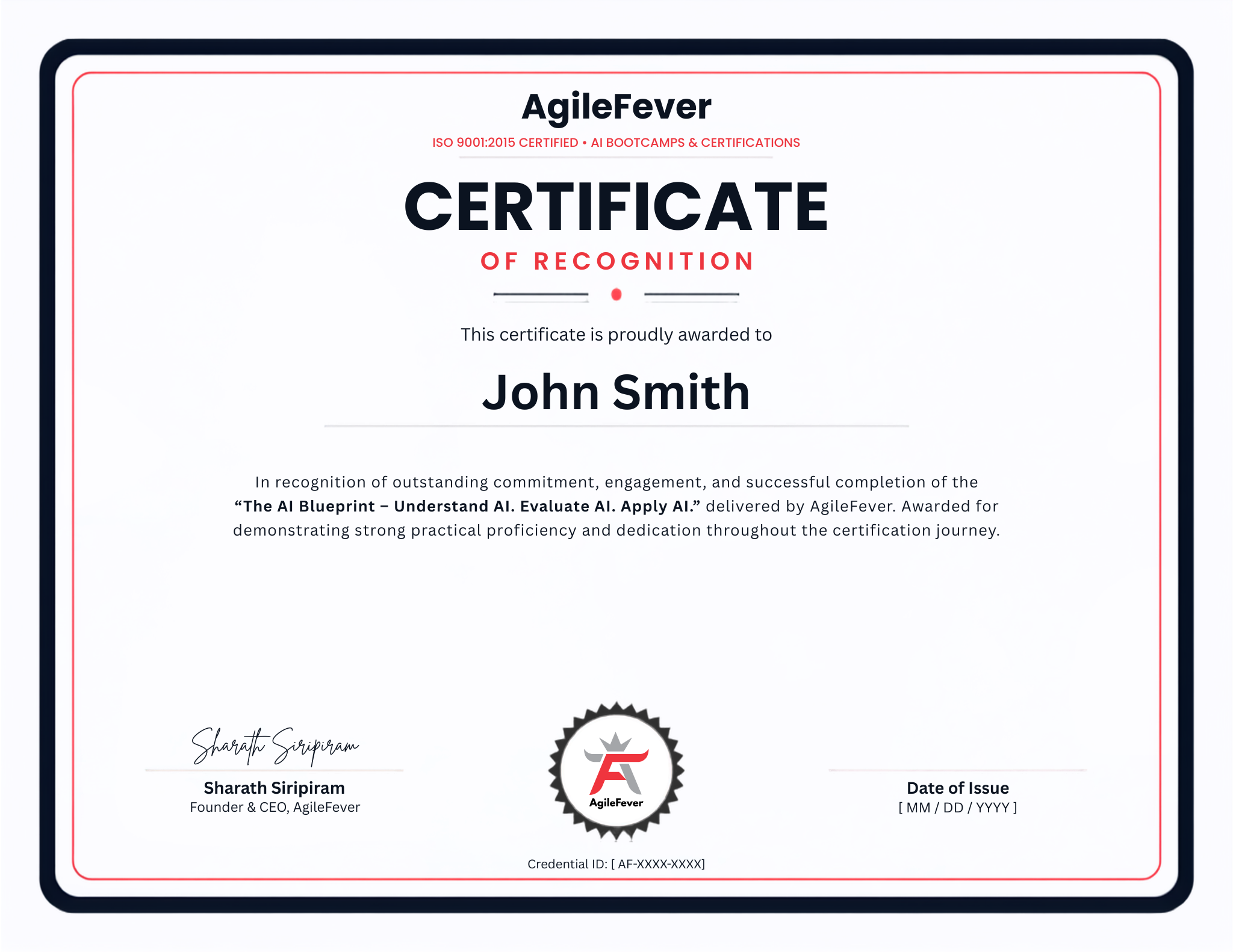














I enrolled in The AI Blueprint certification to build a strong understanding of AI before diving into advanced topics. The course explained AI concepts in a simple and structured way, making it easy to understand even without a technical background.
I particularly liked how each module connected AI concepts to real business scenarios. The prompt engineering section and practical demonstrations helped me understand how AI can improve productivity in my day-to-day work. This certification is a great starting point for anyone looking to build AI knowledge with confidence.

The AI Blueprint certification gave me the clarity I was looking for. Instead of just talking about AI, the trainers explained when to use it, how to evaluate different AI tools, and how to apply them effectively in real projects.
The sessions were practical, engaging, and filled with useful examples that I could relate to. I now feel much more confident discussing AI initiatives with my team and identifying opportunities to use AI in my organization. Highly recommended for working professionals.
I wanted a course that focused on practical AI rather than technical jargon, and The AI Blueprint certification delivered exactly that. The content was well organized, easy to follow, and packed with real-world examples.
Learning prompt engineering and understanding the differences between Machine Learning, Generative AI, and Agentic AI has helped me evaluate AI solutions more effectively for my business. It’s an excellent certification for professionals who want to understand AI and apply it in the workplace without needing programming skills.
Exactly what every IT professional needs before diving into advanced AI topics. The course removed the confusion and gave me a solid roadmap. Thank you Agilefever for the neat training.
Using ChatGPT and understanding AI are two different things — and the gap matters more than most people expect. Without a foundational understanding of how AI models work, why they produce incorrect outputs, and where their limits are, it is easy to trust outputs you should not, miss opportunities that exist, and struggle to explain AI decisions to colleagues or leadership. This course gives you the conceptual layer underneath the tools you already use — making everything you do with them more deliberate, more critical, and more effective.
Yes, genuinely. The course was designed specifically for IT professionals who work around AI and need to understand it without needing to build it. There is no Python, no code, no mathematics, and no technical setup required. Every concept — from how large language models work to what MLOps means in practice — is taught using everyday workplace examples that anyone can follow. If you can have a business conversation, you can take this course.
These are three different layers of the same technology stack — and confusing them leads to poor decisions about AI adoption. Machine Learning is the foundation: systems that learn patterns from data to make predictions. Generative AI is a newer layer: systems that create new content — text, summaries, plans, code — based on what you ask. Agentic AI is the next shift: systems that pursue goals autonomously, taking actions over time without being prompted for each step. This course connects all three into a single coherent picture so you stop treating them as interchangeable buzzwords.
Prompt engineering is not advanced — it is the most immediately practical AI skill any non-technical professional can learn. It is the difference between getting a generic, barely useful output and getting something specific, accurate, and ready to act on. The course teaches the 4-part prompt structure, zero-shot and few-shot prompting, chain-of-thought reasoning, and prompt chaining — with practical workplace examples for each. You will leave with a personal prompt library you can use from day one.
Yes — AI Foundations is the mandatory prerequisite for all six of AgileFever’s role-specific AI courses. The role-specific courses build directly on the concepts, vocabulary, and mental models from Foundations and do not repeat them. Taking a role-specific course without Foundations means missing the conceptual scaffolding that makes everything else click. The four hours here make the subsequent sixteen significantly more valuable.
The course is tool-agnostic by design. It covers the conceptual landscape and the skills — like prompt engineering — that work across ChatGPT, Claude, Gemini, Microsoft Copilot, and any other AI tool you use at work. The examples and exercises use ChatGPT and Claude because they are the most widely used, but everything you learn applies equally to any large language model. The goal is to make you an effective AI user regardless of which tool your organisation adopts.
Yes — every module uses workplace examples designed to be recognisable regardless of your specific role. The course covers how AI applies to professional work in general: drafting, analysis, planning, communication, and decision-making. It intentionally does not go deep into role-specific applications — that is what the 16-hour role courses are for. What you get from Foundations is the understanding that makes the role-specific applications make sense when you encounter them.
Particularly useful. Managers who understand AI are better at evaluating proposals from technical teams, making informed investment decisions, asking the right questions before approving AI initiatives, and having credible conversations with leadership and clients about AI strategy. One of the modules is specifically about how to read AI developments critically — separating genuine capability from vendor hype — which is one of the most valuable skills for anyone in a decision-making role.
The course addresses this directly — including honest expectations about what AI can and cannot do reliably today. The evidence is clear: AI is transforming roles rather than eliminating them wholesale, and professionals who develop AI literacy earn pay premiums of 12–20% and have significantly stronger career prospects than those who do not. The greatest risk is not learning AI — it is being the person in the room who does not understand it when everyone else does. This course is the most efficient way to make sure that is not you.