Most corporate training budgets get spent before anyone has written down what the training is for. A team lead asks for an AI course, L&D finds one, people attend, and six months later nobody can say what changed. A training needs assessment is the step that prevents this. It doesn’t have to be a big consulting exercise. For most teams it’s a few weeks of structured questions, and it saves far more than it costs.
This is a practical framework for L&D leaders and engineering managers, with the questions to ask at each step and the documents you should end up with.
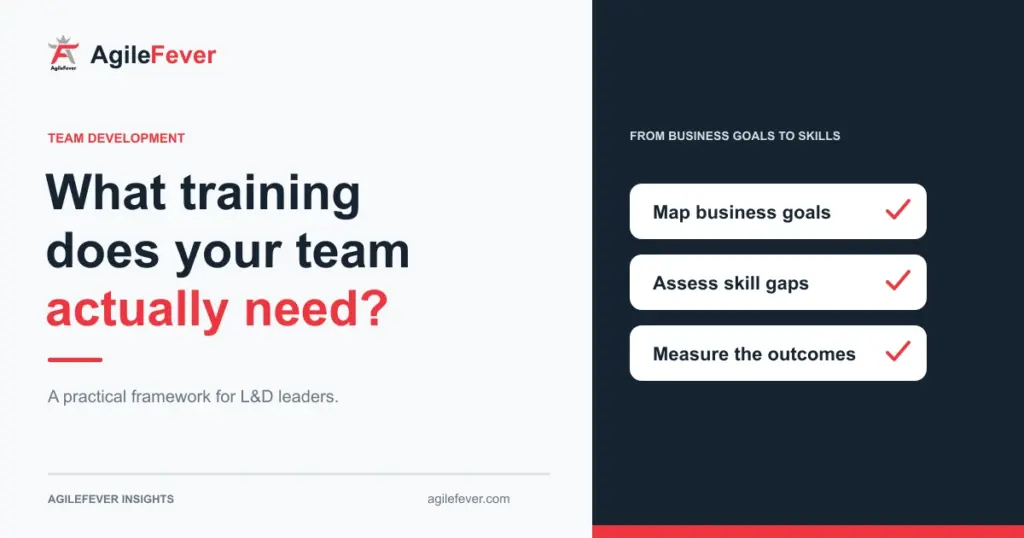
The training needs assessment framework at a glance
| Step | Question it answers | Output |
|---|---|---|
| 1. Start from business goals | What does the business need to be able to do in 12 months that it can’t do now? | Two or three goals, each tied to a real project or metric |
| 2. Map the roles involved | Who has to do something differently for each goal? | A list of roles and headcount per goal |
| 3. Define the skills per role | What does each role need to be able to do? | A skills list per role, written as observable tasks |
| 4. Measure current levels | Where is each person or team today? | A skills matrix with current and target levels |
| 5. Prioritize the gaps | Which gaps matter most, and which can wait? | A ranked list of gaps |
| 6. Choose the format | Course, cohort, coaching, or on-the-job learning? | A training plan with dates, owners, and costs |
| 7. Agree how you’ll measure it | How will we know it worked? | Two or three success measures agreed before training starts |
Step 1: Start from business goals, not course catalogs
Ask leaders what they need the organization to do, not what training they want. “We need to ship our first AI-assisted support feature by Q3” is a goal. “We need AI training” isn’t. If a request for training can’t be traced back to a goal like this, park it until it can.
Step 2 and 3: Map roles, then write skills as tasks
For each goal, list the roles that have to change how they work. Then describe the skills as things a person can be seen doing. “Understands RAG” is hard to assess. “Can design a retrieval pipeline for our policy documents and explain its cost” is easy to assess.
Here’s an example for a team building its first AI feature:
| Role | Skills written as tasks |
|---|---|
| Engineering lead | Choose between prompting, retrieval, and fine-tuning for a feature, and estimate running cost |
| Backend engineers | Build and deploy a retrieval pipeline; write evaluation tests for model output |
| Product owner | Write acceptance criteria and an evaluation set for an AI feature |
| Architect | Review an AI design for security, cost, and integration risks |
| Engineering manager | Plan delivery with realistic stage gates from pilot to production |
Step 4: Measure where people are today
Use a simple 0 to 3 scale so the result is easy to read across teams:
| Level | Meaning |
|---|---|
| 0 | Hasn’t done this and couldn’t without training |
| 1 | Understands the concept; could do it with close support |
| 2 | Has done it at least once on real work |
| 3 | Does it reliably and could teach others |
Self-assessment is quick but tends to be optimistic. Where you can, combine it with a short practical task or a manager’s rating. For most teams a target of 2 is enough; you only need a few people at 3.
Step 5: Prioritize the gaps
Not every gap is worth closing now. Rank each one on two things: how much it blocks a business goal, and how many people it affects. Gaps that block a goal and affect a whole team come first. A gap that only one person has, on a skill nobody needs this year, can wait or be handled with coaching.
| Affects one or two people | Affects a whole team | |
|---|---|---|
| Blocks a business goal | Targeted coaching or a short course | Priority: structured program |
| Doesn’t block a goal yet | Self-study or wait | Plan for next quarter |
Step 6: Match format to the gap
| Situation | Format that usually fits |
|---|---|
| A few people across different teams need the same skill | Public live cohorts |
| A whole team shares a goal and a tech stack | Private in-house cohort using your own examples |
| A team is mid-project and stuck on something specific | Expert-guided sessions or coaching |
| Many people need basic awareness | Short self-paced or foundations course |
| A skill is best learned by doing | On-the-job project with a mentor |
For more on the first two options, see in-house vs public cohort training.
Step 7: Agree the success measures first
Decide before training starts how you’ll judge it, and tie the measures to the goals from step 1. Good examples: the team shipped the AI feature it trained on; AI designs pass architecture review on the first or second attempt; skills matrix levels moved from 0 or 1 to 2 for the target roles within three months. Attendance and satisfaction scores are worth collecting but don’t tell you whether the business got what it needed.
Common mistakes
- Training everyone on the same course regardless of role
- Training engineers without training the managers who approve their work
- Choosing a program before writing down the skills it should build
- Training months before the project that needs the skills, so people forget most of it
- Measuring completion instead of change
Where AgileFever can help
We run corporate training, so we have an interest here. The framework above works whichever provider you choose.
AgileFever’s corporate programs follow four stages: assess, upskill, analyze, and scale. The assess stage covers the same ground as steps 1 to 5 here: goals, roles, and current skills, before a program is chosen. Formats include live virtual and classroom cohorts, private corporate groups, self-paced courses, and expert-guided sessions. Group pricing for private cohorts depends on team size and how much the program is tailored.
Additional discounts are available. Contact us to know more.
FAQ
How long should a needs assessment take?
For a single team with one or two goals, two to three weeks is usually enough. Across a whole engineering organization, plan for longer and start with one team as a pilot.
Who should run it?
L&D can own the process, but engineering managers need to define the skills and rate current levels. It doesn’t work if either side does it alone.
Do we need a tool for the skills matrix?
No. A spreadsheet with roles, skills, current levels, and target levels is enough to start.
What to read next
For mapping engineering roles to specific AI programs, read Corporate AI Training: How to Upskill Your Engineering Team in 2026. To talk through a needs assessment for your team, visit the corporate training page.