



























Written by the AgileFever editorial team. Program details were checked against the live program pages in October 2026. We sell the programs described here. Delivery facts come from our corporate training page, checked on October 28, 2026. Suggested group sizes and review dates are our own suggestions, not measured results.
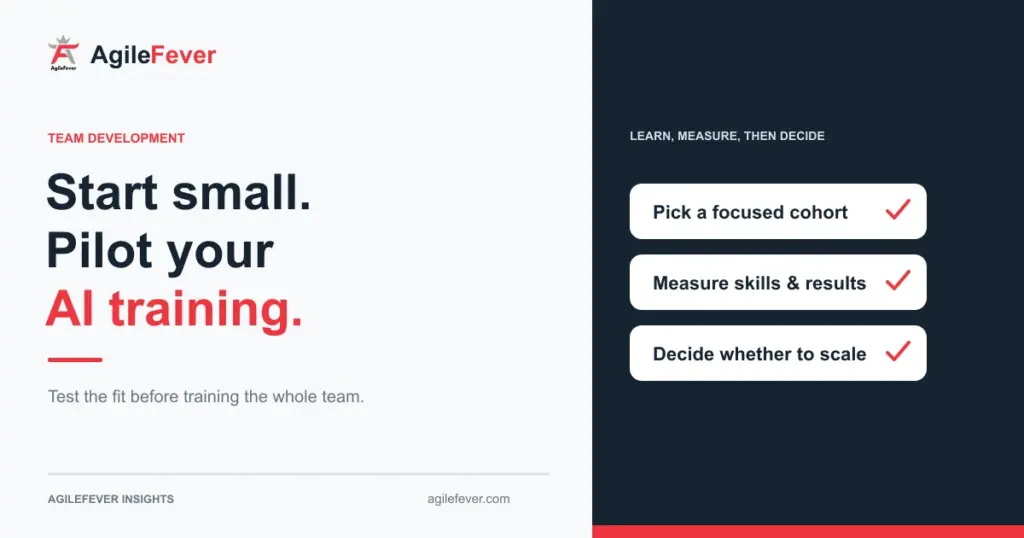
Buying training for hundreds of people before you know whether it works is the expensive way to learn. A pilot cohort costs a fraction of that and answers the questions you actually have: did the right people learn the right skills, and did anything change in the work. This guide describes how we would set one up, using the delivery options on our corporate page.
What the corporate page says you can book
| Item | What our corporate page says |
|---|---|
| Format | Live, instructor-led, virtual or on site |
| Booking | A private cohort for your team, or group seats in a scheduled batch |
| Time zones | US and India sessions |
| Cohort size | Capped at 20 experienced professionals |
| Capstone | Every private cohort ends with a capstone on a problem from your backlog |
| Measurement | A capability report by role, with baseline and post-assessment results |
| Baseline | A free team skills diagnostic with your people after the first call |
| After the cohort | Self-paced access on AgileFever Academy, and new joiners can onboard without waiting for the next batch |
| Teams new to code | Python for AI (6 hours) as the prerequisite |
Eight steps for a pilot
| Step | What to do | Output |
|---|---|---|
| 1 | Write the problem in one sentence, for example “our reviewers cannot assess AI designs” | A single problem statement |
| 2 | Choose one or two roles that feel the problem most | A named list of roles |
| 3 | Pick the program that fits those roles (see the table below) | One program, with its prerequisite |
| 4 | Choose the cohort: a size you can support, with sponsors from each team | A list of participants, up to the cap of 20 |
| 5 | Take a baseline before the first session | Pre-assessment results by role |
| 6 | Pick a real backlog item for the capstone | A scoped item with an owner |
| 7 | Protect the time and agree the AI tool and data rules | Calendar holds and a short policy note |
| 8 | Fix the review date and the decision rules in advance | “Scale, change or stop” criteria written down |
Choosing the program
Hours as listed on our program pages
| If the problem sits with | Start with | Why |
|---|---|---|
| Architects and technical leads | GenAI and Agentic AI for Solution Architects | Covers vendor choice, RAG, agents, cost, security and rollout |
| Delivery and PMO leads | GenAI and Agentic AI for Project and Program Management | Builds six tools for charters, WBS, minutes, status and change control |
| Developers | GenAI and Agentic AI for Full Stack Developers | AI inside the development workflow |
| Infrastructure engineers | GenAI and Agentic AI for DevOps Engineers | Automation for incidents, cost and security |
| Test engineers | GenAI and Agentic AI for QA and Test Engineers | AI for test work and for testing AI features |
| Executives and managers | AI Transformation for Business Leaders | Decision-making and governance for AI |
How to measure the pilot
- Skills: the baseline and post-assessment by role, from the capability report.
- Use on real work: how many participants applied the capstone to a live item, and what happened to it.
- Delivery measures you already track: cycle time, rework or review time. Read measuring training impact for how to avoid overclaiming.
A few weeks of data will not prove cause and effect. Treat the review as a decision aid and write down what would change your mind.
Mistakes to avoid
- Choosing only enthusiasts. Include sceptics, because they will tell you what does not work.
- Having no baseline. Without one you cannot say what changed.
- Leaving the capstone abstract. A real backlog item forces the skills into use.
- Letting the AI data rules wait. Settle which tools may see which data before the first session.
For related decisions, read in-house vs public cohort training, the AI skills matrix for engineering teams and the needs assessment framework. Pricing for groups depends on team size, so ask through our corporate training page.
Questions people ask
How big should a pilot cohort be?
The cap is 20. Our suggestion is a size you can support with active sponsors, large enough to include sceptics and small enough that you can see who applied what they learned.
Can the pilot use our own project?
Yes. Every private cohort ends with a capstone on a problem from your backlog.
Are sessions recorded?
Yes. Live sessions are recorded.