
















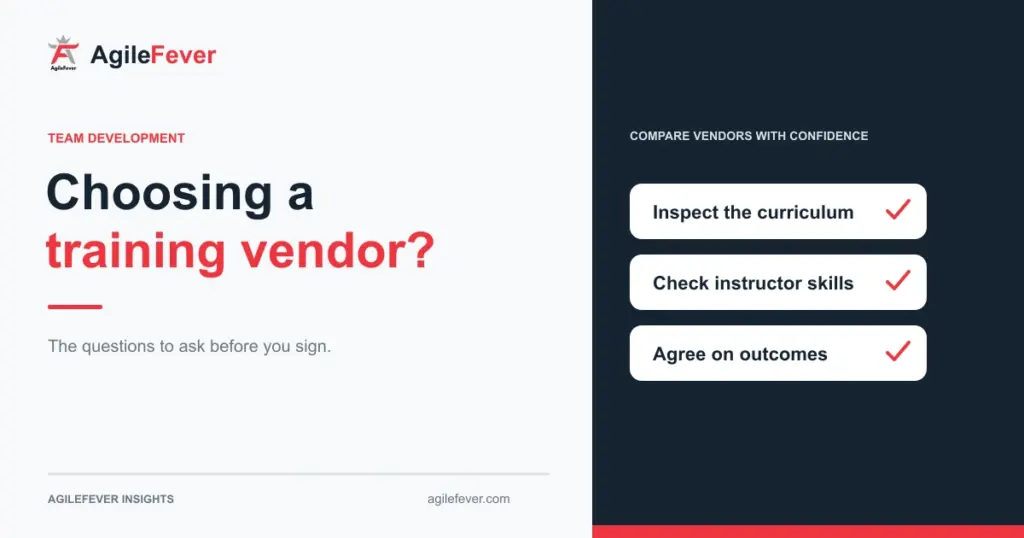
Choosing a training vendor usually comes down to a sales call, a brochure, and a price. That’s a weak basis for a decision that will take hundreds of hours of your team’s time. This corporate training vendor checklist gives L&D leaders and engineering managers the questions to ask before signing, what good answers sound like, and the warning signs to watch for.
Before you talk to vendors
Know what you’re buying. Write down which roles you’re training, what each should be able to do afterward, and how you’ll measure it. If you haven’t done that yet, our training needs assessment framework walks through it. Vendors are much easier to compare when they’re all answering the same brief.
The corporate training vendor checklist
1. Content and curriculum
| Ask | Good answer | Warning sign |
|---|---|---|
| Can we see the full syllabus, module by module? | A detailed outline with topics, labs, and tools per module | Only module titles or a marketing summary |
| When was the content last updated? | A specific recent date and what changed | “Regularly” with no examples |
| Who is it not suitable for? | Clear prerequisites and roles it doesn’t fit | “Everyone can benefit” |
| Can exercises use our tools or examples? | Yes for private cohorts, with a defined process | Yes without asking anything about your stack |
2. Instructors
| Ask | Good answer | Warning sign |
|---|---|---|
| Who will teach our team? | Named instructors with work you can look up | “Our expert trainers” with no names |
| Have they built what they teach? | Specific projects or roles in that area | Only teaching experience |
| Can we meet the instructor before signing? | Yes | Only the salesperson is available |
3. Format and delivery
| Ask | Good answer | Warning sign |
|---|---|---|
| How many hours are live, and how many self-paced? | Separate numbers for each | One total number, with no breakdown |
| What happens if someone misses a session? | Recordings, plus a way to get questions answered | No plan |
| What’s the maximum class size? | A specific number | “It varies” |
| Can sessions fit around our delivery schedule? | Several options, such as evenings, weekends, or blocks | One fixed schedule, take it or leave it |
4. Assessment and outcomes
| Ask | Good answer | Warning sign |
|---|---|---|
| How is learning assessed? | Projects or capstones, ideally on work similar to yours | Attendance only |
| What will you report to us afterward? | Per-person progress and assessment results | Completion certificates only |
| Can you help us measure business impact? | A defined approach, agreed before training | Satisfaction scores presented as impact |
| What results have other clients seen? | Specific examples you can verify, or an honest “we can’t share that” | Big percentages with no source |
5. Commercial terms
| Ask | Good answer | Warning sign |
|---|---|---|
| What’s included in the price? | An itemized list: sessions, materials, recordings, assessment, support | Extras appear later |
| Are there tool, cloud, or exam costs on top? | A clear estimate | “Minimal” |
| What if a participant leaves the company mid-program? | A substitution policy | No answer |
| Can we start with a pilot group? | Yes | Only large commitments |
A simple way to compare vendors
Score each vendor from 1 to 5 on the five areas, weight the areas by what matters most to you, and compare totals. Here’s a weighting that suits most technical training:
| Area | Suggested weight |
|---|---|
| Content and curriculum | 25% |
| Instructors | 25% |
| Assessment and outcomes | 20% |
| Format and delivery | 15% |
| Commercial terms | 15% |
Price sits inside commercial terms on purpose. A cheaper program that doesn’t change how your team works costs more in the end, because you’ll pay for the time and still need to train them again.
Where AgileFever fits
We’re a training vendor too, so use this checklist on us as well.
Our program pages publish module-by-module syllabi, live and self-paced hours separately, prerequisites, and who each program isn’t for. Live sessions are recorded. Corporate cohorts are available in several formats, including private groups, and our corporate programs follow four stages: assess, upskill, analyze, and scale. Group pricing depends on team size and how much the program is tailored.
Additional discounts are available. Contact us to know more.
What to read next
To decide between a public cohort and a private one, read In-house vs public cohort training. To measure results afterward, see Corporate AI training ROI: how to measure it.