







































So, here is your question: Should a single AI agent handle everything, or should multiple specialised agents collaborate? This question lies at the heart of modern Agentic AI architecture.
Earlier AI applications relied on a single agent to perform tasks; the next generation of AI systems is moving toward multiple cooperating agents that can plan, communicate, and work together to achieve complex goals.
Before starting anything, you have to understand the difference between single-agent and multi-agent systems, especially for AI engineers, solution architects, and organizations exploring Agentic AI. Let’s break it down.
What Is a Single-Agent System?
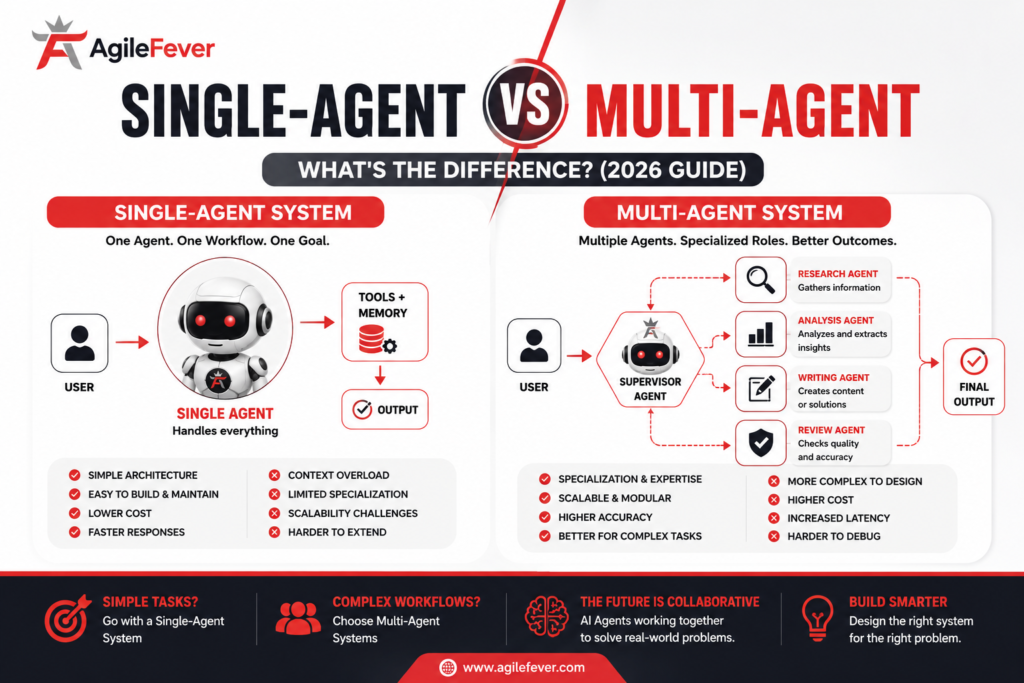
A single-agent system consists of one AI agent responsible for handling an entire task.
This agent may:
- Understand requests
- Plan actions
- Use tools
- Retrieve information
- Generate outputs
Everything happens inside one agent.
Examples of Single-Agent Systems:
- Chatbots
- FAQ assistants
- Personal productivity assistants
- Research assistants
- Customer support bots
Single-agent systems are the foundation of many AI applications today.
How Single-Agent Systems Work
The architecture is relatively simple:
User
↓
AI Agent
↓
Memory + Tools
↓
Response
The same agent manages every step. Because of their simplicity, single-agent systems are often easier to design and maintain.
Advantages of Single-Agent Systems
- Simpler Architecture: Fewer components mean fewer moving parts.
- Easier Debugging: When something goes wrong, identifying the problem is usually straightforward.
- Lower Costs: Only one agent processes requests, reducing computational expenses.
- Faster Responses: Communication overhead between agents is eliminated.
Ideal for Smaller Applications
Single-agent systems work extremely well for:
- Chatbots
- Knowledge assistants
- Simple automation workflows
Not every problem requires multiple agents.
Limitations of Single-Agent Systems
As complexity grows, single-agent systems face challenges.
- Context Overload: One agent must remember and manage everything. This can increase hallucinations and reduce accuracy.
- Limited Specialization: A general-purpose agent may not excel at every task.
- Scalability Issues: As responsibilities increase, systems become harder to maintain.
- Reduced Modularity: Updating one capability often affects the entire system.
These limitations are driving the rise of multi-agent architectures.
What Is a Multi-Agent System?
A multi-agent system consists of several specialized AI agents working together and each agent focuses on a specific responsibility. Think of it like a team.
You cannot expect one employee to peform all the tasks at once:
- Research
- Writing
- Editing
- Quality assurance
Similarly, AI agents can specialize.
How Multi-Agent Systems Work
A typical architecture might look like this:
User
↓
Supervisor Agent
↓
Research Agent
↓
Analysis Agent
↓
Writing Agent
↓
Review Agent
↓
Final Output
Each agent performs its own task and collaborates with others. This approach will resemble how human teams operate.
Recently, we got news about how a housewife is recording household chores to train the AI.
Advantages of Multi-Agent Systems
Each agent becomes highly focused on a particular role.
Examples include:
- Research Agent
- Planning Agent
- Coding Agent
- Review Agent
Specialization often improves quality.
- Scalability: New agents can be added without redesigning the entire system.
- Improved Accuracy: Multiple agents can verify and review outputs. This reduces errors.
- Modularity: Components can evolve independently. Updating one agent doesn’t require rebuilding the entire system.
- Better Performance for Complex Tasks: Multi-agent architectures excel when workflows involve Multiple steps, External tools, Collaboration, Validation
Challenges of Multi-Agent Systems
Despite their advantages, multi-agent systems introduce new complexities.
- Coordination Overhead: Agents must communicate effectively. Poor coordination can create inefficiencies.
- Higher Costs: Running several agents increases token usage and infrastructure costs.
- Increased Latency: Multiple interactions take more time.
- State Management Complexity: Maintaining shared memory and context becomes more difficult.
- Debugging Challenges: Finding the source of failures can be harder. Building multi-agent systems requires thoughtful design.
Real-World Example: Content Creation
Single-Agent Approach
One agent:
- Researches
- Writes
- Edits
- Optimizes SEO
Everything happens in one workflow.
Multi-Agent Approach
Research Agent
Collects information.
↓
Writer Agent
Creates drafts.
↓
Editor Agent
Improves clarity.
↓
SEO Agent
Optimizes content.
↓
Reviewer Agent
Performs quality checks.
This approach often produces better results for complex content workflows.
Real-World Example: Software Development
Single-Agent
One agent:
- Writes code
- Reviews code
- Tests code
Multi-Agent
Coding Agent
↓
Testing Agent
↓
Security Agent
↓
Review Agent
↓
Deployment Agent
This division of responsibilities improves reliability.
Real-World Example: Customer Support
Single-Agent
One assistant handles everything.
Multi-Agent
Intent Agent
Understands the request.
↓
Knowledge Agent
Retrieves information.
↓
Resolution Agent
Generates answers.
↓
Escalation Agent
Transfers complex cases to humans.
This architecture creates more robust support systems.
When Should You Use Single-Agent Systems?
Single-agent systems are ideal when:
- Workflows are simple.
- Costs must remain low.
- Speed is important.
- Maintenance resources are limited.
Examples:
- FAQ bots
- Internal assistants
- Small automation tasks
Simple systems often work surprisingly well.
When Should You Use Multi-Agent Systems?
Multi-agent systems become valuable when:
- Tasks are complex.
- Multiple capabilities are required.
- Quality matters.
- Validation is essential.
- Scalability is important.
Examples include:
- Enterprise research systems
- Coding assistants
- Autonomous workflows
- Multi-step business processes
Popular Frameworks for Multi-Agent Systems
Several frameworks simplify multi-agent development.
- LangGraph: Excellent for stateful workflows and orchestration.
- CrewAI: Designed around role-based agent collaboration.
- AutoGen: Popular for agent communication and coordination.
- OpenAI Agents SDK: Provides tools for building sophisticated AI applications.
Although these frameworks differ, they all implement the same architectural principles.
Human-in-the-Loop Systems
Not every decision should be fully autonomous.
Many organizations prefer:
Human
↓
Supervisor Agent
↓
Specialized Agents
↓
Human Approval
This approach balances:
- Automation
- Reliability
- Governance
- Safety
Human oversight remains critical in many industries.
Why Multi-Agent Systems Matter
Many experts believe multi-agent architectures represent the next stage of AI evolution. Why? Because businesses rarely solve problems with one specialist. They rely on teams. AI systems are following the same pattern. Instead of creating one super-agent, organizations are building collaborative systems composed of multiple specialized agents.
Why AI Engineers Should Learn Multi-Agent Systems
Understanding multi-agent systems is becoming increasingly important for:
- AI Engineers
- Agentic AI Engineers
- Software Engineers
- Data Scientists
- Solution Architects
Modern AI development increasingly involves:
- Agent orchestration
- Tool usage
- Memory systems
- Shared state
- Human-in-the-loop workflows
These concepts are becoming foundational skills.
Learning Multi-Agent Systems
Many professionals start with prompts and chatbots. Eventually, they discover that building sophisticated AI applications requires understanding:
- Agent architecture
- LangGraph
- CrewAI
- AutoGen
- Memory systems
- Multi-agent orchestration
- Model Context Protocol (MCP)
- LLMOps
- Deployment
Programs like AgileFever’s Agentic AI Bootcamp help learners move beyond simple chatbots and explore production-oriented agent systems through hands-on projects and real-world scenarios.
The goal isn’t simply understanding agents. It is learning how to design systems that scale.
If you have any queries to be answered or have problems to solve, do not hesitate to comment below. Our AI experts will get back to you ASAP and answer all your questions.