





































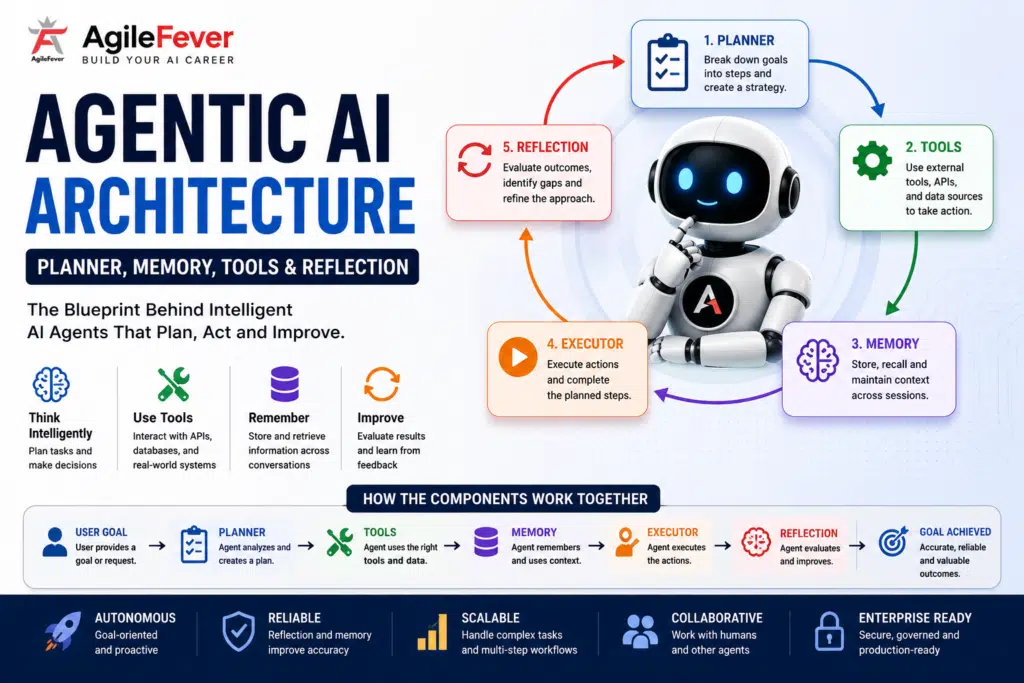
Right now Agentic AI is one of the biggest shifts happening in AI. But while many people understand what AI agents do, fewer understand how they actually work. Behind every intelligent AI agent lies an architecture that enables it to reason, plan, remember information, use tools, and continuously improve its outputs. This architecture is what separates simple chatbots from systems capable of solving real-world problems.
Whether you are building AI agents, learning Agentic AI, or simply trying to know where the industry is heading, understanding Agentic AI architecture is important.
What Is Agentic AI Architecture?
Agentic AI architecture refers to the components and workflows that allow AI systems to act autonomously toward a goal. They are not like traditional Generative AI systems that simply respond to prompts, Agentic AI systems can:
- Plan tasks
- Use external tools
- Maintain memory
- Retrieve information
- Evaluate outputs
- Adjust their approach
- Collaborate with humans and other agents
Think of Agentic AI architecture as the blueprint that allows AI systems to function like problem-solving assistants rather than content generators.
Why Architecture Matters
For example you are building a house. Without a proper foundation, walls, and structure, even expensive materials will not help. The same applies to AI agents.
Large Language Models are powerful. But by themselves, they are not enough. To build reliable systems, you need:
- Planning
- Memory
- Tools
- Feedback loops
- Context management
- Evaluation mechanisms
These components work together to create intelligent behavior.
The Core Components of Agentic AI Architecture
Most modern agent frameworks share four major building blocks:
1. Planner
The planner is the brain behind decision-making. Instead of immediately generating an answer, the planner determines:
- What needs to be done
- Which steps should be executed
- Which tools should be used
- Whether more information is required
For example:
Suppose you ask:
“Analyze our competitors and prepare a summary report.”
The planner might break this into:
- Search competitors.
- Gather information.
- Analyze findings.
- Create report.
- Validate results.
This process is called task decomposition. Planning transforms AI from reactive systems into goal-oriented systems.
2. Memory
Memory enables AI systems to retain information and maintain context. Without memory, every interaction begins from scratch.
Memory allows agents to:
- Remember previous conversations.
- Maintain long-running workflows.
- Personalize experiences.
- Store preferences.
- Improve consistency.
- Types of Memory
- Short-Term Memory
Stores temporary context for ongoing tasks.
Examples:
- Current conversation
- Session state
Long-Term Memory
Stores information across sessions.
Examples:
- User preferences
- Historical interactions
- Semantic Memory
Stores facts and knowledge.
Episodic Memory
Stores experiences and events.
Memory is becoming one of the most important capabilities in advanced AI systems.
3. Tools
Tools extend the capabilities of AI agents. Large Language Models cannot directly:
- Access databases
- Send emails
- Search the internet
- Update CRMs
- Query APIs
Tools allow them to interact with external systems.
Examples include:
- Search Tools: Retrieve information.
- APIs: Communicate with applications.
- Databases: Access structured data.
- Browsers: Interact with websites.
- CRM Systems: Update customer records.
- Calendars: Schedule meetings.
Without tools, agents remain isolated. With tools, they become useful.
4. Executor
The executor performs the actual actions.
After the planner creates a strategy, the executor carries out each step.
Examples include:
- Running searches
- Calling APIs
- Generating reports
- Sending notifications
The executor turns plans into outcomes.
5. Reflection
Reflection enables agents to evaluate and improve their outputs. Instead of blindly producing responses, the agent asks:
- Is the answer accurate?
- Did I miss something?
- Can I improve this result?
This feedback mechanism creates more reliable systems.
Reflection is one reason why modern AI agents often outperform simple prompt-response systems.
How These Components Work Together
Imagine a customer support agent.
Planner
Determines what information is needed.
↓
Tools
Retrieve product information and customer history.
↓
Memory
Maintains context.
↓
Executor
Generates and delivers responses.
↓
Reflection
Checks quality before sending.
Together, these components create intelligent workflows.
Retrieval-Augmented Generation (RAG)
Modern Agentic AI architectures often include RAG. RAG allows agents to access external knowledge sources. Instead of relying solely on training data, agents can retrieve:
- Documentation
- Policies
- Product information
- Knowledge bases
This improves:
- Accuracy
- Freshness
- Reliability
RAG is one of the reasons enterprise AI adoption is accelerating.
Single-Agent vs Multi-Agent Architecture
There are two common architectural approaches.
Single-Agent Architecture
One agent performs everything.
Examples:
- Chatbots
- Virtual assistants
- FAQ systems
Advantages:
- Simpler design
- Easier maintenance
Limitations:
- Less scalable
- Increased complexity as responsibilities grow
Multi-Agent Architecture
Multiple specialized agents collaborate.
Examples:
- Research Agent
Collects information.
- Analysis Agent
Processes data.
- Writing Agent
Creates reports.
- Review Agent
Validates outputs.
Advantages:
- Scalability
- Modularity
- Better performance
This architecture is becoming increasingly popular in enterprise environments.
Human-in-the-Loop Architecture
Complete autonomy is not always desirable. Many systems include human oversight.
Examples:
- Medical decisions
- Financial approvals
- Customer escalations
Humans provide:
- Validation
- Governance
- Safety
Human-in-the-loop systems combine AI efficiency with human judgment.
Why Context Matters
Context is the fuel that powers AI agents.
Poor context leads to:
- Hallucinations
- Irrelevant outputs
- Incorrect actions
Modern architectures focus heavily on:
- Context engineering
- Memory management
- Retrieval mechanisms
This is one reason context engineering is emerging as a critical skill.
Popular Frameworks for Building Agentic AI Systems
Several frameworks simplify implementation.
LangGraph
Excellent for stateful workflows and complex orchestration.
CrewAI
Popular for role-based multi-agent collaboration.
AutoGen
Designed for conversational agent interactions.
OpenAI Agents SDK
Increasingly used for production applications.
Each framework implements the same architectural principles in slightly different ways.
Real-World Examples of Agentic AI Architecture
Customer Support Agents
Combine:
- Memory
- Tools
- Reflection
to provide better customer experiences.
Research Agents
Use:
- Planning
- Search tools
- Summarization
to automate information gathering.
Software Development Agents
Leverage:
- Tool integrations
- Reflection loops
- Code validation
to assist developers.
Enterprise Knowledge Assistants
Combine:
- RAG
- Memory
- Retrieval systems
to answer employee questions.
Why Professionals Should Learn Agentic AI Architecture
Understanding architecture matters because tools will change. Frameworks will evolve. But principles remain valuable.
Professionals who understand:
- Planning
- Memory
- Tool integration
- Reflection
- Multi-agent systems
will be able to adapt regardless of which framework becomes popular.
These skills are increasingly important for:
- AI Engineers
- Agentic AI Engineers
- Data Scientists
- ML Engineers
- Solution Architects
Learning Agentic AI Architecture
Many professionals begin with prompts and chatbots. Eventually, they realize that building reliable systems requires much more.
Topics such as:
- RAG
- Memory systems
- LangGraph
- CrewAI
- AutoGen
- Multi-agent orchestration
- Model Context Protocol (MCP)
- LLMOps
- Deployment
all build on these architectural principles.
Programs like AgileFever’s Agentic AI Bootcamp help learners move beyond theory by implementing these concepts through hands-on projects and real-world scenarios.
The goal is not simply understanding how agents work. It is learning how to build them.