


























When AI entered the space, everyone was talking about ChatGPT, Gemini, Claude, Grok, and other LLMs, but now the companies are talking about AI agents that can plan tasks, use tools, retrieve information, collaborate with other agents, and complete complex workflows with minimal human intervention. That’s what Agentic AI does.
And if you are still thinking whether this is worth learning, then here is our live example.
One of our learners, Deepak, an experienced Data Scientist, joined AgileFever’s Agentic AI Bootcamp after taking a professional break. His goal is not just to add another certificate to his resume but to gain practical experience that builds modern AI systems and a stronger understanding of where AI engineering is heading. After completing the program, he got a Staff Data Scientist role at Altimetrik, increasing his pay from approximately ₹27 LPA to ₹40 LPA.
From his experience: The market is not just looking for people who can use AI tools. It is increasingly looking for professionals who understand how to build AI systems.
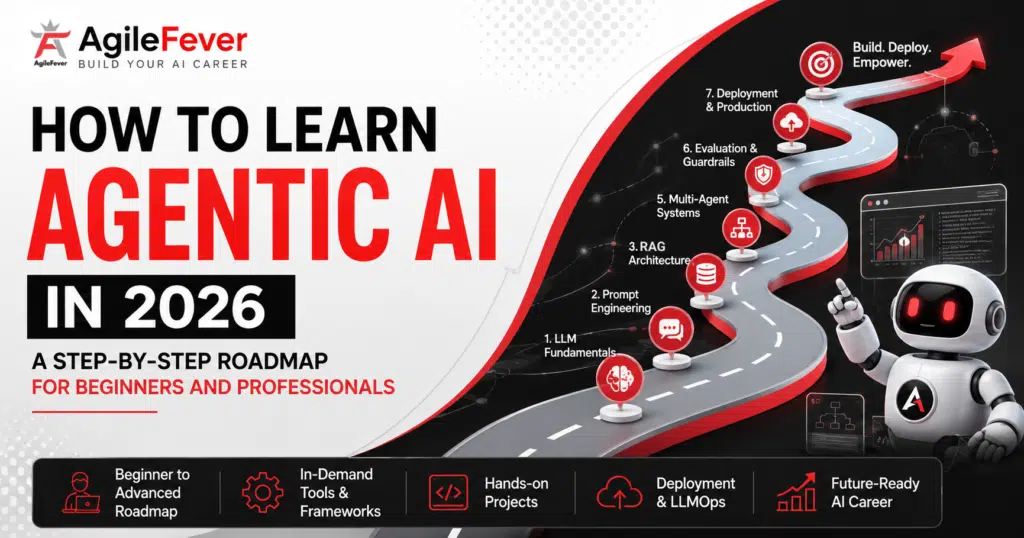
So where should you start? Let us break down a practical roadmap for learning Agentic AI in 2026.
What is Agentic AI?
There is a common misunderstanding about Agentic AI: that it is another name for Generative AI, but it is not.
Generative AI will generate content, whereas Agentic AI takes action. A modern AI agent can:
- Understand goals
- Break goals into tasks
- Decide which tools to use
- Retrieve information
- Evaluate results
- Adjust its approach
- Continue working toward an objective
Think like this: the difference between asking ChatGPT a question and having an AI system research a topic, gather information, create a report, validate its findings, and notify you when it is done.
Step-by-Step to learn Agentic AI in 2026
Let us see what all the steps are included in this learning about agents.
Step 1: Learn How Large Language Models Actually Work
As we know, foundations are very important. Before you jump into agents, start with the following:
- Transformers
- Tokens and context windows
- Attention mechanisms
- Temperature and sampling
- Model limitations
- Hallucinations
- Cost and latency considerations
Here you should know why AI models behave the way they do. Without this knowledge, debugging agents becomes frustrating very quickly.
Step 2: Master Prompt Engineering and Context Engineering
Prompt engineering is important, but context engineering is becoming more valuable now.
Anyone can write: “Summarize this document.” But, the real skill is understanding:
- What context should be provided
- What context should be removed
- How to structure instructions
- How to reduce hallucinations
- How to improve reliability
Learn techniques such as:
- Chain of Thought
- ReAct
- Few-shot prompting
- Prompt chaining
- Structured outputs
- JSON schemas
These skills become the foundation for building reliable agents.
Step 3: Learn RAG (Retrieval-Augmented Generation)
This is where AI engineers hit their first major challenge. Businesses rarely want agents that rely only on training data. They want agents that can access:
- Internal documents
- Knowledge bases
- Product catalogs
- Customer records
- Technical documentation
This is where RAG comes in. So, your focus should be on:
- Embeddings
- Vector databases
- Chunking strategies
- Hybrid search
- Retrieval evaluation
Understanding RAG is one of the fastest ways to move from hobby projects to enterprise AI solutions.
Step 4: Understand Agent Architecture
Here is where our Agentic AI learning begins.
These are the 4 core components the most successful agents share.
1. Planner
This determines what needs to be done.
2. Executor
The executor will perform actions.
3. Tools
Tools allow the agent to interact with external systems.
4. Memory
Stores information and context.
Once you understand these, you can start designing systems.
You will also encounter important patterns such as:
- ReAct
- Plan-and-Execute
- Reflection loops
- Self-critique systems
- Goal decomposition
These patterns separate simple chatbots from capable AI agents.
Step 5: Learn Modern Agent Frameworks
These are the most important three frameworks to learn.
LangGraph
Excellent for stateful workflows and production systems.
CrewAI
Popular for role-based multi-agent collaboration.
AutoGen
Strong for conversational and collaborative agents.
You should also keep an eye on the OpenAI Agents SDK, which is gaining significant enterprise adoption. The goal is not to master every framework. The goal is to understand why different frameworks exist and when to use them.
Step 6: Build Agents That Use Tools and Memory
This is where projects become interesting. The modern agents rarely operate in isolation.
They use:
- APIs
- Databases
- Browsers
- Documents
- Search systems
- External software
At the same time, they need memory. You will have to encounter concepts such as:
- Short-term memory
- Long-term memory
- Semantic memory
- Episodic memory
- Persistent user context
A customer support agent, for example, becomes far more useful when it remembers previous interactions instead of treating every conversation as brand new.
Step 7: Learn Multi-Agent Systems
Multiple specialized agents are often more powerful. Let’s just imagine a research team consisting of:
- Research Agent
- Analysis Agent
- Writing Agent
- Review Agent
Instead of one agent with an overloaded system trying to do everything. This approach is becoming increasingly common in enterprise environments.
Learn concepts such as:
- Agent handoffs
- Shared state
- Role assignment
- Task delegation
- Coordination patterns
- Human-in-the-loop workflows
Many organizations view multi-agent systems as the next evolution of AI applications.
Step 8: Understand Safety, Evaluation, and LLMOps
Here is a reality most tutorials ignore. An agent that works once is not useful. An agent that works consistently is valuable. This requires:
- Evaluation frameworks
- Monitoring
- Tracing
- Guardrails
- Cost tracking
- Reliability testing
Many professional AI teams spend significant effort on:
- Measuring quality
- Preventing failures
- Monitoring performance
- Managing costs
Learning these practices makes you stand out in your resume.
Step 9: Deploy AI Agents to Production
Do not stop at just building a demo because compaines care about deployment.
To do that you should learn:
- Docker
- CI/CD pipelines
- Cloud deployment
- Azure AI Foundry
- Hugging Face Spaces
- Monitoring tools
- Infrastructure basics
This is where you will become an AI engineer.
Step 10: Build Real Projects
You might say, yeah, I have built one chatbot, but that is a generic one, right? Like many of them are already doing it, but do you know how many of them are really focusing on solving real business problems?
For Example:
- Enterprise knowledge assistants
- Customer support agents
- CRM agents
- Research agents
- DevOps agents
- Sales intelligence agents
Strong projects like these give recruiters something tangible to evaluate.
They also expose gaps in your understanding much faster than theory.
Common Mistakes Beginners Make
Learning from mistakes is our generation’s word, and it will never get old to follow.
This one saves you some time to correct you.
Mistake #1: Jumping straight into frameworks
Foundations are really important for anything. Even to build a house, needs a strong foundations. So, understand fundamentals first.
Mistake #2: Ignoring deployment
Production skills matter.
Mistake #3: Collecting tutorials
Building beats consuming.
Mistake #4: Learning tools without understanding architecture
Frameworks change. Principles last.
Mistake #5: Avoiding projects
The fastest learning happens when things break.
And trust me, things will break.
A Practical 30-60-90 Day Learning Plan
First 30 Days
Focus on:
- LLM fundamentals
- Prompt engineering
- Context engineering
- API basics
- Days 31–60
Learn:
- RAG
- Agent architecture
- LangGraph
- CrewAI
- Tool integration
Days 61–90
Build:
- Multi-agent projects
- Memory systems
- Production deployments
- Portfolio projects
By the end of 90 days, you should have several projects that demonstrate real-world capabilities.
Should You Learn on Your Own or Join a Bootcamp?
Self-learning will work, but the problem is that there is too much information, and knowing what is correct and wrong is a real challenge.
One day you are learning prompting. The next day you are watching videos about vector databases.
Then you are reading about MCP, LangGraph, CrewAI, AutoGen, memory systems, Azure deployment, and LLMOps.
It is easy to feel busy without making progress. A structured learning path will help to eliminate this kind of confusion.
For example, AgileFever’s Agentic AI Bootcamp follows a progression from LLM fundamentals and prompt engineering through RAG, agent architecture, memory systems, multi-agent orchestration, evaluation, deployment, and capstone projects. Learners work with tools such as LangGraph, CrewAI, AutoGen, OpenAI Agents SDK, Azure AI Foundry, and production-grade AI workflows while building hands-on projects throughout the journey.
The goal is not just to learn Agentic AI.
It is to learn how to build and deploy it.
And remember: the future belongs not just to people who use AI, but to those who understand how to build systems around it.