




































Two years ago, everyone was talking about Generative AI and today, a new term is everywhere in boardrooms, conferences, and engineering teams: Agentic AI.
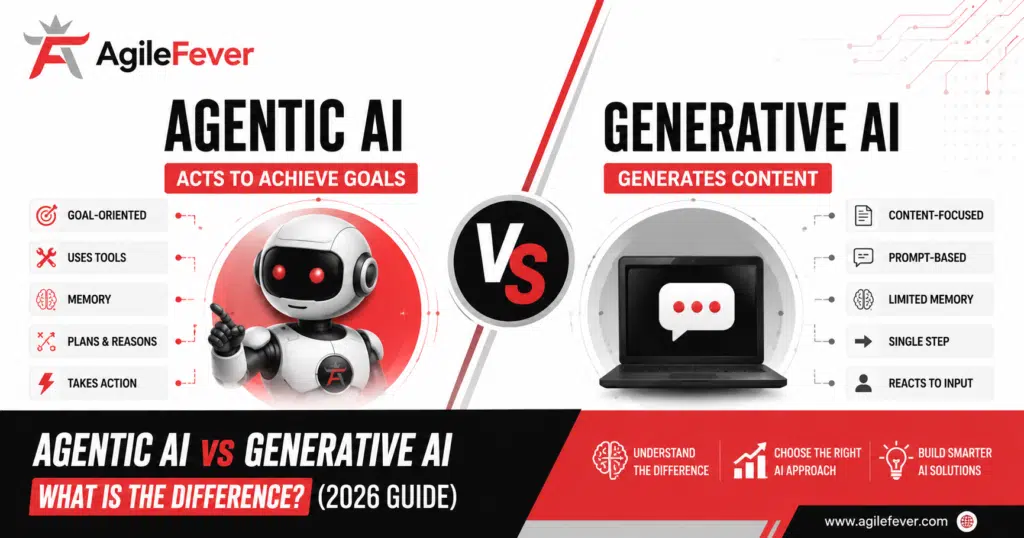
While Generative AI changed how we create content, Agentic AI is changing how work gets done. Understanding the difference between the two is very important because Agentic AI does not replace Generative AI. It builds on top of it.
Agentic AI vs Generative AI: A quick Comparison
| Aspect | Generative AI | Agentic AI |
|---|---|---|
| Purpose | Create content | Complete goals |
| Interaction | Single-step | Multi-step |
| Memory | Limited | Persistent |
| Tools | Usually none | Uses APIs and systems |
| Autonomy | Reactive | Proactive |
| Output | Content | Outcomes |
| Examples | ChatGPT, Claude | Research agents, CRM agents |
How They Work: Under the Hood
Agentic AI systems typically integrate several components:
- Planner / Orchestrator: Splits high-level goals into sub-tasks.
- Memory / Context Store: To persist state, past interactions, or decisions.
- Tool / API Connections: Access external systems (databases, calendars, CRMs).
- Feedback Loops / Monitoring: For correctness, safety, to detect failures or hallucinations.
Generative AI systems often just need the model + prompt management, less infrastructure. Agentic AI adds complexity — which means more engineering, more testing, and stronger governance.
How Generative AI Powers Agentic AI
LLM (Generative AI)
↓
Reasoning
↓
Tools
↓
Memory
↓
Planning
↓
Agentic AI
Real-World Statistics & Market Trends
- A recent Gartner survey (2024) found that over 60% of large enterprises are exploring autonomous agents, up from ~35% in 2022.
- IDC estimates the global generative AI market (~content generation, chatbots) will reach USD 110 billion by 2027. Agentic AI (tooling + orchestration) is forecasted to grow faster, at ~30-40% CAGR, because many businesses see it as the next operational layer.
- In a developer survey by O’Reilly (2024), 40% of respondents said implementing agentic workflows (multi-step agents) was one of their top two priorities for R&D in the next 18 months.
When to Use Which: Product & Business Value
If Your Goal Is… |
Generative AI’s Strengths |
Agentic AI Adds Value |
|---|---|---|
| Fast content / prototype / simple tasks | Low setup, quick iterations | Overkill in complexity |
| Customer support, summarization | Useful for templated responses | Agentic AI can route, take action (e.g. open ticket) |
| Automation across tools / workflows | Partial benefit (via scripts) | Full benefit: autonomous agents reduce manual coordination |
| Data-sensitive, regulated domain | Generative AI needs heavy guardrails | Agentic demands stricter governance, audit trails, compliance |
For businesses, Agentic AI offers potential for cost savings (by automating repeated multi-step tasks), faster time-to-market, and more consistent operations. But the up-front investment is higher: in engineering, monitoring, and data infrastructure.
If you are confused to choose between course or bootcamp, here is our quick comparison on AI BootCamps and Courses.
Infrastructure & Risks You Must Plan For
- Persistent storage/memory: Agentic AI often needs to remember past interactions, user preferences, or state across steps. Without good memory systems, agents degrade.
- Security and Compliance: Agents are running actions — e.g. accessing customer data or running external service calls. Misconfigurations or exploited APIs can lead to data leaks or regulatory violation (GDPR, HIPAA, etc.).
- Monitoring & Error Handling: Agents can make bad decisions, hallucinate, or get stuck. You’ll need logging, human-in-the-loop fallback, rollback mechanisms.
- Tool orchestration & latency: Agents calling many tools can suffer latency, rate limits, dependency failures. Business impact must be measured.
Career Implications: What You Should Learn Now
If you want to lead or contribute in this space:
- Understand how to design agents (planning, memory, tool chaining).
- Familiarize yourself with toolkits like OpenAI’s function calling, LangChain, RL agents, or agent frameworks from Microsoft, NVIDIA, or open-source.
- Skills in cloud infrastructure, secure API design, observability, and governance become more important.
- Roles will emerge: “Agent Architect”, “Agent Reliability Engineer”, “Autonomous Systems PM”.
If you already work in GenAI, adding agentic components to your skill set could make you more in demand; for instance, job listings looking for “agent engineer” increased ~ 2.5× in the last year (according to job-board data).
Business Implications: What Leaders Should Consider
- Evaluate ROI vs complexity: pilot small agentic usecases before scaling.
- Security / legal exposure: more actions = more liability.
- Cost of scaling: tool integration, memory storage, model inference.
- Talent acquisition: Agentic AI needs people who cross ML, infra, security, UX.
Adoption Roadmap: 5 Steps for Teams
- Define scope & goal: what tasks should the agent do and what not.
- Map workflow: How many steps/tools are involved? Who owns which part?
- Set up infrastructure: memory store, orchestrator, secure API access.
- Develop pilot agent: test in sandbox, track errors, test human-fallback.
- Measure & iterate: success metrics (accuracy, cost, user satisfaction), refine agents, plan scale.
Some Real-world examples
Writing an Email
Generative AI:
- Writes email.
Agentic AI:
- Researches context.
- Checks calendar.
- Drafts email.
- Sends reminder.
Customer Support
Generative AI:
- Answers questions.
Agentic AI:
- Retrieves information.
- Updates CRM.
- Escalates tickets.
Software Engineering
Generative AI:
- Generates code.
Agentic AI:
- Creates code.
- Tests code.
- Reviews output.
- Opens pull requests.
How this Helps Your Career & Business
- For you: Mastering agentic AI opens high-impact roles, higher compensation, leadership opportunities. It’s a career differentiator.
- For businesses: Agentic systems can reduce manual overhead, automate complex workflows, improve consistency, and scale with fewer errors.
To build agentic systems confidently, you need more than theory. AgileFever’s AI Product & Infrastructure Bootcamp teaches you practical agent design, tool orchestration, memory systems, and deployment in real settings. Join us to create real agents by week 6, with code, architecture review, and readiness for production.
Here: Boost Your Agentic AI & Infrastructure Skills
Download our: Agentic AI BootCamp Brochure
Our Learner’s Real Story
One AgileFever learner, Deepak G, joined the Agentic AI Bootcamp to strengthen his practical understanding of Agentic AI after a professional break. Soon after, he transitioned into a Staff Data Scientist role at Altimetrik, increasing his compensation from approximately ₹27 LPA to ₹40 LPA.
Generative AI and Agentic AI FAQs
Q: Is agentic AI going to replace generative AI?
Not really. Generative AI will keep doing what it does best: content, prototypes, inquiries. Agentic AI builds on it when tasks need multiple steps, memory, or actions. They complement each other.
Q: Can small businesses benefit from agentic AI, or is it only for big firms?
Absolutely they can. Even a small company that automates multi-tool tasks (e.g. data collection + scheduling + follow-ups) will see big efficiency gains. Just start small, limit scope, and scale as you go.
Q: What’s the toughest part of developing agentic systems?
Often, it’s managing unexpected behavior and keeping state consistent. Also, ensuring the agent doesn’t do something it shouldn’t — so governance, testing, human fallback matter.
Q: What kind of roles are hiring for agentic AI expertise?
Roles like “Agent Architect”, “AI Infrastructure Engineer”, “Automation Engineer”, “AI Product Manager” with agent-focused responsibilities are growing.
Q: Do I need to be an ML expert to work with agentic AI?
You’ll benefit from ML fundamentals, but more crucial are engineering skills (APIs, tools), infrastructure, prompt engineering, and understanding system design.
Q: How should I measure success after deploying an agentic solution?
Look at task success rate, error rate, human override count, speed improvements, and cost savings. Also get user satisfaction feedback — if users trust and accept the agent’s actions.
Conclusion
Agentic AI is not “future tech” anymore; it is increasingly becoming a core capability for firms that want smart automation. It demands careful architecture, strong governance, and cross-disciplinary skills. Start small, build pilot agents, learn the tradeoffs and once you master it, your career and your organization can leap ahead.