











In simple words, Agentic AI is the skill every corporation is looking for. If you have this question: “Do I need an Agentic AI certification to build a career in AI?” then you are in the right direction.
After all, whenever a new technology becomes popular, certifications usually follow. But Agentic AI is different. And before you spend money chasing certificates, it is worth understanding what employers, recruiters, and companies actually care about and the answer may surprise you.
Is There an Official Agentic AI Certification?
Agentic AI is not like other certifications such as:
- AWS Solutions Architect
- PMP
- Google Cloud Professional
- Microsoft Azure
There is no universally recognized Agentic AI certification yet. The field itself is still evolving. New frameworks, tools, and architectures are appearing almost every month. What companies care about today may change significantly over the next few years. That is why Agentic AI careers are currently being shaped more by skills and practical experience than by certificates.
Why Everyone Is Suddenly Talking About Agentic AI?
There is more work for businesses than simple chatbots. Organizations are now building systems that can:
- Plan tasks
- Use external tools
- Retrieve information
- Maintain memory
- Collaborate with other agents
- Automate workflows
These systems require a completely different skill set compared to traditional AI applications. And that is why companies are looking for professionals who understand:
- Agent architecture
- RAG systems
- Multi-agent workflows
- Tool integrations
- Memory systems
- Evaluation and monitoring
- Deployment
The industry needs builders. Not just certificate collectors.
Do Employers Care About Certifications?
In simple words, yes. But probably not as much as you think. The AI era has changed everything. Before times, having certifications was enough to get the job, but now real skills matter more than ever.
However, most employers ultimately ask:
- Can you solve problems?
- Can you build systems?
- Can you deploy solutions?
- Can you work with modern frameworks?
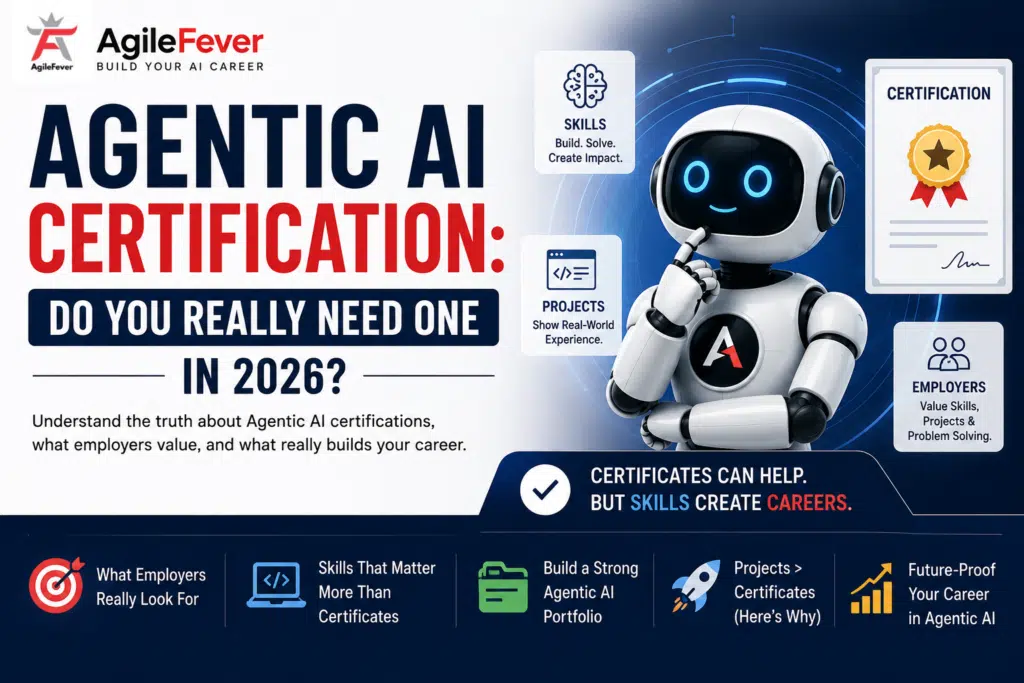
A certificate may help your resume stand out. But skills are what help you get hired.
What Recruiters Actually Look For
When companies hire AI professionals, they typically value:
- Practical Projects: Can you show what you’ve built?
- Architecture Knowledge: Do you understand how agents work?
- Framework Experience: Have you worked with LangGraph, CrewAI, AutoGen, OpenAI Agents SDK
- RAG Systems: Can you build retrieval-based applications?
- Multi-Agent Systems: Do you understand orchestration and collaboration?
- Deployment Skills: Can you take AI applications from prototype to production?
- LLMOps: Can you evaluate, monitor, and optimize AI systems?
These capabilities often matter more than the logo printed on a certificate.
When Certifications Can Be Helpful
This does not mean certifications are useless. They can provide value in certain situations.
- Beginners: Certifications offer structure and a clear starting point.
- Career Changers: They help demonstrate commitment to learning.
- Professionals Seeking Credibility: Certificates can strengthen your profile.
- Organizations That Require Formal Credentials: Some companies value certifications as part of internal career development.
Skills Matter More Than Certifications
We all know that the AI industry is moving incredibly fast. Because tools change, frameworks evolve, but foundational skills remain valuable.
By 2026, strong Agentic AI professionals should understand:
- LLM Foundations: Understanding how models work.
- Prompt Engineering: Creating reliable instructions.
- Context Engineering: Managing information effectively.
- Retrieval-Augmented Generation (RAG): Connecting models to knowledge.
- Memory Systems: Maintaining long-term context.
- Tool Integration: Allowing agents to interact with external systems.
- Agent Architecture: Understanding planners, executors, and workflows.
- Multi-Agent Systems: Designing collaborating agents.
- Model Context Protocol (MCP): Building interoperable systems.
- LLMOps: Monitoring and evaluating AI applications.
- Deployment: Taking systems into production.
These are the skills companies increasingly value.
Projects vs Certifications: Which Matters More?
Imagine two candidates.
Candidate A
- Three AI certifications.
- No projects.
Candidate B
Has built:
- A customer support agent.
- A research assistant.
- A CRM automation agent.
- A multi-agent workflow.
Who would you hire?
Most organizations choose Candidate B.
Because projects demonstrate:
- Problem-solving ability.
- Technical depth.
- Practical understanding.
- Real-world experience.
Whereas projects tell stories, certificates tell intentions. Both are useful. But projects often carry more weight.
How to Build an Agentic AI Portfolio
A strong portfolio does not need twenty projects. Even four or five meaningful applications can make a huge difference.
For example:
- Enterprise Knowledge Assistant: Search and summarize internal documents.
- Customer Support Agent: Handle questions and escalation workflows.
- Research Agent: Collect and analyze information automatically.
- Sales Intelligence Agent: Generate insights from customer interactions.
- CRM Automation Agent: Integrate with external systems and streamline workflows.
The goal here is not complexity. The goal is demonstrating capability.
A Real Example of Skill-Based Career Growth
Deepak G joined AgileFever’s Agentic AI Bootcamp after taking a professional break.
As an experienced Data Scientist, he wanted to strengthen his practical understanding of Agentic AI and prepare for the next phase of his career.
Through hands-on projects and real-world implementations, he sharpened his skills and aligned himself with industry trends.
Soon afterward, he transitioned into a Staff Data Scientist role at Altimetrik.
His compensation increased from approximately ₹27 LPA to ₹40 LPA.
His story highlights an important truth:
Career growth usually comes from capabilities. Not certificates alone.
So, Should You Join an Agentic AI Bootcamp?
Many professionals do not necessarily need another certificate.
What they need is:
- Structure.
- Mentorship.
- Hands-on projects.
- Practical experience.
- Modern frameworks.
- Real-world scenarios.
A well-designed bootcamp provides:
- Guided Learning: No random tutorials.
- Hands-On Projects: Learning by building.
- Industry Tools: Working with technologies used in production.
- Mentorship: Learning from experienced practitioners.
- Accountability: Staying consistent and focused.
Programs like AgileFever’s Agentic AI Bootcamp focus on helping learners build production-oriented skills through topics such as:
- LangGraph
- CrewAI
- AutoGen
- OpenAI Agents SDK
- Memory systems
- RAG
- Multi-agent orchestration
- Model Context Protocol (MCP)
- LLMOps
- Deployment
- Capstone projects
The emphasis is on building capabilities rather than simply collecting certificates.
When Should You Pursue Certification?
Consider certification if:
- You prefer structured learning.
- You are transitioning into AI.
- You want to strengthen your resume.
- You need external validation.
- Your organization values credentials.
But remember: Certification should support skill development. Not replace it.
Final Verdict: Do You Need an Agentic AI Certification?
Yes, if it helps you learn. No, if you are expecting a certificate alone to transform your career.
The future of AI belongs to professionals who can:
- Design agents.
- Build systems.
- Deploy applications.
- Solve real problems.
In the world of Agentic AI, skills are the ultimate credential. And that is unlikely to change anytime soon.