










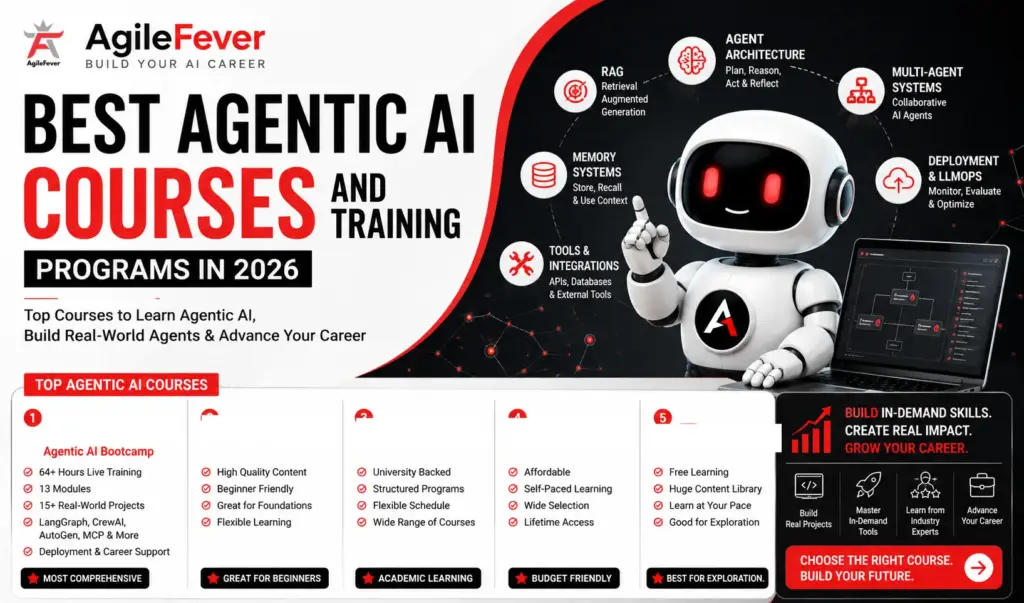
Almost every company is building AI agents that can reason, plan, use tools, collaborate with other agents, and automate complex workflows. Obviously, our next question is “What’s the best way to learn Agentic AI?”
There are thousands of articles, videos, and tutorials. The problem is one day you will learn LLM and the next day you are trying to understand LangGraph, CrewAI, memory systems, RAG, and multi-agent orchestration. It is exciting. Actually overwhelming. That is why choosing the right learning path matters a lot.
I have searched a lot for this Agentic AI bootcamp, course and training program. I have downloaded almost every brochure, compared the curriculum, reviews, hours, prices, and found the best one that suits your real goal with real learner experience.
Let us see every single point and consider the best one which suits your goals.
Disclosure. AgileFever runs one of the programs compared here, the GenAI and Agentic AI BootCamp. We list what the other options are good at so you can judge for yourself.
The options at a glance
| Option | Format | Strongest at | Watch out for |
|---|---|---|---|
| AgileFever GenAI and Agentic AI BootCamp | Live, 74 hours over 8 weeks (64+ live, 10 self-paced) | Building and deploying agents, with projects and a capstone | Pace of about 8 live hours a week; needs coding fluency |
| DeepLearning.AI short courses | Self-paced video | Clear introductions to individual topics | Topic by topic, so you build your own roadmap |
| Coursera programs | Self-paced, often university-linked | Structured academic coverage | Hands-on agent building varies a lot by course |
| Udemy courses | Self-paced video | Low cost and wide choice | Quality and currency vary by instructor |
| Documentation, GitHub and YouTube | Self-directed | Staying current, free | No structure, no feedback |
Why Learning Agentic AI Is Different
Learning Agentic AI is not the same as learning Python or machine learning.
You are not learning a single technology. You are learning an ecosystem.
Modern Agentic AI involves:
- Large Language Models (LLMs)
- Prompt Engineering
- Context Engineering
- Retrieval-Augmented Generation (RAG)
- Agent Architecture
- Memory Systems
- Tool Integration
- Multi-Agent Systems
- LLMOps
- Evaluation and Monitoring
- Deployment
Do not try to learn everything randomly; it often leads to tutorial fatigue. Consuming lots of content for months, but you never feel confident enough to build something meaningful. This is where structured learning becomes valuable.
How to Choose the Right Agentic AI Course
Here are the five things worth looking for before selecting any course.
1. Curriculum Depth
Some programs focus only on prompting while others teach production-grade systems.
You should look for topics such as:
- RAG
- Agent Architecture
- Memory Systems
- Multi-Agent Systems
- Evaluation
- Deployment
The industry is moving quickly, and surface-level knowledge becomes outdated fast.
2. Hands-On Projects
The more practical knowledge you have, the more you build.
A strong program should include projects that allow you to:
- Build AI agents
- Work with real frameworks
- Solve business problems
- Deploy applications
Employers care far more about hands-on projects than certificates.
3. Framework Coverage
Modern AI engineers are expected to understand popular frameworks.
Look for exposure to:
- LangGraph
- CrewAI
- AutoGen
- OpenAI Agents SDK
These frameworks are increasingly appearing in enterprise AI projects.
4. Deployment and Production Skills
Many courses stop after teaching concepts. But the real-world systems do not.
Look for programs that cover:
- LLMOps
- Monitoring
- Evaluation
- Deployment
- Cost optimization
Building a demo is easy. Building something reliable is where the challenge begins.
5. Instructor Experience
Learning from practitioners who are actively working with AI systems often provides more practical insights than theory alone.
Best Agentic AI Courses and Training Programs in 2026
Let us look at some popular options.
1. AgileFever Gen and Agentic AI Bootcamp
Best For
This Gen and Agentic AI bootcamp is for professionals who can code and want hands-on, production-focused learning.
Highlights
- 74 hours in total, 64+ of them live and instructor-led
- 17 live modules plus a recorded n8n module
- 10+ hands-on projects
- 8 capstone options
- Career support
- Industry mentors
Topics Covered
- LLM Foundations
- Prompt Engineering
- RAG Systems
- Agent Architecture
- LangGraph
- CrewAI
- AutoGen
- OpenAI Agents SDK
- Memory Systems
- Multi-Agent Systems
- Model Context Protocol (MCP)
- Evaluation and LLMOps
- Azure AI Foundry
- Deployment and production workflows
One thing that makes the program stand out is its emphasis on building real systems rather than stopping at theory.
Learners work on projects that simulate practical enterprise scenarios instead of simple chatbot examples.
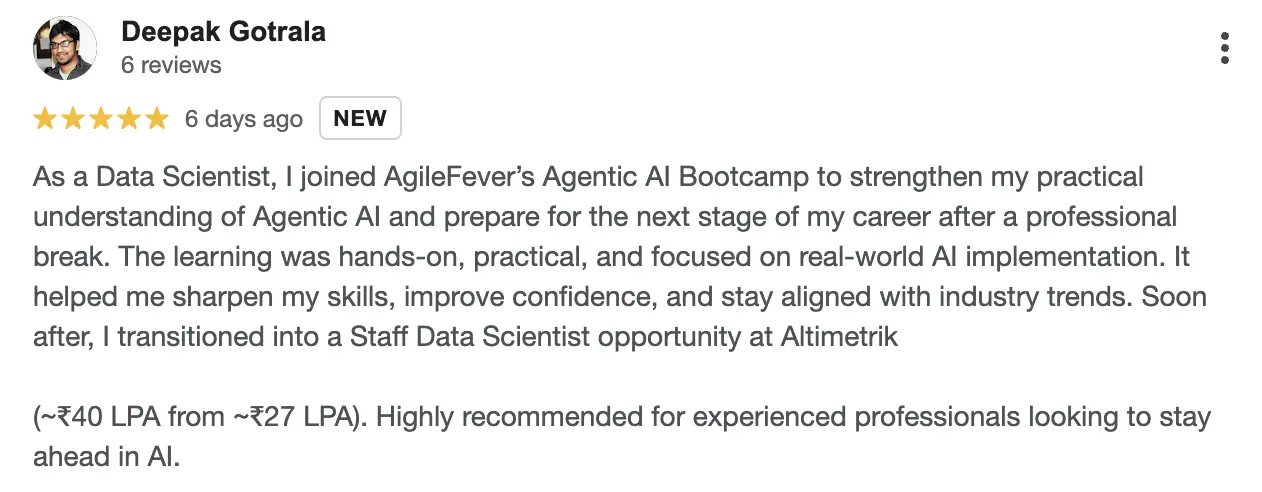
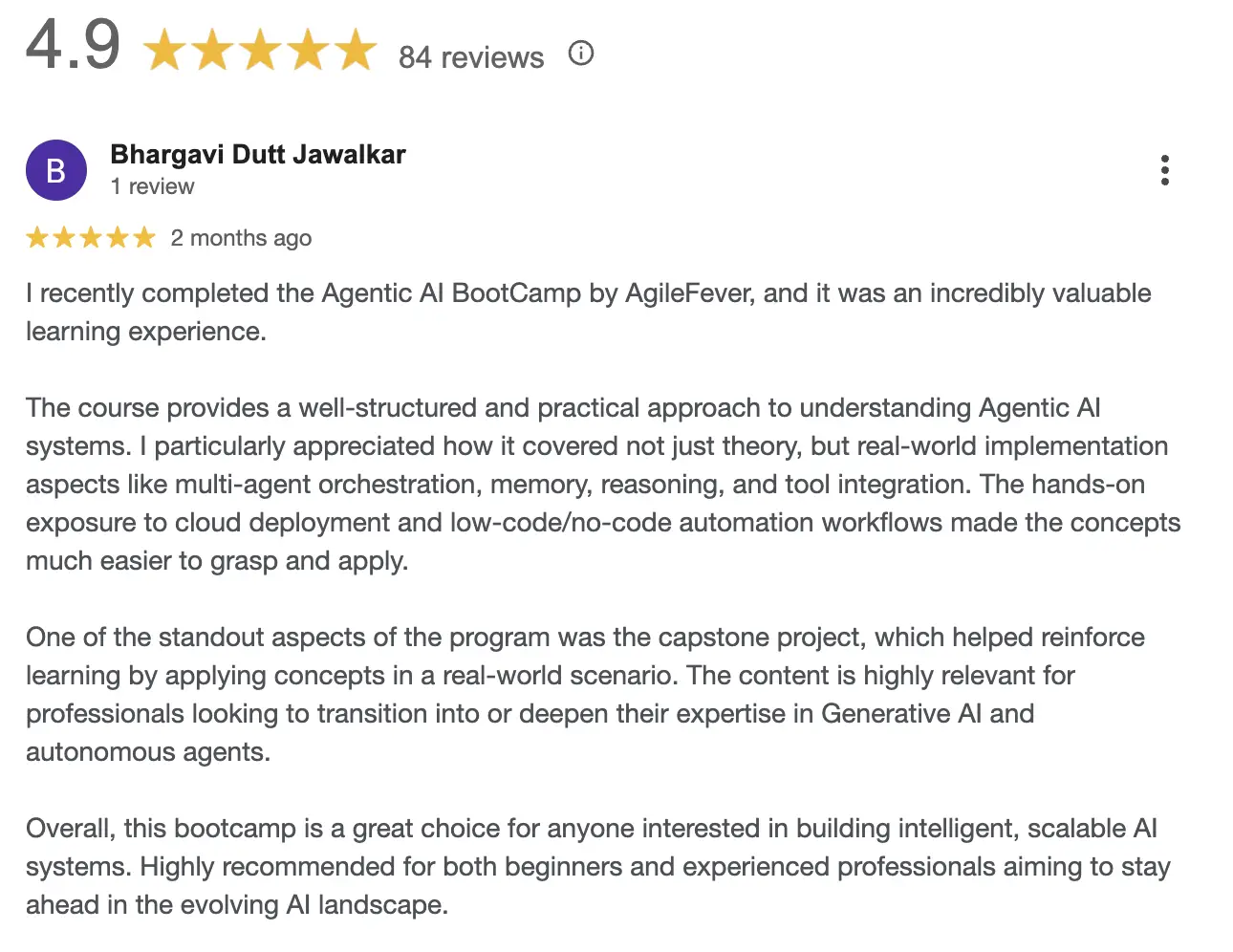
Real Learner experience:
2. DeepLearning.AI
Best For
Beginners exploring Generative AI concepts.
Strengths
- High-quality content
- Beginner-friendly
- Excellent theoretical foundations
- Limitations
Many courses focus on individual topics rather than providing a complete production-oriented roadmap.
3. Coursera
Best For
Structured academic learning.
Strengths
- Flexible pace
- University-backed programs
- Broad AI coverage
- Limitations
Hands-on agent-building experience can vary depending on the course.
4. Udemy
Best For
Budget-conscious learners.
Strengths
- Affordable
- Wide selection
- Self-paced
- Limitations
Quality varies significantly between instructors.
5. YouTube and Self-Learning
Best For
Exploration and staying updated.
Strengths
- Free
- Huge amount of information
- Limitations
Information overload.
Many learners struggle to connect topics such as:
- LangGraph
- CrewAI
- Memory systems
- RAG
- Multi-agent orchestration
without a structured path.
Self-Learning vs Bootcamps
This isn’t a battle.
Both approaches work.
Self-Learning Works Well If You:
- Enjoy experimenting
- Have plenty of time
- Prefer learning independently
Bootcamps Work Well If You:
- Want a roadmap
- Prefer live guidance
- Learn better with projects
- Need accountability
- Want to accelerate learning
Neither approach is right or wrong.
It depends on your goals.
Who Should Join an Agentic AI Bootcamp?
A structured program can be valuable for:
- Software Engineers: Who want to transition into AI engineering.
- Data Scientists: Looking to expand beyond traditional machine learning.
- Machine Learning Engineers: Interested in modern agentic systems.
- AI Engineers: Who want to master frameworks and deployment.
- Solution Architects: Exploring enterprise AI applications.
- Automation Engineers: Building intelligent workflows.
- Freshers who already code in Python and want to start a career in AI
What Skills Should an Agentic AI Course Teach?
By 2026, a good program should cover:
Foundations
- LLMs
- Prompt Engineering
- Context Engineering
Intermediate Topics
- RAG
- Memory Systems
- Tool Integration
Advanced Topics
- LangGraph
- CrewAI
- AutoGen
- OpenAI Agents SDK
Enterprise Topics
- Multi-Agent Systems
- MCP
- Evaluation
- LLMOps
- Deployment
These are increasingly becoming the skills employers expect from AI professionals.
What the AgileFever program contains, as of October 2026
This table reflects the current GenAI and Agentic AI BootCamp page and replaces the figures in the earlier version of this post.
| Item | Current detail |
|---|---|
| Total time | 74 hours: 64+ live instructor-led and 10 self-paced |
| Length | 8 weeks |
| Modules | 17 live modules plus a recorded n8n module |
| Projects | 10+ hands-on projects |
| Capstone | 8 options; 2 are built live and 6 are briefs on GitHub. The capstone is the final evaluation and there is no exam |
| Covers | Prompt and context engineering, advanced RAG, fine-tuning, CrewAI, AutoGen and LangGraph, memory, planning, multi-agent systems, MCP and A2A, security, deployment and agents on Azure |
| Built for | Experienced IT professionals who can read and write code. A Python for AI module is provided as pre-work |
| Price | $2,000 in the US, with session recordings for every live class |
Additional discounts are available. Contact us to know more.
If you are an experienced IT professional
Most people reading this already work in software, data, cloud or architecture, so the useful question is which gap you have. Use this as a quick guide.
| Your gap | What to look at first |
|---|---|
| You can code but have not built agents | The GenAI and Agentic AI BootCamp |
| You build ML models and want LLM work | The Gen AI BootCamp (broader on models, fine-tuning and image generation) |
| You operate platforms and want to run AI in production | The MLOps, LLMOps and Agentic AI Ops BootCamp (60 live hours, $2,000) |
| You are a leader or architect who will not code | A role-based course, such as the 16-hour Solution Architects course ($450) |
| You need Python first | The 6-hour Python for AI course |
To decide between the two longer programs, read Gen AI BootCamp vs GenAI and Agentic AI BootCamp and the skills you will build.
Which Course Is Right for You?
There isn’t one perfect answer.
If you are exploring AI casually, self-learning resources may be enough.
If your goal is to:
- Build production-grade agents
- Understand modern frameworks
- Work on hands-on projects
- Learn from industry experts
- Accelerate your career
then a structured program can save months of confusion.
If you still have any queries, let us know in the comments box below, and our AI experts will get back to you shortly. If you want to talk to our AI experts, you can always fill out the form on the right-side panel or put your questions in the chatbox for a quick response.
More questions answered
How long does it take to learn agentic AI?
For someone who already codes, a structured program of 60 to 80 hours spread over two months is realistic for building and deploying a first agent. Becoming comfortable in production takes longer and comes from working on real systems.
Do I need a machine learning background?
No. Agentic AI work is mostly software engineering around language model APIs: orchestration, retrieval, tool calls, evaluation and security. You do need to be comfortable coding, usually in Python.
Is a certificate important?
Less than what you can show. A repository with an agent that handles failure, an evaluation set and a deployment tells an employer more than a certificate does.
Last reviewed October 2026 by the AgileFever editorial team.