

































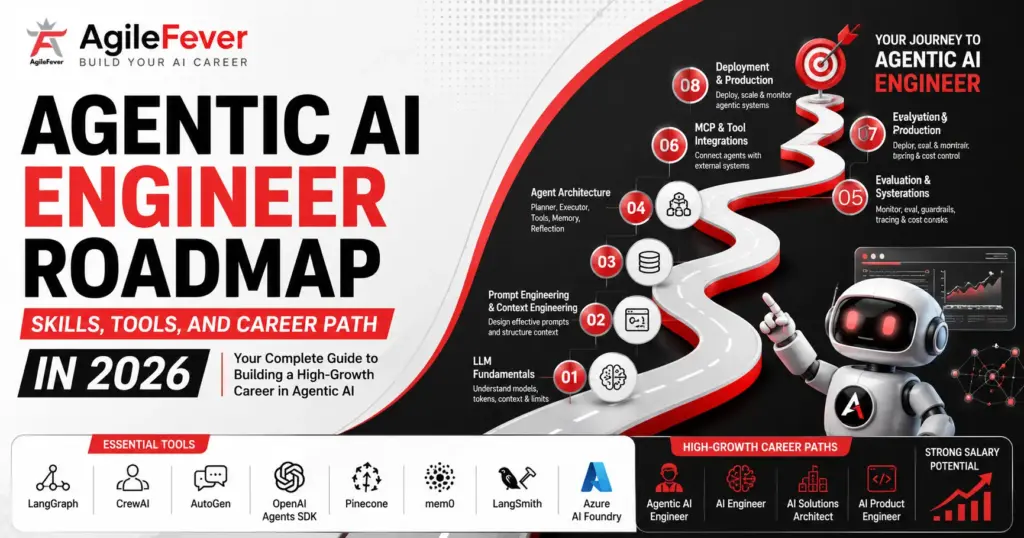
As we all know, company requirements for hiring have totally changed. They are no longer asking only for machine learning engineers and are actively looking for professionals who can build AI systems that reason, plan, use tools, collaborate with other agents, and automate complex workflows. To put it simply, they are looking for Agentic AI Engineers.
There is so much demand for this role, but at the same point the confusion too.
What exactly is an Agentic AI Engineer? What skills do you need? Which tools should you learn? And how do you build a career in this field? If you are one of those who wants to build a growing career, then this is for you. In this guide, we will explain everything in a simple terms so you can save it as a reference.
What Is an Agentic AI Engineer?
So, what does an Agentic AI engineer do? They will design, build, deploy, and manages AI agents that can perform tasks autonomously not like those traditional AI applications that simply generate responses.
Agentic systems can:
- Plan actions
- Use external tools
- Access data sources
- Maintain memory
- Collaborate with other agents
- Make decisions based on goals
For example:
A traditional chatbot answers questions.
Without requiring constant human involvement, an Agentic AI system can:
- Research a topic
- Gather information
- Analyze findings
- Create a report
- Validate outputs
- Send notifications
That is why organizations are investing heavily in agent-based systems.
Why Agentic AI Is Becoming a High-Demand Career
Every major technology wave creates new job categories.
Cloud computing created Cloud Engineers.
DevOps created Platform Engineers.
AI is now creating Agentic AI Engineers.
And now businesses want more than AI-powered chat interfaces.
They want systems that can:
- Automate workflows
- Improve productivity
- Reduce operational costs
- Enhance customer experiences
- Support decision-making
As Agentic AI adoption is growing and professionals who understand these systems will be more valuable.
A Real Example of Career Growth
One of our AgileFever learners, Deepak G, joined our Agentic AI Bootcamp to strengthen his practical understanding of modern AI systems after a professional break.
He wanted hands-on experience with Agentic AI concepts, tools, and real-world implementations which he learned by the end of this bootcamp.
Once he received the certification he got an Staff Data Scientist role at Altimetrik, with a pay of approximately ₹27 LPA to ₹40 LPA.
His experience says it all. Organizations are now hiring professionals who can apply AI in real-world scenarios. The more practical knowledge you have the more chances of getting hired.
Stage 1: Build Strong AI Foundations
For any career, foundations are very important. Before diving into agents, you need to understand the fundamentals.
Start with:
Large Language Models (LLMs)
Learn:
- How LLMs work
- Tokens and context windows
- Attention mechanisms
- Model limitations
- Hallucinations
You do not need a research-level knowledge. But you should understand why AI behaves the way it does.
Prompt Engineering
This remains an essential skill.
Focus on:
- Prompt design
- Few-shot prompting
- Chain-of-thought reasoning
- Structured outputs
- Context management
Good prompting often separates average AI systems from highly effective ones.
Stage 2: Learn Retrieval-Augmented Generation (RAG)
Most enterprise AI applications depend on RAG. But, why?
Because organizations need AI systems that can access:
- Internal documentation
- Knowledge bases
- Policies
- Product information
- Customer data
Key topics include:
- Embeddings
- Vector databases
- Retrieval pipelines
- Semantic search
- Hybrid search
Mastering RAG dramatically improves your ability to build business-ready AI solutions.
Stage 3: Understand Agent Architecture
This is where your transition into Agentic AI truly begins. Every AI engineer should understand the core building blocks of agents.
- Planner will determine what needs to be done.
- Executor will carry out an actions.
- Tools will enable interaction with external systems.
- Memory will store information and context.
- Reflection will allow the system to improve outputs.
These components form the foundation of modern agentic systems.
Stage 4: Learn Agent Frameworks
Agent frameworks help developers build sophisticated systems faster. The most important frameworks to learn today include:
LangGraph
Excellent for production-grade workflows and state management.
CrewAI
Popular for role-based multi-agent collaboration.
AutoGen
Widely used for agent communication and orchestration.
OpenAI Agents SDK
An increasingly important framework for enterprise applications.
See, you do not need to start everything at once; start simple, understand the concepts and then exapand to the other.
This way, there won’t be any jargon in learning, and there won’t be a time-consuming process just looking at many.
Stage 5: Master Memory and Tool Usage
This is where many developers separate themselves from beginners.
Modern AI agents do not simply generate responses. They interact with tools.
Examples are:
- Databases
- APIs
- Search engines
- CRM systems
- Documentation systems
- External applications
You should also understand memory systems:
- Short-term memory
- Long-term memory
- User memory
- Context management
The more effectively agents remember and use information, the more useful they become.
Stage 6: Learn Multi-Agent Systems
Single agents can be powerful, but multiple agents working together can be transformational.
A typical multi-agent system may include:
- Research Agent
- Planning Agent
- Writing Agent
- Review Agent
Each agent specializes in a specific task. This approach improves performance, scalability, and maintainability.
Learning multi-agent architecture is becoming one of the most valuable skills in modern AI engineering.
Stage 7: Understand MCP and AI Integrations
Model Context Protocol (MCP) is becoming more important than ever. It allows AI systems to connect with external tools and resources in a standardized way.
Why does this matter?
Because businesses do not want an isolated AI systems. They want agents that can connect with:
- Slack
- Jira
- Salesforce
- Databases
- Internal platforms
MCP helps make that possible. You can expect this skill to become more valuable in the coming years.
Stage 8: Learn Evaluation, Monitoring, and LLMOps
Building an agent is only half the challenge, and keeping it reliable is equally important.
This is where LLMOps comes in.
You should learn:
- Agent evaluation
- Monitoring
- Tracing
- Guardrails
- Cost optimization
- Performance analysis
Companies need AI systems they can trust. LLMOps will help deliver that trust.
Stage 9: Deploy Agents to Production
Many learners stop after creating demos but employers care about production systems.
For this you should Learn:
- Docker
- Cloud deployment
- Azure AI Foundry
- CI/CD pipelines
- Infrastructure basics
- Observability tools
A deployed solution demonstrates far more value than a local prototype.
Essential Tools Every Agentic AI Engineer Should Know
By 2026, a strong Agentic AI Engineer should be comfortable with:
AI Models
- GPT
- Claude
- Gemini
Agent Frameworks
- LangGraph
- CrewAI
- AutoGen
- OpenAI Agents SDK
Vector Databases
- Pinecone
- FAISS
- Chroma
Memory Systems
- mem0
- Zep
- MemGPT
Deployment Tools
- Docker
- Azure AI Foundry
- Hugging Face
Monitoring
- LangSmith
- Phoenix
- Weights & Biases
Start with one, become an expert and then expand.
Agentic AI Engineer Salary in 2026
Salaries vary by region, experience, and technical depth. However, professionals who can demonstrate expertise in:
- Agent architecture
- Multi-agent systems
- Production deployments
- Enterprise AI workflows
often command significantly higher compensation than traditional AI practitioners.
As businesses move from experimentation to implementation, demand is expected to continue growing.
Common Mistakes Aspiring Agentic AI Engineers Make
Learning Frameworks Before Fundamentals
- Tools change.
- Principles remain valuable.
Avoiding Real Projects
- The best learning happens through building.
Ignoring Deployment
- Production skills matter.
Skipping Multi-Agent Systems
- Many enterprise applications rely on multiple collaborating agents.
Focusing Only on Prompt Engineering
- Prompting is important. But architecture, memory, tools, and orchestration are what define modern Agentic AI systems.
Should You Follow a Structured Learning Path?
Many professionals start with YouTube videos and random tutorials. This will help you to explore what it is but it does not help you to become expert in it.
The real challenge is connecting all the learnings:
- LLMs
- Prompt Engineering
- RAG
- Agent Architecture
- Multi-Agent Systems
- Memory
- MCP
- LLMOps
- Deployment
A structured learning path will help to reach our goal without any guesswork.
For example, AgileFever’s Gen and Agentic AI Bootcamp takes learners from foundational AI concepts through advanced topics such as LangGraph, CrewAI, AutoGen, MCP, memory systems, multi-agent orchestration, deployment, and production-ready capstone projects.
The goal is not just learning about the agents, it is to learn how to build them.
And the future belongs not only to people who use AI but also to those who can engineer intelligent systems that work autonomously at scale.