































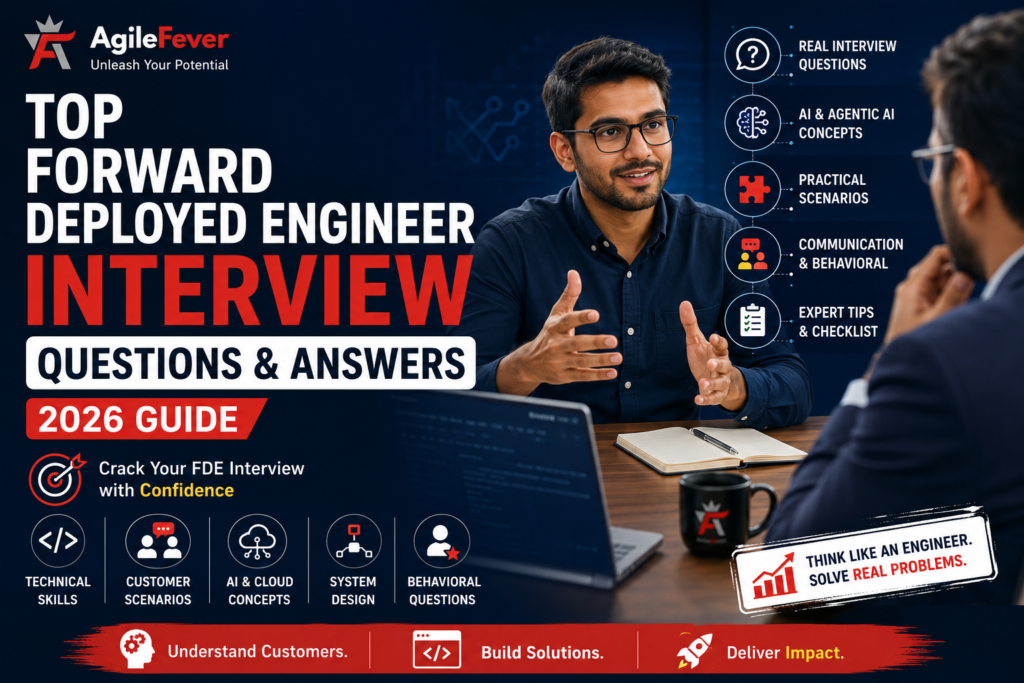
We don’t want to dump 100 questions on you, but make you say, “Now I understand how an FDE interview actually works”. Let us see the top Forward Deployed Engineer Interview Questions and Answers you are most likely to face during your interview. Forward Deployed Engineer (FDE): The Complete Career Guide for 2026 | Roles, Skills, Salary, Roadmap, AI, Interview and Future
How Most FDE Interviews Are Structured
Every company has its own hiring process, and most interviews include these stages:
| Interview Round | What They’re Looking For |
|---|---|
| Recruiter Screening | Communication, motivation, career goals |
| Technical Round | Programming, APIs, SQL, cloud fundamentals |
| Customer Scenario | Problem-solving and debugging approach |
| System Design | Architecture and technical decision-making |
| Behavioral Round | Collaboration, ownership, adaptability |
| Hiring Manager | Overall fit and customer mindset |
Top Forward Deployed Engineer Interview Questions and Answers
Recruiter Round
1. Tell me about yourself.
- Why they are asking: They are not looking for your entire career history. They want to know if your background fits an FDE role.
✅ Good Answer
Focus on:
- Your engineering experience
- Projects you’ve built
- Customer-facing experience
- Why you’re interested in solving real business problems
Keep it under two minutes.
❌ Weak Answer
“I completed my engineering in 2022, then I joined…”
Avoid turning it into a timeline of your life.
Pro Tip
End by explaining why the FDE role excites you.
Technical Questions
1. What is a Forward Deployed Engineer?
- Why they are asking: They are checking whether you understand the role beyond the job title.
✅ Good Answer
A Forward Deployed Engineer works directly with customers to understand business problems, build integrations, deploy solutions, and improve products based on real-world feedback. The role combines software engineering, solution design, and customer collaboration.
❌ Weak Answer
“An FDE bridges the gap between business and engineering.” It is too generic and doesn’t explain what the role actually involves.
Pro Tip
Mention both technical implementation and customer collaboration.
2. Explain REST APIs.
- Why they are asking: Enterprise software relies heavily on integrations. You wil work with APIs almost every day.
✅ Good Answer
REST APIs allow different applications to communicate.
For example, an HR application can send employee information to an AI assistant through an API. The assistant processes the request and returns a response.
Use simple examples instead of textbook definitions.
❌ Weak Answer
“REST is an architectural style…”
Technically correct, but difficult for non-technical stakeholders to understand.
Pro Tip
If you can explain APIs to a customer, you can explain them in an interview.
3. What would you do if an API call suddenly failed?
- Why they are asking: They want to see your debugging approach.
✅ Good Answer
Start with a structured investigation.
- Check logs.
- Verify authentication.
- Validate request payload.
- Review response codes.
- Test using Postman.
- Confirm whether any recent deployments introduced changes.
Explain your thought process before jumping to a solution.
❌ Weak Answer
“I’ll restart the server.”
Never guess.
Pro Tip
Interviewers value a structured debugging process more than a quick answer.
4. What’s the difference between SQL and NoSQL?
- Why they are asking: Enterprise applications often use both.
✅ Good Answer
- SQL databases are ideal when data has a structured format and relationships matter.
- NoSQL databases are better suited for flexible schemas and applications that need to scale quickly.
- Give a practical example instead of memorizing definitions.
- Customer Scenario Questions
These questions often determine whether you move to the next round.
5. A customer says, “Your AI chatbot gives incorrect answers.” What would you do?
Why they are asking: They are evaluating how you troubleshoot AI systems.
✅ Good Answer
Start by understanding the problem.
Ask questions like:
- What kind of answers are incorrect?
- Is the knowledge base up to date?
- Is Retrieval-Augmented Generation (RAG) configured correctly?
- Has anything changed recently?
Then investigate:
- Retrieval quality
- Prompt design
- Source documents
- Model configuration
- Logs
Only after understanding the issue should you suggest a fix.
❌ Weak Answer
“I’ll change the prompt.”
That’s guessing.
Pro Tip
Interviewers love engineers who investigate before solving.
How to Become a Forward Deployed Engineer: Step-by-Step Roadmap
6. A customer wants to integrate your platform with Salesforce. Where do you begin?
- Why they are asking: They are checking whether you understand enterprise integrations.
✅ Good Answer
Begin by understanding the customer’s workflow.
Then identify:
- Business requirements
- APIs
- Authentication
- Data mapping
- Security
- Testing strategy
Technology comes after understanding the business problem.
AI Questions
As AI becomes part of enterprise software, these questions are becoming increasingly common.
7. What is Retrieval-Augmented Generation (RAG)?
- Why they are asking: They want to know whether you understand how enterprise AI systems retrieve information.
✅ Good Answer
RAG allows an AI model to retrieve relevant information from external documents before generating a response.
For example, instead of answering from general knowledge, an AI assistant can search company policies and provide answers based on the latest documents.
8. What is an AI Agent?
Why they are asking: AI Agents are becoming part of many enterprise products.
✅ Good Answer
An AI Agent doesn’t just answer questions.
It can plan tasks, call APIs, retrieve information, interact with other systems, and complete workflows with minimal human intervention.
Use a real-world example whenever possible.
Forward Deployed Engineer Salary Guide (India, USA and Global)
System Design Question
Design an AI assistant for a hospital
- Why they are asking: They are evaluating your ability to design systems, not memorize architectures.
✅ Good Answer Framework
Think through the problem step by step.
- Understand the users.
- Identify the data sources.
- Design the architecture.
- Plan authentication and security.
- Choose AI components.
- Explain deployment and monitoring.
Pro Tip
Speak through your thought process.
Interviewers often care more about how you think than the final design.
Behavioral Questions
Tell me about a time you handled a difficult customer.
- Why they are asking: Forward Deployed Engineers work directly with customers.
Communication matters just as much as technical ability.
✅ Good Answer
Use the STAR method:
- Situation
- Task
- Action
- Result
Focus on how you listened, collaborated, and solved the problem.
❌ Weak Answer
“The customer was wrong.”
Never blame the customer.
Questions You Should Ask the Interviewer
Many candidates forget this part.
Good questions include:
- What kinds of customers do FDEs usually work with?
- How much customer interaction should I expect?
- What technologies does the team use most?
- How is AI changing the work of your FDE team?
- What would success look like during the first six months?
Thoughtful questions show genuine interest in the role.
Things Nobody Tells You
Forward Deployed Engineer interviews often feel more like consulting interviews than software engineering interviews. The interviewer is not just looking for the correct answer.
They’re observing:
- How you approach uncertainty.
- Whether you ask clarifying questions.
- How you communicate your ideas.
- Whether you think about the customer’s perspective.
That is what separates a good engineer from a great FDE.
Mistakes I See Beginners Make
❌ Jumping straight into coding.
❌ Giving textbook definitions.
❌ Ignoring customer requirements.
❌ Not asking clarifying questions.
❌ Panicking when they don’t know an answer.
Remember, interviewers do not expect you to know everything. They expect you to think logically.
If I Were Interviewing Tomorrow
I would spend my final day reviewing:
- Python fundamentals
- REST APIs
- SQL
- Cloud basics
- AI concepts like RAG and AI Agents
- One project I know inside out
- A few customer scenarios
I would not try to learn something completely new the night before.
Confidence comes from reinforcing what you already know.
10-Minute Interview Checklist
Before your interview, ask yourself:
✅ Can I explain an API without using technical jargon?
✅ Can I describe one project from start to finish?
✅ Can I explain RAG with a real example?
✅ Can I design a simple enterprise AI system?
✅ Can I explain how I troubleshoot production issues?
✅ Can I communicate technical concepts clearly?
If you answered “yes” to most of these, you are in good shape.
Mock Interview
Interviewer: A customer tells you that your AI assistant is giving incorrect answers. Walk me through how you’d handle the situation.
Candidate:
“The first thing I’d do is understand what the customer means by ‘incorrect.’ Are the answers outdated, unrelated, or completely wrong? Then I’d check whether the AI is retrieving the correct documents, review the prompt configuration, examine logs for any recent deployment changes, and verify user permissions. Once I understand where the issue originates, I’d explain my findings to the customer and recommend the most appropriate fix. I prefer to investigate first rather than assume the problem is with the AI model.”
This kind of structured thinking is exactly what interviewers want to hear.
Frequently Asked Questions
Is there always a coding round?
Most companies include one, but practical problem-solving is often valued more than solving complex algorithm questions.
Do I need AI knowledge?
Not every company requires it today, but AI skills are becoming increasingly valuable for enterprise software roles.
How should I prepare for an FDE interview?
Build real projects, practice explaining your work, study enterprise systems, and improve your communication skills.
Are customer-facing skills really that important?
Absolutely. That is one of the biggest differences between a Forward Deployed Engineer and a traditional Software Engineer.
What’s Next?
Clearing a Forward Deployed Engineer interview isn’t about memorizing perfect answers. It is about demonstrating how you think, how you communicate, and how you solve real customer problems. The strongest candidates don’t rush to solutions.
- They ask questions.
- Understand the business.
- Then build the right solution.
That is exactly what companies expect from a Forward Deployed Engineer.
Recommended Learning Paths
If you are preparing for an FDE role, these AgileFever learning paths can help you build the practical skills employers look for:
- Gen AI and Agentic AI Bootcamp – Build AI agents, RAG systems, and enterprise AI solutions.
- GenAI & Agentic AI for Solution Architects – Learn enterprise solution design for AI systems.
- Enterprise AI Agents on Azure – Gain hands-on experience deploying AI applications in enterprise environments.
- Python for AI – Strengthen your programming skills through practical AI-focused projects.