































Anyone who can solve the customer problem and see through the project to the end can become a forward deployed engineer. For example, let’s say you are a software engineer and your manager has asked you to join a customer call as they are having trouble integrating our platform with their internal systems.
You join the meeting thinking it will be a quick technical discussion. An hour later, you realize something, i.e., the biggest challenge is not writing the code, but understanding how the customer’s business works. Their approval process, security rules are different, and their data flows differently.
You leave the meeting thinking, “I actually enjoyed solving their business problem more than writing the code.” That is usually how people discover they are a good fit for a Forward Deployed Engineer role.
Before getting to the roadmap, know what a Forward deployed engineer is?
Can Anyone Become a Forward Deployed Engineer?
Yes. There is no single path. You may be from software engineering, start as a solution engineer, or move from consulting or transition from DevOps or cloud engineering.
What matters most is your ability to solve the problems for customers.
Step 1: Build Strong Programming Skills
Coming to FDE skills, you will still write code, actually a lot of it. You might build APIs today, automation tomorrow and a custom integration next week.
Start with one language. Python is a great choice. Then learn another enterprise language like Java or JavaScript. Don’t spend months watching tutorials. Build things. Break things. Fix them. That is how you will learn faster.
Step 2: Learn APIs and System Integration
Here is something you will hear often as an FDE. “Can you connect your platform with ours?” This is where APIs come in.
Learn how to work with:
- REST APIs
- JSON
- OAuth
- Webhooks
- API Authentication
A simple side project is enough. Connect two applications. You will learn more from that than just reading documentation for hours.
Step 3: Understand How Businesses Work
Many do, but as an FDE, you should not ever skip this step.
For example, let’s say you are building software for a logistics company.
Before writing a single line of code, you should ask questions.
- How do packages move?
- Who approves shipments?
- Where does data come from?
- What causes delays?
Once you understand the business, the technical solution becomes much clearer.
Step 4: Learn Cloud Platforms
Nowadays, most of the enterprise software runs in the cloud. You do not have to become an Azure expert overnight. Start with the basics.
Learn:
- Virtual Machines
- Storage
- Identity Management
- Networking
- Containers
Once you are comfortable, move on to cloud-native services.
Step 5: Get Comfortable Talking to Customers
This surprises a lot of engineers. You might spend two hours in customer meetings and only one hour writing code. That is completely normal. You should learn to ask questions like:
- “Can you show me how your current process works?”
- “What happens if this step fails?”
- “What’s slowing your team down today?”
Customers do not expect you to know everything. They expect you to listen. Meanwhile check Forward Deployed Engineer (FDE): The Complete Career Guide for 2026 | Roles, Skills, Salary, Roadmap, AI, Interview and Future.
Step 6: Learn AI
Five years ago, this step was not there. Today, it has become important. Many enterprise customers are not just buying software anymore. They are asking for AI.
They want:
- AI chatbots
- AI agents
- Document search
- Workflow automation
- Knowledge assistants
If you understand how these systems work, you will have a big advantage.
A good way to start is:
- LLMs
- Prompt Engineering
- RAG
- AI Agents
- MCP
- Enterprise AI
Recommended Learning Path: AgileFever’s Gen AI and Agentic AI Bootcamp gives you hands-on experience building AI agents, RAG applications, and enterprise AI workflows that are directly relevant to modern FDE roles.
Step 7: Build Real Projects
It is all about how much real experience you have rather than just certificates. They are useful but projects make better understanding about your knowledge.
Show an AI agent you’ve built.
Ideas:
- Customer support chatbot
- CRM integration
- AI document search
- Ticket automation
- Dashboard with API integrations
Even two or three solid projects can make a huge difference during interviews.
Step 8: Learn System Design
Sooner or later someone will ask, “How would you build this for one million users?” That is when system design matters.
Learn:
- Scalability
- Databases
- Queues
- Caching
- High Availability
- Security
You do not have to master everything. Just understand why these things are important.
Step 9: Develop Problem-Solving Skills
The best FDEs do not jump straight into the coding.
- They investigate first.
- Ask questions.
- Collect information.
- Understand the real issue.
- Then write code.
Sometimes the customer’s problem has nothing to do with the software. It could be a broken workflow, missing documentation, or poor communication between teams.
Step 10: Never Stop Learning
Technology changes quickly. Enterprise AI changes even faster. The engineers who stay curious usually build the strongest careers. Spend a little time every week learning something new.
- One article.
- One project.
- One new tool.
It adds up.
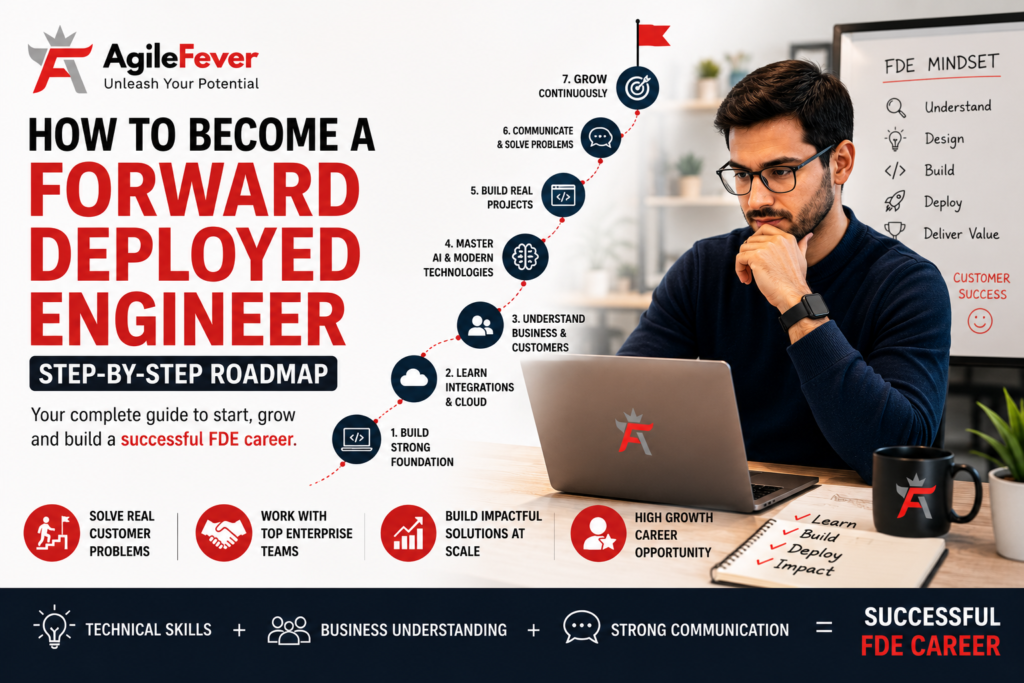
A Simple Forward Deployed Engineer Roadmap
Beginner
Learn Python
Learn Git
Learn SQL
Build APIs
↓
Intermediate
Cloud Platforms
Docker
System Design
Enterprise Integrations
↓
Advanced
AI Agents
RAG
MCP
Enterprise AI
Customer Solution Design
Common Mistakes to Avoid
Here are a few things people often get wrong.
- Thinking coding is enough: It is not. You will spend a lot of time understanding customers too.
- Ignoring communication: A great solution is useless if nobody understands it. Practice explaining technical ideas in simple words.
- Chasing certifications without building projects: Projects show what you can actually do. Build first. Certifications can come later.
- Waiting until you “know everything”: You will never know everything. Start applying. You will learn a lot on the job.
Frequently Asked Questions
Can a fresher become a Forward Deployed Engineer?
Yes. Strong programming skills, good communication, and practical projects can help you get started.
Which programming language should I learn first?
Python is usually the easiest starting point. It is widely used for automation, integrations, and AI applications.
Do I need AI skills?
Not for every role. But more companies are hiring FDEs to deploy AI-powered products, so it’s becoming a valuable skill.
Is this role good for introverts?
Yes. You don’t need to be a public speaker. You just need to enjoy working with people and solving their problems.
What’s Next?
If your goal is to become a Forward Deployed Engineer, don’t try to learn everything in one month. Start with programming, build projects, learn how enterprise systems work. Then move into AI and customer-facing solution design.
That is the path many successful FDEs follow today.
Recommended Learning Paths
If you are building toward an FDE career, these AgileFever programs fit naturally into your journey:
- Gen AI and Agentic AI Bootcamp – Learn to build AI agents, RAG systems, and enterprise AI applications that companies are actively adopting.
- GenAI & Agentic AI for Solution Architects – Ideal if you see yourself moving into solution design and enterprise architecture after gaining implementation experience.
- Python for AI – A practical starting point if you’re strengthening your programming skills for AI and automation.
- Attend our free masterclass on AI topics.