

































“One of our customers can’t connect their ERP system with our AI platform. They have strict security rules, different data formats, and a tight deadline. How would you approach it?” they asked in a Forward Deployed Engineer role interview. With this they are not only testing your coding skills but also trying to understand if you
- Can you break down a problem?
- Can you talk to customers?
- Can you write code?
- Can you design a solution?
- Can you stay calm when things don’t go as planned?
That is exactly what companies look for in a Forward Deployed Engineer. Before going into the skills, learn what a forward-deployed engineer is and the roles and responsibilities of an FDE here.
Do You Need to Be an Expert at Everything?
In simple words, no. Probably, this is the biggest misconception everyone has. Because you don’t have to be the world’s best programmer, or you don’t have to know every cloud service or every AI framework. But… yes, but you should have enough knowledge to understand the customer’s problem and figure out the best way to solve it. FDE’s role will be like a problem solver first and an engineer second.
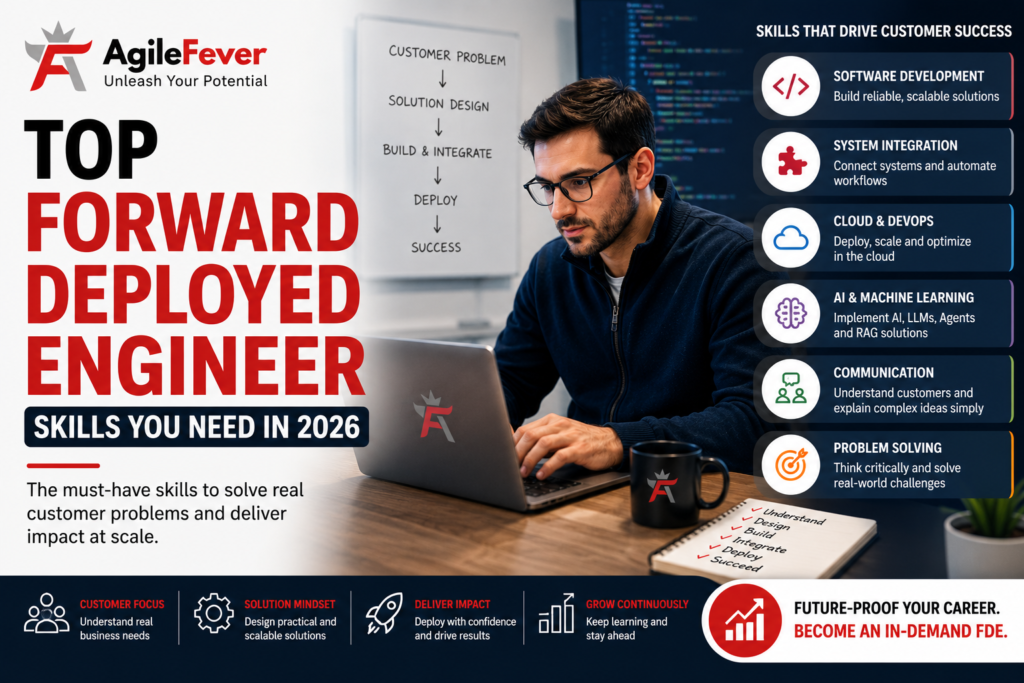
Forward Deployed Engineer Skills You Need
These are the top skills every FDE needs.
1. Software Development
You will build APIs, automation scripts, integrations, new features and writing code.
Languages commonly used include:
- Python
- Java
- JavaScript
- Go
Focus on writing clean, maintainable code instead of clever code.
2. API Integration
Almost every customer uses different software. FDE’s job is to connect them.
That means working with:
- REST APIs
- GraphQL APIs
- Webhooks
- Authentication
- OAuth
- JSON
If APIs confuse you today, spend time here. It is one of the most useful skills for an FDE.
3. Cloud Platforms
Enterprise software rarely runs on someone’s laptop. You will work with cloud platforms like:
- Microsoft Azure
- AWS
- Google Cloud
You do not have to do every certification.
But you should understand:
- Virtual Machines
- Containers
- Storage
- Networking
- Authentication
- 4. System Design
For example, when a customer asks,
“Can this AI system handle 50,000 users?”
You need to think beyond writing code. Questions you should ask:
- Where will data be stored?
- How will services communicate?
- What happens if one service fails?
- Can it scale?
That is a system design. Check this Forward Deployed Engineer (FDE): The Complete Career Guide for 2026 | Roles, Skills, Salary, Roadmap, AI, Interview & Future.
5. Problem Solving
Customers rarely tell you the real problem. They will say, “The AI isn’t working.”
After digging deeper, you will find that the AI is fine, but the API is failing or the wrong data is reaching the AI or permissions are blocked.
Good FDEs spend more time asking questions than writing code.
6. Communication
The universal language and the most important skill is communication. FDE spend most of the time talking to the customers, product managers, developers, architects, executives.
If you cannot explain the technical ideas in simple language, you will struggle. The best FDEs are usually very good listeners.
7. Business Understanding
This is one of the most important skills every FDE needs.
For example, let us say you are building an AI assistant for a hospital. Before writing any code, you first need to understand
- How patients move through the hospital.
- Who approves treatments.
- Which data is sensitive.
- What regulations apply.
Technology comes after understanding the business.
8. AI Skills
Here your role will be changing because five years ago, APIs and cloud knowledge were rnough and today many enterprise customers are asking, “Can we add AI?” which means FDEs should understand:
- Large Language Models (LLMs)
- AI Agents
- RAG
- Prompt Engineering
- MCP
- AI Evaluation
- Enterprise AI
You should know how these technologies work in real projects.
Want hands-on experience? AgileFever’s Gen AI and Agentic AI Bootcamp helps you build AI agents, RAG applications, and enterprise AI solutions using real-world projects.
9. Customer Management
In our client calls, most of the time, customers do not know what exactly they need, and sometimes they ask for something impossible and other times they will change their requirements halfway through the project.
Here, a good FDE manages expectations without damaging relationships. That is a skill you will only improve by working with people.
10. Curiosity
One of the never-ending skills needed for everyone. Because technology ends every month, and AI is changing every day. If you are curious enough to keep learning, that is how you will stay valuable. If you stop learning, this role becomes difficult.
Which Skills Matter the Most?
| Skill | Importance |
|---|---|
| Problem Solving | ⭐⭐⭐⭐⭐ |
| Communication | ⭐⭐⭐⭐⭐ |
| Software Development | ⭐⭐⭐⭐⭐ |
| API Integration | ⭐⭐⭐⭐⭐ |
| AI Skills | ⭐⭐⭐⭐☆ |
| Cloud Platforms | ⭐⭐⭐⭐☆ |
| System Design | ⭐⭐⭐⭐☆ |
| Business Understanding | ⭐⭐⭐⭐☆ |
| Customer Management | ⭐⭐⭐⭐☆ |
Skills You Can Learn First
If you are starting from scratch, I would learn them in this order:
- Programming
- APIs
- SQL
- Git
- Cloud Basics
- Docker
- System Design
- Enterprise Architecture
- AI Fundamentals
- AI Agents and RAG
Do not ever try to learn everything at once, as that will be overwhelming and distract you from the main topic. Always start with one, learn it, own it and move to the next. This is how you scale your career.
Check out the FDE roadmap here.
Frequently Asked Questions
Do I need to know AI to become an FDE?
Not always. But more companies are building AI products, so learning AI will definitely help.
Is coding more important than communication?
Both matter. You might write amazing code, but if you can’t understand what the customer needs, the project can still fail.
Which programming language is best?
Python is a great place to start. Java and JavaScript are also common in enterprise environments.
Can freshers become FDEs?
Yes. Many companies hire graduates with strong technical foundations and good communication skills.
If you have any more queries, comment below, and our AI experts will get back to you. Feel free to explore our AI related skill courses, Self Paced learnings and more. We are just one message away.
Let’s grow together!