





































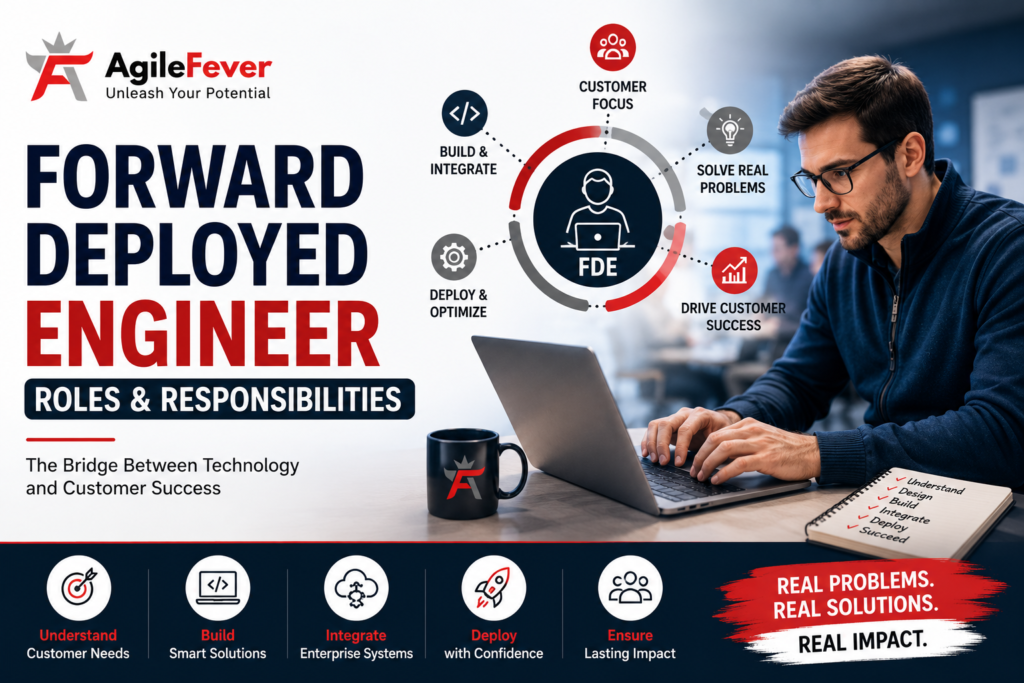
We have discussed what a Forward Deployed Engineer is, and now we will learn more about roles and responsibilities. Imagine your company has just bought an AI platform to automate customer support. The sales demo looked amazing. Everyone was so excited.
A week later, reality kicks in.
The AI cannot connect to your internal CRM. Customer data is stored differently. The approval workflow does not match how your teams work. Security policies block a few integrations. Suddenly, the product that looked perfect in the demo needs a lot of work before anyone can actually use it. I have personally faced this in our organisation.
This is where a Forward Deployed Engineer (FDE) steps in.
They do not just tell the customer what to do. They sit with them, understand how their business works, write code, solve integration problems, and work with the product team until the solution fits the customer’s environment.
That is why FDEs have become one of the most valuable roles in enterprise software and AI companies now.
What Does a Forward Deployed Engineer Do?
A Forward Deployed Engineer is the person who makes sure a product works in the real world, not just in a demo.
Their typical days go like:
- On Monday, they might be writing Python code.
- On Tuesday, they could be discussing requirements with a customer.
- On Wednesday, they are debugging an API integration.
- By Friday, they are giving feedback to the product team because three different customers asked for the same feature.
No two days are the same.
Core Roles and Responsibilities of a Forward Deployed Engineer
| Responsibility | What They Actually Do |
|---|---|
| Understand Customer Requirements | Meet customers, understand how they work, and identify the real business problem. |
| Design the Right Solution | Decide how the product should fit into the customer’s existing systems. |
| Write Code | Build integrations, automation, APIs, scripts, and custom features when needed. |
| Integrate Enterprise Systems | Connect CRMs, ERPs, databases, cloud services, and third-party applications. |
| Deploy AI Solutions | Implement AI models, AI agents, RAG systems, or automation workflows for customers. |
| Test Everything | Make sure the solution works before it goes live. |
| Fix Problems | Debug production issues, integration failures, and performance bottlenecks. |
| Work With Product Teams | Share customer feedback that helps improve the product for everyone. |
| Support Customers | Guide customers during implementation and answer technical questions. |
| Keep Improving | Find better ways to make deployments faster, easier, and more reliable. |
What Does an FDE Actually Do Every Day?
Let us say you are an FDE working for an enterprise AI company.
Your day might look something like this.
- 9:00 AM: Join a customer call. The customer explains they are trying to automate invoice processing using AI, but their ERP system isn’t sending the right data. You ask questions, understand their workflow, and identify where the problem starts.
- 11:00 AM: Open your laptop. Write a small API integration to connect the ERP system with the AI platform. Test the data flow. Fix a couple of bugs.
- 2:00 PM: Speak with your product team. You realize three different customers have requested the same feature. Instead of building custom code every time, the product team decides to add it to the platform.
- 4:00 PM: Deploy the updated solution. Run a few tests. The customer is finally able to process invoices automatically. Tomorrow you will probably be working on a completely different industry. That is what makes this role exciting.
Skills You Need to Handle These Responsibilities
Being a good FDE is not just about coding. You need a mix of technical and people skills.
Technical Skills
- Programming (Python, Java, JavaScript)
- APIs
- SQL
- Cloud platforms
- Docker
- Git
- System integrations
- REST APIs
- Debugging
Checkout the FDE Roadmap here.
Business Skills
Customers usually do not explain problems in technical terms. They will say things like,
“Our approval process takes three days.” Your job is to figure out what is happening behind the scenes and build a solution.
That is why understanding business processes is just as important as writing code.
Communication Skills
An FDE talks to many different people.
- Developers
- Product Managers
- Customers
- Solution Architects
- Business Leaders
You need to explain technical ideas without making people feel lost.
AI Skills
A few years ago, knowing APIs and cloud platforms was enough. Today, many companies expect FDEs to understand AI too. Some useful skills include:
- Large Language Models (LLMs)
- AI Agents
- Retrieval-Augmented Generation (RAG)
- Prompt Engineering
- MCP (Model Context Protocol)
- AI Workflows
- Enterprise AI Integration
If you are planning to work with modern enterprise software, these skills are becoming harder to ignore.
Want to build these skills? AgileFever’s Generative AI and Agentic AI Bootcamp teaches you how to build AI agents, RAG applications, enterprise AI workflows, and real-world AI solutions that companies are actively deploying with 10+ hands-on projects, capstones and completely live.
Challenges Every Forward Deployed Engineer Faces
Every customer is different, so are their requirements.
For example, one customer uses Azure, another uses AWS, and someone is still running software that was built 15 years ago.
And the biggest challenge is that you need to make everything work together.
Some common challenges are:
- Legacy systems
- Missing documentation
- Security restrictions
- Tight deadlines
- Changing customer requirements
- Performance issues
- AI model limitations
- Data quality problems
That is why problem-solving is probably the most important skill an FDE can have.
Which Industries Hire Forward Deployed Engineers?
You will mostly find this role in companies that build complex software.
Some examples are:
- Artificial Intelligence
- SaaS
- Cloud Computing
- Cybersecurity
- Financial Services
- Healthcare
- Manufacturing
- Government Technology
As more companies adopt AI, the demand for FDEs is growing beyond traditional enterprise software.
Where Can This Role Take You?
Many FDEs do not stay in the same role forever.
After gaining experience, they often move into positions like:
- AI Engineer
- Solution Architect
- Technical Lead
- Product Manager
- Enterprise Architect
- Customer Engineering Manager
If you enjoy solving technical problems and working directly with customers, this career opens a lot of doors.
If you are interested in designing enterprise-scale AI solutions rather than just implementing them, AgileFever’s GenAI & Agentic AI for Solution Architects program is a natural next step.
Frequently Asked Questions
Is a Forward Deployed Engineer mostly a developer?
No. Coding is a big part of the job, but you’ll also spend time talking to customers, designing solutions, troubleshooting issues, and working with product teams.
Do Forward Deployed Engineers write production code?
Yes. Depending on the company, FDEs often write production-ready integrations, APIs, automation scripts, and deployment tools.
Is this role customer-facing?
Very much. You will regularly work with customers to understand their requirements and help them succeed with the product.
Do I need AI skills to become an FDE?
Not always. But more companies are building AI products, so understanding AI agents, LLMs, and enterprise AI deployments will give you an advantage.