



































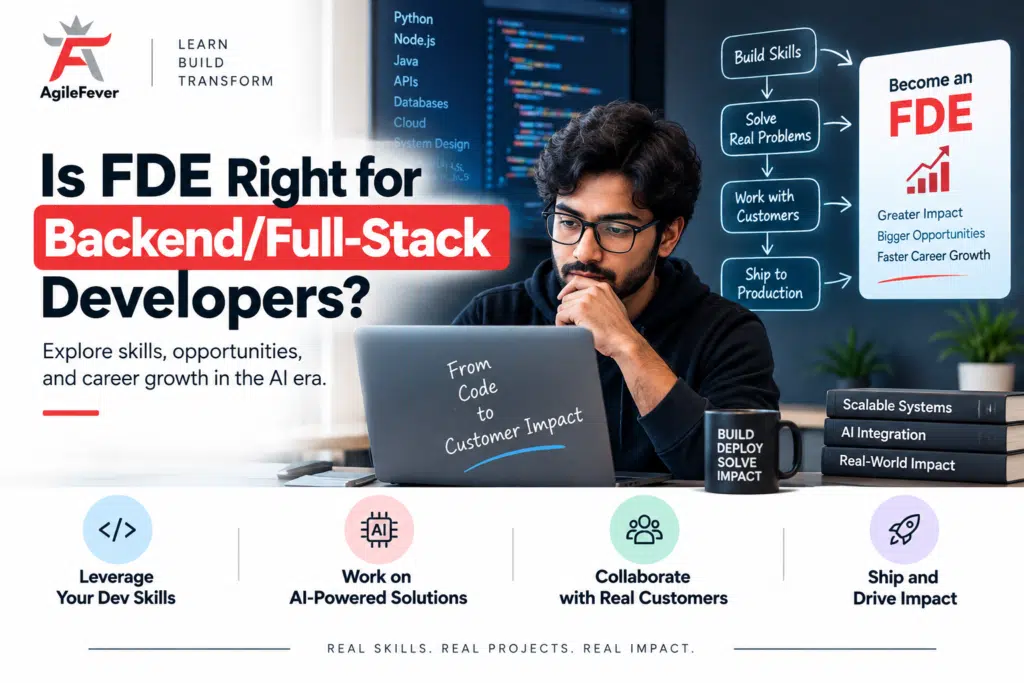
You have shipped backend services for a few years. You know your way around REST APIs, you have debugged a production incident at 2 am, and you’ve probably built at least one integration that had to survive contact with someone else’s messy system. Then a recruiter messages you about a “Forward Deployed Engineer” role, the pay band looks better than what you’re making now, and you are not sure if you are actually qualified or if the title is just AI hype wearing a new badge.
Short answer: if you’re a backend or full-stack developer with a couple of years of production experience, you’re closer to FDE-ready than most job postings make it sound. The gap isn’t your engineering. It’s everything that happens around the engineering.
What you already bring to the table
Forward Deployed Engineers spend their days doing things that will feel familiar if you’ve built backend systems for real users:
- Working with APIs, authentication, and data flows between systems that weren’t designed to talk to each other
- Debugging something that broke in production, with incomplete information and someone waiting on an answer
- Reading someone else’s codebase or architecture and figuring out why it behaves the way it does
- Making tradeoffs between “the correct fix” and “the fix that ships by Friday”
A full-stack developer has an extra edge here: you can put a working interface in front of a business stakeholder without waiting on a frontend team, which matters a lot in a role where “show them something they can click” often does more than a slide deck. A backend-only developer isn’t at a disadvantage exactly, but you’ll want to get comfortable enough with basic UI work that you’re not blocked when a client wants to see something visual.
None of this is nothing. It’s most of the job’s technical foundation.
Where the actual gap is
The part that doesn’t show up in a typical backend role is the client. Not “the product team” or “the users,” but an external company that bought a product and is now sitting across from you, expecting you to make it work inside their environment, on their timeline.
Requirements that arrive vague, and stay vague
Internal tickets usually come with acceptance criteria someone already thought through. Client requirements often arrive as “we need this to work with our system” without much detail on what “work” means, what “our system” actually is, or who has to sign off. An FDE has to ask the right questions in the room, sometimes in front of a VP who doesn’t have patience for a long discovery process, and turn a vague ask into something scoped enough to build.
Environments you don’t control
As a backend developer, you likely have real authority over your stack: the framework, the database, the deployment pipeline. An FDE inherits whatever the client already runs, often a mix of legacy systems, specific compliance requirements, and an IT team that’s protective of access for good reason. You’re building inside constraints you didn’t choose and usually can’t change.
Explaining tradeoffs to people who don’t code
Telling your tech lead “we should use a message queue here instead of synchronous calls” is a different conversation than telling a non-technical client stakeholder why their timeline needs to move by two weeks. The second version has to work without any of the technical vocabulary doing the persuading.
The relationship doesn’t end at deployment
Ship a feature internally and you move to the next ticket. Ship a system for a client and you’re still accountable for whether it keeps working, whether the client trusts your company enough to keep buying, and whether the next deployment cycle goes any smoother than this one did.
A quick self-check
| Area | What most backend/full-stack devs already have | What the FDE role adds on top |
|---|---|---|
| Technical depth | APIs, databases, deployment, debugging production systems | Enterprise integration patterns (SSO, RBAC, legacy system quirks), usually learned on the job or in a targeted course |
| Problem framing | Tickets with defined acceptance criteria | Ambiguous business requirements you have to scope yourself, live, in front of the client |
| Stakeholder conversations | Standups, PR reviews, maybe a product manager | Discovery calls and status updates with people who evaluate you on clarity, not code quality |
| Ownership window | Until the ticket closes | Until the client’s team trusts the system, which can be months after go-live |
| Environment control | High, usually your own team’s stack | Low, you work inside whatever the client already has |
If most of the right column feels unfamiliar but not intimidating, that’s a normal starting point. If the idea of sitting in front of a client and improvising a scope conversation sounds actively unpleasant, that’s worth taking seriously before you chase the title. Forward Deployed Engineer vs Software Engineer goes deeper into that specific tradeoff if you’re still deciding.
Backend-only vs full-stack: does it matter which one you are?
It matters less than the title suggests. A backend developer with strong API and integration skills and a full-stack developer with the same background will both close the gap through the same things: client exposure and enterprise integration practice, not more backend depth. Where full-stack helps is speed of demoing. Where backend-only can be a limitation is if you’ve never had to present anything you built to someone who isn’t an engineer. That’s a fixable skill, not a permanent ceiling, but it’s worth practicing before it’s the thing standing between you and an offer.
How to actually close the gap
The fastest way to find out if this fits is not by reading another article; it is by building one thing that proves it. A few options that work whether or not you pay for a program:
- Build one real integration project that connects to an actual third-party system (a CRM API, a ticketing platform, an SSO provider) and deploy it somewhere you can walk someone through, not just run it locally.
- Practice explaining a technical decision to a non-technical audience, out loud, before you need to do it in an interview. Recording yourself explaining a project to “a client” who’s never seen your code is a cheap, uncomfortable, effective drill.
- Read up on the enterprise integration patterns you likely haven’t touched: OAuth flows, webhooks, RBAC, audit logging. Top Forward Deployed Engineer Skills You Need in 2026 lays out the specific list.
- If you want structured practice with real client-style constraints rather than assembling it yourself, AgileFever’s AI Forward Deployed Engineer Bootcamp is built specifically around this gap: enterprise integrations, governance, and a capstone that has to survive the same questions a real client would ask, on top of the AI-specific curriculum. Forward Deployed Engineer Bootcamp Reviews: Is It Worth It? lays out exactly what to check before paying for any program, including this one.
Who this genuinely isn’t for, at least not yet
If you are newer to engineering and still building comfort with APIs and production systems, an FDE path skips ahead to the client-facing half of the job without the technical depth that makes it sustainable. You would be underprepared for the part of the role that is still, underneath everything, real engineering. Python for AI is a better starting point in that case, with FDE as the next step once the fundamentals are solid.
If your interest in engineering is specifically that it doesn’t require talking to non-technical people, that’s a legitimate preference, not a weakness, and it points toward roles like platform engineering or SRE work instead.
FAQ
Do I need a computer science degree to move into FDE work?
No. What matters is that you can already write production code and work with APIs comfortably. Several people currently doing this work came from solutions engineering, DevOps, or backend development rather than a formal CS or ML background.
Is full-stack experience required, or is backend-only enough?
Backend-only is enough technically. Full-stack experience makes it easier to build something demoable quickly, which helps in client conversations, but it’s not a requirement for the role itself.
How long does it typically take a backend developer to become client-ready?
That depends more on how much client exposure you get than on calendar time. Some developers pick up the discovery and stakeholder side within a few months of real practice; others take longer if they haven’t had a reason to present technical decisions to non-technical people before. Structured practice, whether through a bootcamp or a self-directed project with real stakeholders, shortens that timeline more than passive reading does.
What’s the pay difference actually like?
FDE roles tend to price above general backend roles because the client-facing half of the job is the rarer skill, not because the engineering is harder. Forward Deployed Engineer Salary Guide (India, USA & Global) has the current numbers by market and seniority.
What’s next
If the self-check above pointed toward “yes, this fits,” How to Become a Forward Deployed Engineer: Step-by-Step Roadmap lays out the practical path from where you are now. If you’re still comparing this against other roles you could move into, Forward Deployed Engineer vs Solution Architect and Forward Deployed Engineer vs DevOps Engineer cover the two comparisons backend developers ask about most.