







































Both jobs sit at the point where software meets the messy reality of production. Both get pulled in when something that worked perfectly in a demo doesn’t work in the real environment. That overlap is exactly why the two titles get confused, and it’s worth untangling properly if you are trying to decide which direction to point your career, because the day-to-day work, the pace, and the definition of success are genuinely different.
Here is the short version before we go in the detail, since the two roles get flattened into “basically the same job” more often than they should:
| DevOps Engineer | Forward Deployed Engineer | |
|---|---|---|
| Answers to | Own engineering leadership | External client stakeholders |
| Controls the environment? | Yes, designed it | No, inherits whatever the client already runs |
| Primary metric | Deployment frequency, uptime, MTTR | Client go-live success, retained account |
| Work pattern | Deep on one system, over years | Wide across different client stacks, project by project |
| Client-facing time | Low to none | High, regularly presenting to non-technical stakeholders |
| Typical employer | SaaS companies, internal platform teams | AI/enterprise software vendors selling into large clients |
The table is a starting point, not the decision. The reasoning behind each row is where the actual differences live.
Start with who each person is accountable to
This is the fastest way to tell the roles apart, and it’s the distinction most comparisons skip.
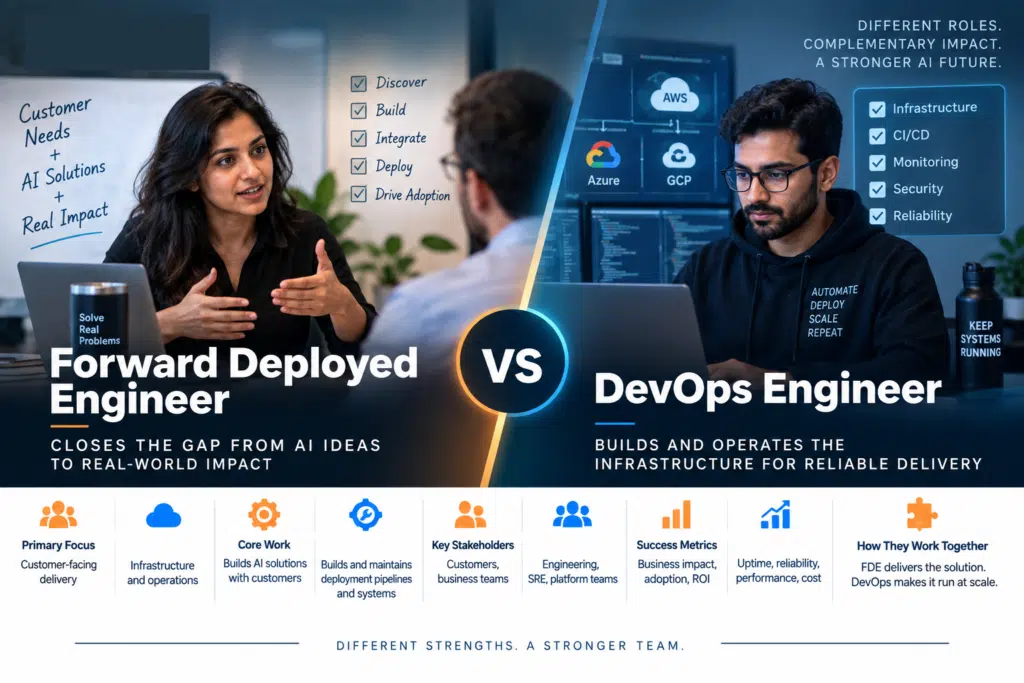
A DevOps Engineer at a SaaS company answers to their own engineering leadership. Their “customer” is the internal development team, and their job is measured against internal metrics: deployment frequency, mean time to recovery, uptime, how often a bad release makes it to production. They control the environment. They picked the cloud provider, they designed the CI/CD pipeline, they set the standards everyone else follows.
A Forward Deployed Engineer answers to a client. Not their own company’s engineering org, but an external organization that bought a product and needs it working inside their specific environment, on their timeline, under their security policy. The FDE doesn’t control that environment. Every client has a different stack, a different legacy system that “just needs to stay working,” a different procurement and compliance process. The job is to make a product built somewhere else function inside that mess, often while sitting in meetings with the client’s own engineers and explaining tradeoffs in language a non-technical stakeholder can act on.
That single difference in internal accountability versus client accountability explains almost everything else that separates the two roles.
What a typical week actually looks like
A DevOps engineer’s week is shaped by their own release calendar. Reviewing infrastructure-as-code changes, tuning alerting thresholds so the on-call rotation isn’t getting paged for noise, running a postmortem on last week’s incident, maybe migrating a service to a new orchestration setup. The work compounds. The pipeline you build in March is still running in October, and you’re the one who knows why it’s built that way.
An FDE’s week is shaped by whichever client relationship is active. That might mean a discovery call Monday to understand a new client’s data architecture, a Tuesday spent figuring out why the client’s SSO setup won’t authenticate against your product, a Wednesday presenting a revised deployment timeline to a client stakeholder who wasn’t in the room when the original scope was agreed. The work doesn’t compound the same way. You might not touch that client’s environment again for months, and the next one will look nothing like it.
Neither pattern is objectively better. They reward different temperaments.
Where the skill sets genuinely overlap
Both roles need real infrastructure fluency: cloud platforms, containers, networking fundamentals, security basics, the ability to read a system you didn’t build and figure out why it’s misbehaving under load. Both get called into production fires outside business hours. Both need to communicate technical risk clearly, even if the audience differs: a DevOps engineer explaining risk to their own VP of Engineering, an FDE explaining the same category of risk to a client’s IT director who has no reason to trust them yet.
This overlap is exactly why companies without a clean org chart use the titles loosely, and why job postings sometimes blur the two. If you’re genuinely strong at operational engineering, you could plausibly succeed at either, which makes the decision less about raw capability and more about which environment and which kind of accountability you’d rather live with.
A concrete example: the same production issue, two different jobs
Imagine a critical service starts throwing errors at 9pm.
If you are the DevOps engineer, you’re paged, you pull up the dashboards your team built, you already know the architecture because you designed it, and you’re debugging a system you have full context on and full authority to change. The incident is resolved when the service is stable and the postmortem identifies a fix your own team will implement.
If you’re the FDE, the equivalent situation is a client calling to say their deployment broke after their internal team pushed an unrelated change to a system next to yours: one you don’t own, can’t see the internals of, and can only access through whatever permissions the client granted. You’re debugging blind, in someone else’s house, while also managing a stakeholder relationship that gets more strained by the hour. The incident is resolved when the client’s system works and the client still trusts your company to keep deploying with them.
Same instinct (stay calm, isolate the problem, fix it under pressure), completely different working conditions. Laid out step by step, the gap is even clearer:
| Step | DevOps Engineer | Forward Deployed Engineer |
|---|---|---|
| Alert arrives | Paged directly, on-call rotation | Client calls or opens a support ticket |
| System knowledge | Built it, knows the architecture | Inherited it, has to learn the relevant pieces fast |
| Access level | Full authority to change anything | Limited to whatever permissions the client granted |
| Who’s in the room | Own team, internal Slack channel | Client’s engineers and often a client stakeholder |
| “Resolved” means | Service is stable, postmortem filed internally | System works and the client still trusts the relationship |
The question that actually decides which path fits you
It comes down to whether you’d rather go deep on one environment or wide across many. DevOps rewards depth: knowing one company’s infrastructure cold, tuning it over years, being the person who can diagnose a production incident fast because you built the alerting and the runbooks yourself. FDE rewards range: walking into an unfamiliar client’s stack every few months, learning it fast enough to be useful within days, and being comfortable presenting a technical plan to people who don’t care about your Kubernetes configuration. They care whether their team can use the product by next quarter.
If sitting across from a client and translating technical tradeoffs into a decision they can act on sounds like the interesting part of the job rather than the tedious part, FDE is the better fit. If you’d rather the client-facing conversations happened without you in the room, if the appeal of engineering is precisely that it’s insulated from that, DevOps, or a platform engineering role, will make you happier on a Tuesday afternoon in month eighteen, not just in the interview.
How the titles actually vary by company
The confusion isn’t purely conceptual. It’s also a naming problem, and it helps to know that going into a job search. At companies like Palantir, which popularized the “Forward Deployed Engineer” title, and at enterprise AI vendors that have adopted the same model, FDE is a distinct, well-defined track with its own hiring process, separate from DevOps or SRE roles entirely. At smaller AI or SaaS startups selling into enterprise clients, you’ll often see the same responsibilities under titles like “Deployment Engineer,” “Implementation Engineer,” or “Solutions Engineer.” The DevOps-vs-FDE line hasn’t been drawn as a formal org boundary yet, so the job description is the only reliable signal, not the title.
DevOps titling is more standardized by comparison, partly because the role has existed longer and partly because it maps cleanly onto internal team structures. Platform Engineering, SRE, and DevOps often sit under the same umbrella with clearly differentiated scopes. If a job posting uses “DevOps Engineer” but the responsibilities section is full of client meetings, discovery calls, and deployment timelines set by external customers, read the responsibilities over the title every time. Titles lag behind how companies actually organize this work, especially at companies still figuring out their AI delivery model.
A rough map of what you’ll actually find on job boards:
| Company type | Common title for FDE-shaped work | Common title for DevOps-shaped work |
|---|---|---|
| Large enterprise AI vendor (Palantir-style) | Forward Deployed Engineer | Site Reliability Engineer |
| Mid-size B2B SaaS | Solutions Engineer, Implementation Engineer | DevOps Engineer, Platform Engineer |
| Early-stage AI startup | Deployment Engineer, Founding Engineer (client-facing) | DevOps often folded into a generalist “Backend Engineer” title |
Use this as a filter for reading postings, not as a rule. The responsibilities section always overrides the title.
They are not two paths to the same destination
Because the skills overlap, it’s tempting to treat these as interchangeable career tracks with different names. They’re not. A company hires a DevOps engineer to keep its own systems reliable. It hires an FDE to get its product working inside someone else’s business, which is a delivery-and-relationship job that happens to require serious engineering ability, not an engineering job with occasional client contact attached. Confusing the two going into an interview is a fast way to sound like you don’t understand the role you’re applying for.
If you are trying to decide which one to apply for right now
Look at your last two years of work, not your job title. If most of your satisfying moments came from making an internal system more reliable (cutting deploy time, killing a recurring incident for good, building a dashboard your team actually uses), that instinct points toward DevOps or platform engineering, and an FDE role will likely feel like a distraction from the parts of the job you’re good at. If your best moments came from a client meeting going better than expected, from translating a technical constraint into something a non-technical stakeholder could finally act on, that instinct points toward FDE, and a pure DevOps role may end up feeling isolating regardless of how technically interesting the infrastructure is.
Neither answer is a downgrade from the other. They’re different jobs wearing similar-sounding titles, and the market currently pays well for both. The FDE premium exists specifically because the client-facing half is rarer, not because the engineering half is harder.
If FDE work sounds like the closer fit after reading this, Forward Deployed Engineer Course: The Complete Guide is the right next read, and How to Become a Forward Deployed Engineer: Step-by-Step Roadmap lays out the practical path from where most engineers are starting. If you’re still weighing FDE against other adjacent roles, Forward Deployed Engineer vs Software Engineer and Forward Deployed Engineer vs Solution Architect cover the other two comparisons people usually make before deciding.