






























You have shipped three GenAI pilots this year. All three impressed the demo audience. None of them is in production. The VP who greenlit the budget is now asking why the “AI roadmap” hasn’t produced anything a customer can touch, and your manager has started using the word “traction” in a tone that isn’t friendly.
That gap, pilot works, but production does not happen is not a you problem. MIT’s 2025 “State of AI in Business” research found that 95% of generative AI pilots fail to deliver a measurable return. The pattern shows up at almost every company running a GenAI initiative: strong prototypes, no reliable path to a system a customer can actually run.
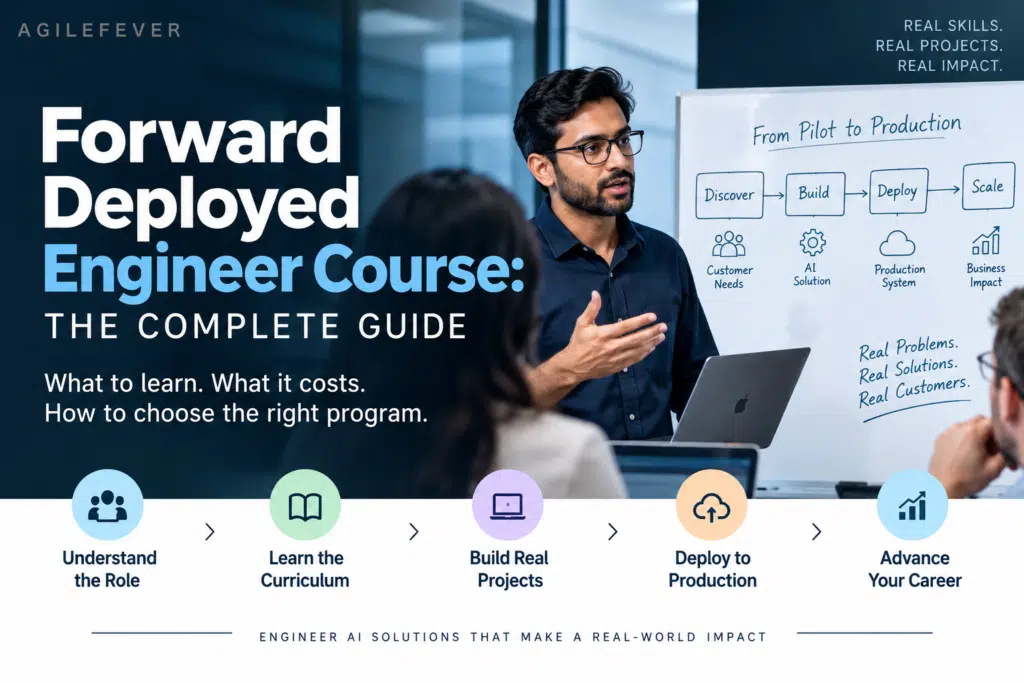
The people who close that gap are being hired under a specific title: Forward Deployed Engineer. If you are evaluating a Forward Deployed Engineer course because you want to be one of them, or because your company needs someone who can turn a pilot into a shipped system, this guide covers what the role actually requires, what a course should teach to prepare you for it, and how to tell a program built around real delivery work from one built around a certificate.
What a Forward Deployed Engineer course actually needs to teach
“Forward Deployed Engineer” started as an internal title at Palantir for engineers embedded directly with customers to build and ship solutions on-site. The title has since spread across the AI hiring market because the job it describes (sit with a customer, understand the actual business problem, build the system, get it into production, stay accountable for whether it works) is exactly the skill gap the MIT research points to.
That means a course preparing you for this role has to cover more ground than a typical “AI engineering” bootcamp. Three things separate an FDE course from a general LLM or prompt engineering course:
- It ends in deployment, not a notebook: A Jupyter notebook that calls an LLM API is not a Forward Deployed Engineer skill. Cloud deployment, monitoring, and integration with the systems a customer already runs (Salesforce, ServiceNow, SharePoint, Slack) are the parts of the job that separate a pilot from a shipped product, and the parts most AI courses skip.
- It teaches the business conversation, not just the technical one: FDEs sit in discovery calls, scope what’s actually buildable, and explain ROI to people who don’t care about your model architecture. A course that never puts you in front of a business requirement isn’t preparing you for the job title it’s selling.
- It uses real enterprise constraints: Role-based access control, audit logging, and governance aren’t optional extras once a system touches real customer data. They’re why most pilots stall at the security review. If a course’s capstone never has to survive one, it’s not testing the skill the job actually needs.
AgileFever’s AI Forward Deployed Engineer Bootcamp was built around this list rather than around what’s easy to teach in a video. Here’s what that looks like as an actual curriculum.
Curriculum breakdown: the 90 hours, module by module
The program runs 80 hours of live, practitioner-led instruction plus 10 hours of self-paced work, delivered over 10 weeks. That is a deliberate ratio: enough live time to work through real scoping and architecture decisions with an instructor, enough self-paced time to practice the mechanical parts (API syntax, environment setup) on your own so live sessions aren’t spent watching someone install a package.
|
Module |
What it covers |
|
Foundations |
Python for AI work, REST APIs, JSON, calling LLM APIs, environment setup |
|
LLM fundamentals |
How LLMs work, prompt engineering, structured outputs, context management |
|
Retrieval-Augmented Generation |
Embeddings, vector databases, chunking, retrieval pipelines, a working RAG app |
|
AI agents |
Agent loops, function/tool calling, MCP, memory, single-agent builds |
|
Multi-agent systems |
LangGraph, CrewAI, orchestration patterns, agent-to-agent workflows |
|
Evaluation and reliability |
Evals, guardrails, error handling, testing agent behavior, cost and latency optimization |
|
Cloud deployment |
Docker, CI/CD, AWS/Azure/GCP deployment, monitoring, logging, observability |
|
Enterprise integration |
Solution architecture and integration patterns (OAuth, webhooks, REST, MCP), hands-on with Microsoft Teams, SharePoint, Salesforce, Jira, ServiceNow, and Slack |
|
Governance |
RBAC, secrets management, audit logging, compliance awareness, AI governance, executive reporting |
|
The FDE role itself |
The enterprise AI delivery lifecycle, ROI framing, discovery calls, requirements gathering |
|
Capstone |
A group capstone spanning BFSI, insurance, healthcare, and retail scenarios: a production build, not a slide deck |
Notice what is absent from most competing courses: modules 8 and 9. Enterprise integration and governance are usually the first things cut when a bootcamp needs to fit into a shorter format, and they’re also the parts of the job a Forward Deployed Engineer spends the most time on once hired. If a course you’re comparing skips straight from “build an agent” to “capstone, ” ask what happened to the deployment and integration weeks.
What you should be able to build by the end
By design, this isn’t a course that ends with one polished demo project. You leave with three separate, deployable systems: a working RAG application, a multi-agent system with real tool integrations, and a capstone built against one of four industry scenarios (BFSI, insurance, healthcare, retail) that has to survive the same architecture and security questions a real client would ask.
That matters for the interview conversation more than a certificate does. When a hiring manager asks “walk me through something you built, ” the honest answer to “was this deployed” should be yes, not “it works locally. ”
Salary and demand data (with sources)
Two numbers are doing the work in every FDE hiring conversation right now, and both are checkable rather than marketing copy:
- Job posting growth: Forward Deployed Engineer postings grew 1,165% year-over-year in the US and 729% in India through 2026, according to hiring-platform data tracked by AgileFever’s curriculum team. Growth at that rate over a short window usually means a title is catching up to demand that already existed under other job titles (solutions engineer, AI implementation engineer). Worth knowing if you’re deciding whether to reposition your resume around it.
- Compensation: Median US base salaries for the role sit at $183K–$210K; in India, reported ranges run 18–90 LPA depending on company stage and prior experience. The wide India range reflects a market still sorting out what experience level the title requires. Early postings at large enterprises price closer to the top of that band, and startups experimenting with the title price lower.
Treat these as directional, not guaranteed outcomes. A course teaching the right skills doesn’t set your offer; your prior experience, the market you’re applying in, and how well you can talk through what you built still do most of that work.
Who this path fits, and who it doesn’t
This works well if you’re already a software engineer, cloud engineer, solutions architect, or consultant who wants to move into enterprise AI delivery, and you’re comfortable being the person in the room explaining a technical tradeoff to someone non-technical. It also fits engineers currently doing AI pilot work who keep hitting the same production wall described at the top of this guide.
It is a weaker fit if you are new to programming. The course assumes you can already work with APIs and write Python comfortably. It spends its live hours on architecture and delivery, not on teaching you to code from zero. If that’s where you’re starting, Python for AI or The AI Blueprint are the right on-ramp first.
If your goal is deep research work on model architecture rather than deployment, an FDE course also isn’t the right target. The role is customer-facing delivery, not model development.
How to evaluate any FDE course before you pay for it
Whether you take AgileFever’s program or someone else’s, ask these questions before enrolling. They’re the same questions this guide used to describe what a real FDE course needs to teach:
- Does it include a cloud deployment module, or does it stop at a working notebook? Ask to see the syllabus, not the sales page.
- Does the capstone integrate with real systems (a CRM, a ticketing system, a messaging platform), or is it a standalone demo?
- Is there a module on governance and security (RBAC, audit logging, compliance)? This is what enterprise reviewers actually gate deployment on.
- Are live instruction hours led by someone who has done FDE-type delivery work, or is the course pre-recorded content with an AI chatbot for support?
- What do you walk away with that you can show in an interview: a GitHub link to a deployed project, or a certificate PDF?
A course that can’t give a straight answer to question 2 or 3 is teaching you to prototype, not to deploy. That’s the exact gap this whole guide started with.
FDE course vs. self-study vs. a general AI certification
|
Structured FDE course |
Self-study (YouTube, docs, side projects) |
General AI/prompt engineering certification |
|
|
Covers cloud deployment |
Yes, dedicated module |
Only if you seek it out separately |
Rarely |
|
Covers enterprise integration (CRM, ticketing, SSO) |
Yes, hands-on |
Unlikely (these systems aren’t free to practice on) |
No |
|
Structured FDE course |
Self-study (YouTube, docs, side projects) |
General AI/prompt engineering certification |
|
|
Covers governance/compliance |
Yes |
Rarely covered in tutorials |
Rarely |
|
Structured feedback on real builds |
Yes, from instructors |
None unless you find a mentor |
Limited |
|
Time to competence |
10 weeks, defined |
Open-ended, self paced |
Days to weeks, narrower scope |
|
Portfolio output |
3 deployed systems |
Depends entirely on your discipline |
Usually one exercise, not deployed |
Self-study is a legitimate path if you already have production deployment experience and just need the LLM-specific pieces: retrieval, agents, evals. Where it tends to fall short is the enterprise integration and governance work, since those need systems (a real ServiceNow instance, a real SSO setup) that are hard to practice against without a job that already has them.
FAQ
What’s the difference between a Forward Deployed Engineer and an AI engineer?
An AI engineer typically focuses on building and improving models or AI-powered features. A Forward Deployed Engineer takes those capabilities and deploys them against a specific customer’s environment and business problem. The job leans more toward solution architecture, integration, and delivery than model work. If you want the fuller comparison, AgileFever’s guide on FDE vs. AI Engineer breaks down the day-to-day differences in more depth.
Do I need a computer science degree to take an FDE course?
No. What matters is that you can already write Python and work with APIs comfortably. Several current FDE hires come from solutions engineering, DevOps, or backend development rather than traditional ML backgrounds.
Is the AgileFever program self-paced or live?
Mostly live: 80 hours of live, instructor- led sessions plus 10 hours you complete on your own, across 10 weeks. The self-paced hours cover setup and mechanical work so live sessions stay focused on architecture and delivery decisions.
What will I actually walk away with?
Three built systems: a RAG application, a multi- agent system with real integrations, and an industry-specific capstone, plus a course completion certificate. The systems are the part worth putting on GitHub and talking through in interviews.
How much does it cost?
Current pricing and EMI options are listed on the AI Forward Deployed Engineer Bootcamp page, since these change periodically.
What’s next
If you’ve read this far because you’re trying to figure out whether FDE is the right career move at all, not just which course to take, start with the pillar guide: Forward Deployed Engineer: Roles, Skills, Salary, Roadmap & Future. It covers the roadmap and interview prep this guide doesn’t.
If you’re specifically comparing FDE to a role you’re already in, read Forward Deployed Engineer vs. AI Engineer next.
Recommended learning path
- New to Python/APIs → Python for AI or The AI Blueprint
- Comfortable with Python, new to LLMs/agents → AI Forward Deployed Engineer Bootcamp (this course)
- Completed the bootcamp, want the certification track → AI Forward Deployed Engineer Accelerator (certification program)
Ready to move from pilots to production? See the full FDE Bootcamp curriculum and upcoming batch dates →