











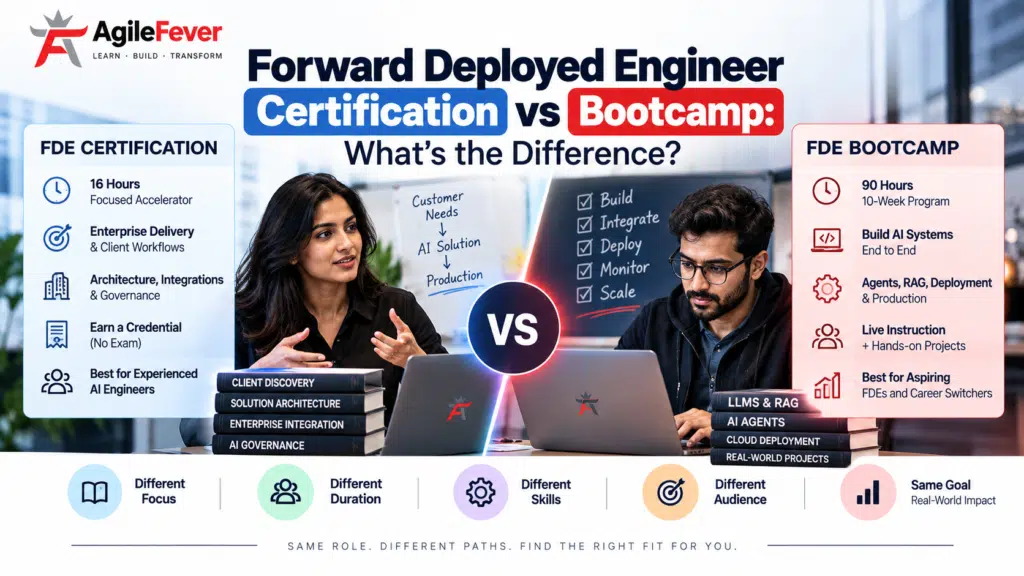
You are on a program page, you like what you see, and then you notice AgileFever (or whoever you are comparing) sells two different things with “Forward Deployed Engineer” in the name: a bootcamp and a certification. They are priced differently, run for different lengths, and the page copy doesn’t always make it obvious which one you actually need. Pick wrong and you either pay for content you didn’t need or skip content you did.
The short version: a bootcamp teaches you to build AI systems. A certification like this teaches you to deliver them. Most people need one or the other, not both at once, and which one depends entirely on what you can already do.
What each one actually is: Certification vs BootCamp
| Bootcamp | Certification | |
|---|---|---|
| Duration | 90 hours (80 live + 10 self-paced) over 10 weeks | 16 hours, live |
| Starting assumption | You may not have built AI systems before | You can already build AI systems (LLMs, RAG, agents) |
| What it teaches | Python, LLM fundamentals, RAG, AI agents, multi-agent systems, evaluation, cloud deployment, enterprise integration, governance | Enterprise discovery, stakeholder engagement, solution architecture, governance, delivering AI from discovery to adoption |
| Evaluation | No exam; capstone across a BFSI, insurance, healthcare, or retail scenario | No exam; capstone building an Enterprise AI Digital Workforce agent (HR assistant, IT service desk, etc.) |
| Output | Three deployed systems: a RAG app, a multi-agent build, and the capstone | One capstone plus a completion certificate |
| Who it’s for | Engineers who need the AI-building skills, the delivery skills, or both | Engineers who can already build AI systems and need the delivery and stakeholder layer |
Notice the overlap in the bottom rows of the curriculum comparison: both touch governance and enterprise integration. The difference is depth and starting point, not the topic list. The bootcamp builds that knowledge alongside teaching you to build the AI system in the first place. The certification assumes the AI system part is already there and spends its entire 16 hours on the delivery layer.
The actual decision: what can you already build?
This is the only question that matters, and it’s worth being honest with yourself about it before you compare pricing.
You have never built an LLM-powered system: start with the bootcamp
If you have not built a RAG pipeline, haven’t used an agent framework, and would need to look up what MCP stands for, the certification will lose you in the first hour. It’s 16 hours don’t include time to teach you what an embedding is. That’s covered in the bootcamp’s first few modules, and skipping to the certification without it means you’re evaluated on delivery skills for a system you don’t actually know how to build.
You can already build AI systems, but you’ve never delivered one to a client: the certification is the right size
If you’re comfortable with LLMs, RAG, and agent frameworks, whether from prior work, self-study, or the bootcamp already, but you’ve never had to scope a business requirement, present an architecture to a non-technical stakeholder, or think through access control for something touching real client data, the certification is built specifically for that gap. Paying for 90 hours of content you already know defeats the purpose.
You need both: the bootcamp first, then the certification
This is the path AgileFever’s own program structure assumes. The certification’s prerequisite explicitly recommends finishing the bootcamp (or equivalent experience) first, then coming back for the delivery-focused certification once the technical foundation is solid. Doing them in that order means the 16 certification hours are spent on genuinely new material instead of half being review.
What it costs to do it each way
As of this writing, AgileFever’s bootcamp runs $2,000 (US, sale price) or ₹100,000 (India, sale price), and the certification runs $650 (US, sale price) or ₹35,000 (India, sale price). Pricing and cohort dates change, so check the bootcamp page and certification page directly before enrolling.
Doing both costs more than either alone, obviously, but it’s worth comparing against the alternative: teaching yourself the AI fundamentals from scattered tutorials, then trying to manufacture client-facing practice on your own with no real stakeholder to practice on. That path is free and slower, and it usually skips the delivery practice entirely because there’s no client to simulate it against. Forward Deployed Engineer Bootcamp Reviews: Is It Worth It? and Forward Deployed Engineer Certification: Is It Worth It? each go deeper into that tradeoff for their respective program.
A quick self-test
- Can you explain, without looking it up, the difference between RAG and fine-tuning? If no, start with the bootcamp.
- Have you built and deployed at least one working AI agent or RAG application? If no, start with the bootcamp.
- Have you ever had to explain a technical tradeoff to a non-technical stakeholder and get their sign-off? If no, and you answered yes to the first two, the certification is the gap worth closing.
- Do you already have production delivery experience, just not on AI-specific projects? The certification is likely enough on its own, without the full bootcamp.
One thing neither program replaces
Whichever one you pick, neither is a substitute for actually building something and showing it to someone. A certification confirms you completed a structured program. A hiring manager still wants to see the capstone, walk through your architecture decisions, and hear you explain a tradeoff out loud. Treat the credential as evidence that supports a real project, not as the deliverable itself.
FAQ
Can I skip the bootcamp and go straight to the certification?
Only if you already have the equivalent AI-building experience elsewhere. The certification’s prerequisite is knowledge, not a specific course, so relevant work experience or self-study can substitute for the bootcamp itself.
Is the certification a shorter version of the bootcamp?
No. It’s not a condensed rerun of the bootcamp’s content. It covers different material almost entirely: stakeholder engagement, enterprise architecture, and governance, assuming the AI-building skills are already in place.
Which one looks better on a resume?
Neither replaces a deployed project in an interview conversation. The bootcamp gives you three systems to talk through; the certification gives you one plus direct evidence you can handle the delivery side. Which matters more depends on what the role you’re applying for actually tests for, which is usually visible in the job description’s responsibilities section.
Do I need to do both to get hired as an FDE?
No single credential guarantees a hire. What tends to matter is whether you can demonstrate both halves of the job, building the system and delivering it to a client, in some form. Whether that comes from one program, both, or a mix of a program and real work experience is less important than being able to show it.
What’s next
If you’re still deciding whether you have the AI foundation the certification assumes, AI Skills Every Forward Deployed Engineer Should Learn in 2026 is a fast way to check. If you’re confident on the fundamentals and want the full breakdown of what the certification actually requires, read Forward Deployed Engineer Certification Requirements: Skills & Experience You Need next.