

















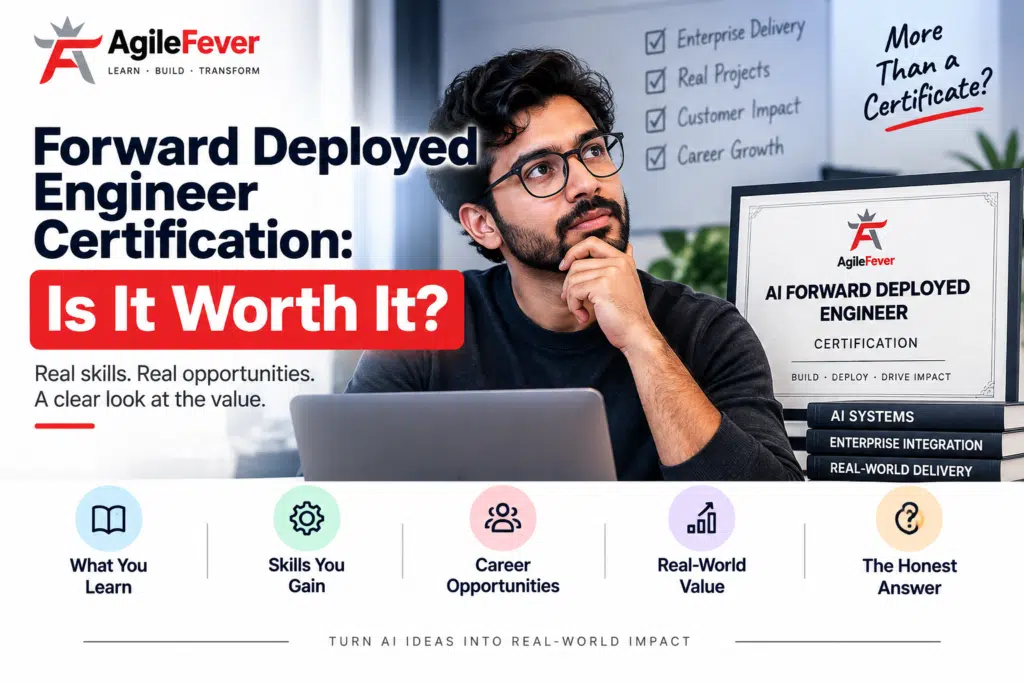
Last reviewed: September 2026. Disclosure: AgileFever runs its own AI Forward Deployed Engineer Accelerator certification, so weigh anything below accordingly. The evaluation questions are written to work for any certification you’re considering, not just ours.
You’ve already read that certifications alone don’t make you an FDE. Fair enough. But that leaves an open question if you’re staring at a specific FDE certification and a price tag: does this particular one actually do anything for you, or is it 16 hours and a few hundred dollars for a PDF you’ll link on LinkedIn once?
The honest answer depends on what you’re missing right now, not on how good the marketing page looks.
What an FDE certification is actually for
A certification like this isn’t trying to teach you to code. It’s trying to compress the business and delivery side of the role, the part that’s hardest to pick up on your own because it requires practicing in front of stakeholders, into a short, structured format. AgileFever’s Accelerator, for example, runs 16 hours live, has no exam, and evaluates you through a capstone: an Enterprise AI Digital Workforce build (an HR assistant, IT service desk agent, or similar) that has to hold up the way a real client engagement would.
That’s a narrower promise than a bootcamp makes, and it should be. A certification like this assumes you can already build AI systems and is teaching you to deliver them, not teaching you AI from zero.
The four questions worth asking before you pay for any FDE certification
1. What does it assume you already know?
This is the one people skip. If a certification’s curriculum is 80% AI fundamentals and 20% delivery, it’s really an AI course with a delivery label. AgileFever’s certification explicitly recommends finishing a foundational AI program first (its own bootcamp, or equivalent experience with LLMs, RAG, and AI agents) precisely because the 16 hours are spent on stakeholder engagement, enterprise architecture, and governance, not on teaching prompt engineering. If you enroll without that foundation, you’ll spend the certification catching up instead of practicing the thing it’s actually meant to teach.
2. Is there a real evaluation, or just attendance?
Check whether “certified” means you showed up, or whether you had to build and defend something. A capstone that a reviewer actually has to sign off on is a meaningfully different signal than a certificate that’s issued automatically after the last session. AgileFever’s version requires a completed capstone project before you receive the completion certificate, no exam, but also no free pass for attendance alone.
3. What does it cost relative to what it replaces?
As of this writing, AgileFever’s certification runs $650 (down from $850) for US-based cohorts and ₹35,000 (down from ₹50,000) for India-based cohorts, for a 16-hour live program. Pricing and cohort dates shift over time, so check the certification page for current numbers before you enroll anywhere. The number that actually matters isn’t the sticker price in isolation, it’s whether 16 focused hours with feedback would take you longer to piece together yourself from documentation, YouTube, and trial and error, and whether that self-taught version would include anything resembling stakeholder practice at all.
4. Does it target a transition you’re actually trying to make?
A certification built around specific role transitions is a better signal than one built around a generic “AI professional” label. AgileFever frames its outcomes this way:
| Starting role | Target outcome |
|---|---|
| AI Engineer | Forward Deployed Engineer |
| Software Engineer | Enterprise AI Delivery Lead |
| Solution Architect | AI Solution Architect |
| Technical Consultant | AI Implementation Consultant |
| Cloud Engineer | AI Infrastructure & Integration Engineer |
| Technical Project Manager | AI Delivery Manager |
If your starting point isn’t roughly one of these, the curriculum may not be built with your gap in mind, whichever certification you’re looking at. Match the transition, not just the job title.
Certification vs. building it yourself: an honest comparison
| Structured certification | Self-directed (docs, side projects, no credential) | |
|---|---|---|
| Time to complete | 16 hours, fixed schedule | Open-ended, depends on your discipline |
| Stakeholder/discovery practice | Built into the format, with feedback | Only if you find real client-style scenarios to practice on, which is hard without a job that has them |
| Governance & enterprise architecture coverage | Explicit module, taught directly | Rarely covered in tutorials; usually learned the hard way, on the job |
| Cost | A few hundred dollars (varies by program) | Free, aside from your time |
| What you can show a hiring manager | A capstone project plus a completion credential | Whatever you built, if you built and deployed something real |
The self-directed path isn’t a worse path. It’s a slower and less certain one, mainly because the stakeholder-facing practice is genuinely hard to simulate without either a paying client or a structured program built to fake one convincingly. If you already have real client or stakeholder exposure from your current job, a certification is buying you less than this table suggests, since you’re not missing the part it’s built to teach.
When it’s worth paying for
It’s worth it if you can already build AI systems (or general software systems, with a foundation in LLMs and agents) but have never had to scope a business requirement, present an architecture to a non-technical stakeholder, or think through governance and access control for something touching real data. That combination of gaps is common, and it’s exactly what a short, evaluation-based certification is designed to close in a defined window instead of an open-ended one.
It’s also worth it if you’re making a specific, named transition, like Solution Architect to AI Solution Architect, and want a credential plus a capstone that demonstrates the AI-specific piece of that shift to a hiring manager who’s skimming resumes.
When it isn’t
If you’re already doing client-facing delivery work in your current role and just need the AI-specific vocabulary, a shorter, cheaper resource (or the AI-focused sections of a broader course) probably closes that gap without the full certification price. And if you haven’t built anything with LLMs or agents yet, a certification focused on delivery skills is the wrong first purchase. Start with the underlying AI skills, then come back to the delivery layer once you have something to deliver.
If you’re mainly trying to decide between paying for something structured at all versus building a portfolio piece on your own, Forward Deployed Engineer Bootcamp Reviews: Is It Worth It? walks through that broader tradeoff in more depth, including when a paid program of any kind isn’t the right next step.
FAQ
Is there an exam for the AgileFever certification?
No. Completion is based on finishing the live sessions and delivering the capstone project, not a written or timed exam.
Do I need to finish a bootcamp before this certification?
It’s recommended, not strictly required. The 16 hours assume you’re already comfortable with Python, prompt engineering, LLMs, RAG, AI agents, and multi-agent systems, since the certification builds on that foundation rather than teaching it.
What do I actually walk away with?
A completed Enterprise AI Digital Workforce capstone (an HR assistant, IT service desk agent, or similar build) and a course completion certificate. The capstone is the part worth putting in front of a hiring manager; the certificate supports it, it doesn’t replace it.
How is this different from a general AI certification?
Most general AI certifications focus on model or prompt knowledge. This one assumes that knowledge exists already and focuses on stakeholder engagement, enterprise architecture, governance, and delivery, the parts of the FDE job that a general AI credential doesn’t touch.
What’s next
If you’re not sure whether you have the AI foundation this certification assumes, AI Skills Every Forward Deployed Engineer Should Learn in 2026 is a good gut check before you enroll in anything. If you’ve already decided the delivery gap is real but want to compare this specific format against a full bootcamp first, read Forward Deployed Engineer Course: The Complete Guide alongside this page before choosing between them.