




























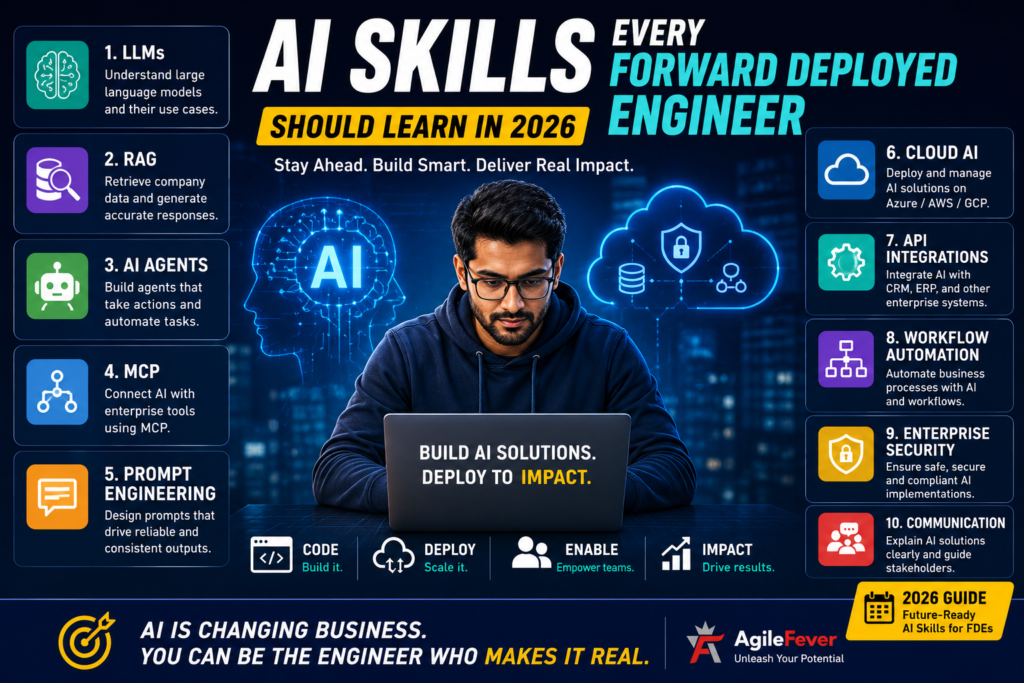
The Forward Deployed Engineers are expected to do much more than deploy software. As organizations adopt Generative AI, companies increasingly look for engineers who understand AI Agents, Retrieval-Augmented Generation (RAG), Large Language Models (LLMs), Model Context Protocol (MCP), cloud AI services, APIs, and workflow automation.
You don’t need to become a machine learning researcher. But understanding how enterprise AI systems are built and deployed is quickly becoming one of the most valuable skills for an FDE. Forward Deployed Engineer (FDE): The Complete Career Guide for 2026 | Roles, Skills, Salary, Roadmap, AI, Interview and Future
Imagine This…
Five years ago…
A customer asks, “Can you integrate Salesforce with our application?”
Today the same customer asks, “Can you build an AI assistant that searches our company documents, connects to Salesforce, creates support tickets, and answers employee questions securely?”
The job changed, the customer changed, the technology changed; Forward Deployed Engineers are changing too.
Why AI is important for Forward Deployed Engineers
Imagine your customer wants to build an internal AI assistant. The AI itself is only one piece of the solution.
Someone still needs to:
- Connect company databases
- Integrate Microsoft Teams
- Secure employee access
- Deploy cloud infrastructure
- Monitor production
- Train customer teams
That is where FDEs create value.
AI Skills Forward Deployed Engineer Should Learn
1. Large Language Models (LLMs)
LLMs power many modern AI applications.
Examples include:
- GPT
- Claude
- Gemini
- Llama
As an FDE, you don’t need to build these models. You need to understand how businesses use them.
Why it matters
Customers often ask:
- Which model should we use?
- How do we connect it?
- How do we control costs?
- How do we keep company data secure?
Knowing the strengths and limitations of different models helps you guide implementation decisions.
2. Retrieval-Augmented Generation (RAG)
One of the biggest challenges in enterprise AI is ensuring answers come from trusted company data. That is where RAG comes in. Instead of relying only on the model’s training, a RAG system retrieves relevant documents before generating a response.
For example, an employee asking, “What is our travel reimbursement policy?” Instead of guessing, the assistant searches the company’s latest HR documents and answers based on those files.
That is why RAG has become a core building block for enterprise AI.
3. AI Agents
AI assistants answer questions and complete work.
For example, an AI Agent can:
- Read an email
- Search a knowledge base
- Call an API
- Create a support ticket
- Notify a manager
All without manual intervention.
As more organizations automate workflows, understanding AI Agents becomes an important skill for FDEs.
4. Model Context Protocol (MCP)
Modern AI applications rarely work in isolation. They need access to enterprise tools such as:
- CRM systems
- Databases
- Calendars
- Email platforms
- Knowledge bases
Model Context Protocol (MCP) provides a standardized way for AI applications to connect with these external systems. Think of it as a common language that allows AI assistants to work with business software more effectively.
5. Prompt Engineering
Prompt engineering is more than writing clever questions. In enterprise environments, prompts help define:
- AI behavior
- Security boundaries
- Output format
- Business rules
- Customer experience
Good prompts improve reliability. Great system design makes prompts even more effective.
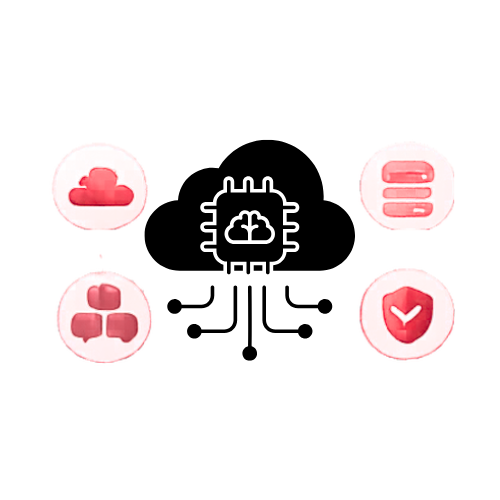
6. Cloud AI Platforms
Most enterprise AI applications run in the cloud. Popular platforms include:
- Microsoft Azure AI
- AWS Bedrock
- Google Vertex AI
As a Forward Deployed Engineer, you should understand:
- Authentication
- Deployment
- Security
- Monitoring
- Cost management
Cloud knowledge makes AI solutions production-ready.
7. API Integrations
AI becomes useful only when it connects with existing business systems.
Common integrations include:
- Salesforce
- SAP
- Microsoft Teams
- Slack
- ServiceNow
- SharePoint
APIs allow AI applications to exchange information with these systems. Without integrations, AI often remains an isolated demo instead of a useful business tool.
8. Workflow Automation
Many AI projects combine intelligence with automation.
For example:
Customer submits a support request.
↓
AI understands the issue.
↓
Creates a ticket.
↓
Assigns the right team.
↓
Sends a confirmation.
↓
Updates the CRM.
Learning workflow automation platforms such as n8n, Power Automate, or similar tools can significantly improve your ability to deliver end-to-end solutions.
9. Enterprise Security
Enterprise customers care about security as much as AI performance.
You will need to understand concepts such as:
- Authentication
- Authorization
- Role-based access control
- Encryption
- Data privacy
- Compliance
A brilliant AI assistant that exposes confidential information won’t succeed in production.
10. Communication
Surprisingly, this remains one of the most valuable AI skills.
Customers don’t just want someone who understands AI.
They want someone who can explain:
- What AI can do
- What AI cannot do
- Expected limitations
- Costs
- Risks
- Implementation roadmap
The ability to communicate technical ideas clearly is often what separates a good FDE from a great one.
Frequently Asked Questions
Do Forward Deployed Engineers need machine learning?
Not necessarily. Most FDEs work with existing AI models rather than building new ones from scratch.
Is prompt engineering enough?
No. Prompt engineering is useful, but enterprise AI also requires integrations, security, cloud platforms, and deployment expertise.
Should I learn RAG before AI Agents?
Yes. RAG helps you understand how enterprise AI retrieves trusted information before you build more advanced AI workflows.
Is AI replacing Forward Deployed Engineers?
No. If anything, AI is increasing the demand for engineers who can successfully implement enterprise AI solutions.
What’s Next?
AI is changing what businesses expect from engineers. Forward Deployed Engineers who understand AI aren’t replacing traditional engineering skills. They are expanding them.
- Programming.
- Cloud.
- Enterprise systems.
- Customer communication.
Now AI. Together, these skills prepare you to build and deploy the next generation of enterprise applications.
Recommended Learning Paths
If you are ready to build practical AI implementation skills, these AgileFever programs can help:
- GenAI and Agentic AI Bootcamp – Build AI agents, RAG systems, MCP integrations, and enterprise AI applications through hands-on projects.
- Enterprise AI Agents on Azure – Learn to deploy secure AI solutions using Microsoft Azure.
- GenAI & Agentic AI for Solution Architects – Understand enterprise AI architecture and design patterns.
- Python for AI – Strengthen your programming skills with practical AI-focused projects.