

















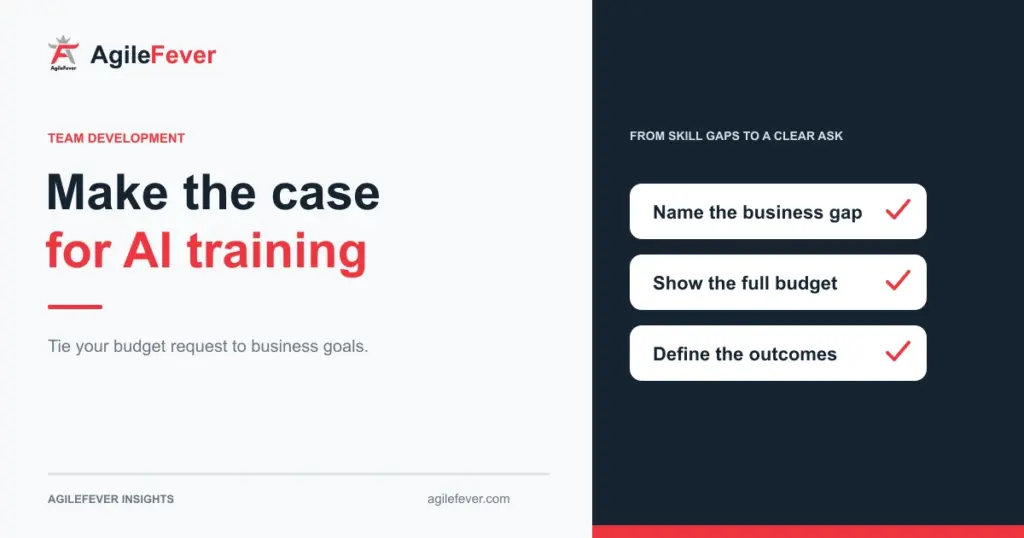
Most requests for training budget fail for the same reason: they ask for money for training, when leadership wants to fund an outcome. “We need AI training” competes with every other line item. “We need two people who can take our support assistant from pilot to production by Q2” is a decision leadership can make.
This guide shows how to put together an AI upskilling budget pitch that gets approved, with a one-page structure, an example budget, and answers to the questions you’ll be asked.
Start with the business problem
Before you price anything, write down what the company can’t do today that it needs to. Good pitches name one or two specific gaps:
- An AI project is stuck in pilot because nobody can deploy or monitor it
- Leaders are approving AI spend without a way to judge the proposals
- Product teams are about to ship AI features with no way to test them
- The company pays contractors for work an internal team could do
If you can’t name a gap like these, do a training needs assessment first. It’s much harder to argue for budget without one.
The one-page AI upskilling budget pitch
| Section | What to include |
|---|---|
| The problem | One or two business gaps, with what they cost today in delays, contractor spend, or risk |
| The plan | Which roles get trained, in what, and when |
| The cost | Program fees plus participant time, so nobody can say you hid it |
| The expected result | One or two measures, such as a pilot reaching production or contractor hours reduced |
| How you’ll report back | When you’ll show results, usually at three and six months |
| The ask | A specific amount and a decision date |
An example budget
A hypothetical team plan, priced at AgileFever’s public US prices as of October 2026. Swap in your own roles and providers.
| Who | Program | People | Per person | Total |
|---|---|---|---|---|
| Engineers building the AI feature | GenAI and Agentic AI BootCamp (74 hours) | 2 | $2,000 | $4,000 |
| Platform engineers who’ll run it | Enterprise AI Agents on your cloud (12 hours) | 2 | $199 | $398 |
| Product owner and QA lead | Role courses for product owners and QA (12 hours each) | 2 | $450 | $900 |
| Architect | GenAI & Agentic AI for Solution Architects (16 hours) | 1 | $450 | $450 |
| Sponsoring leaders | AI Transformation for Business Leaders (16 hours) | 2 | $1,000 | $2,000 |
| Total program fees | 9 | $7,748 |
Program fees by group, from the hypothetical plan above
Example only. Group pricing for private cohorts is quoted separately.
Note what the example does. It trains the people who’ll build, run, test, design, and approve the same feature. A plan that trains only engineers often stalls at approval, because the leaders signing off can’t judge the work.
Also include participant time. Nine people across these programs add up to well over 200 hours, and finance will ask.
Questions you’ll be asked
| Question | A good answer |
|---|---|
| Why not use free online courses? | We’ll use them for awareness. For the people delivering this project we need structure, live help, and a capstone tied to our work, on a deadline |
| Why not hire instead? | Hiring takes months and costs more per person. Training people who already know our systems is faster for this project; we may still hire for the long term |
| What if people leave after we train them? | Some will. Training tied to a real project and a growth path tends to help retention, and the work they deliver stays with us |
| How will we know it worked? | The pilot reaches production by a set date, and we’ll report the measures at three and six months |
| Can we start smaller? | Yes. Start with the leaders and the two builders, and fund the rest once the first results are in |
Useful context for the pitch
The World Economic Forum’s Future of Jobs Report 2025 expects 39% of workers’ core skills to change by 2030, and estimates that 59 of every 100 workers will need some training by then. That’s useful framing, but keep it to one line. Leadership will be persuaded by your company’s own gap, not by global statistics.
Where AgileFever fits
We provide corporate training, so weigh this as one option among several.
AgileFever runs public cohorts and private corporate groups for every program in the example above, and our corporate programs follow four stages: assess, upskill, analyze, and scale. Group pricing for private cohorts depends on team size and how much the program is tailored.
Additional discounts are available. Contact us to know more.
What to read next
For measuring results after the budget is approved, read Corporate AI training ROI: how to measure it. For choosing a provider, see the training vendor checklist.