















Written by the AgileFever editorial team. Facts checked on November 5, 2026 against the official pages of the organizations named in this post. AgileFever sells training for some of the topics covered here, and we say so wherever it applies. Every documentation page named below was opened on that date and is free to read. Hour and week figures are our own estimates, not published numbers.
Most roundups of free LLM courses sit in long lists with no order. You finish a video on transformers, a notebook on agents and a post on prompting, and still cannot build one working thing. This post gives you the order instead. It names no course providers and ranks nothing. It points at the official documentation of model makers and open-source projects, because those pages stay current when videos age.
If you want the background first, read our large language models guide. If you are weighing paid options, LLM training courses 2026 covers how to choose one.
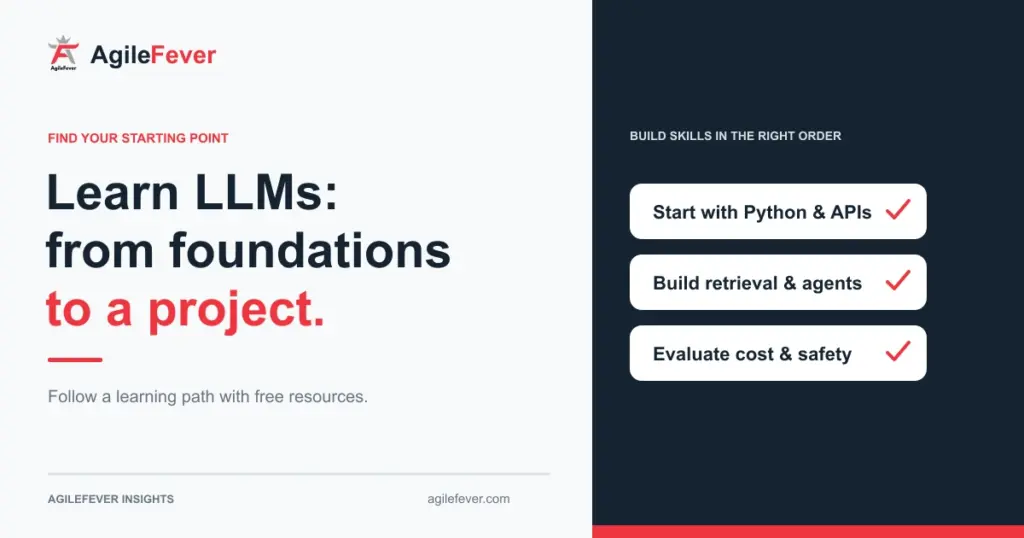
Free LLM courses: the learning path in seven stages
Each stage depends on the one before it. Retrieval needs prompting. Agents need tool use and retrieval. Evaluation only makes sense once something exists to measure. Skip ahead and you end up copying code you cannot debug.
Functions, dictionaries, JSON, HTTP calls and environment variables. Enough to call a model from your own script.
Tokens, context windows, sampling settings, why outputs vary, what training and fine-tuning change.
Clear instructions, examples, structured output, and deciding what text goes into the context.
Split documents, search them, put the best passages into the prompt, and cite them.
Let the model call your functions, run a loop with a step limit, and handle failed calls.
A test set with expected answers and a score you can compare before and after a change.
Tokens per request, cost per thousand requests, prompt injection and data leakage.
Stage by stage: what to learn and how long it takes
The hours below are our estimate for a working IT professional who can read code but has not built with a model API. They are ranges, not promises. Add time if Python is new to you.
| Stage | What you must be able to do at the end | Our estimate (hours) |
|---|---|---|
| 1. Python and APIs | Call a model API from a script, read the JSON reply, keep keys out of code | 20 to 30 |
| 2. How models work | Explain tokens, context limits and temperature, and predict when a prompt will not fit | 8 to 12 |
| 3. Prompting and context | Get consistent structured output from a model on 20 varied inputs | 10 to 14 |
| 4. Retrieval | Answer questions from your own documents with the source named | 20 to 28 |
| 5. Tool use and agents | Give a model two tools and stop the loop safely | 20 to 28 |
| 6. Evaluation | Score changes with a test set instead of by feel | 8 to 12 |
| 7. Cost and safety | State the cost per 1,000 requests and test ten hostile inputs | 4 to 8 |
| Total | A small, measured, working application | 90 to 132 |
Time estimates are AgileFever’s own, built from the stage tasks above. They are not figures from any documentation page.
The free materials, by type
Think of free LLM courses as six kinds of material. Use each kind for the job it does well.
| Type | Best for | Examples we opened on November 5, 2026 |
|---|---|---|
| Language and framework documentation | Stage 1, and the syntax of anything you build | The Python Tutorial in the official Python documentation, which assumes you already program in some language |
| Model makers’ own documentation | Stages 3, 5, 6 and 7: prompting, tool use, evaluation, pricing | Claude’s prompt engineering overview, its page on tool use, and its guide to defining success criteria and building evaluations |
| Model makers’ cookbooks | Working code you can run and change | The Claude Cookbooks (MIT-licensed, with folders for retrieval, tool use and evaluations) and the OpenAI Cookbook (agents and evals among its topics) |
| Open-source project tutorials | Stages 2 and 4: models, tokenizers, fine-tuning, retrieval, agent frameworks | The Hugging Face Course, which says it is free and without ads, and the LangChain documentation |
| Open standards and security lists | Stages 5 and 7 | The Model Context Protocol introduction and the OWASP Top 10 for LLM and Gen AI apps (2025 list, Creative Commons licence) |
| University lecture series | Stage 2 and the theory behind everything | Many universities publish slides and recordings for their language-model courses. Check the course page for the term, the prerequisites and whether videos are public |
These pages change often. Read the date on each before you rely on it, and prefer the page that matches the model version you actually use.
Stages 1 and 2: Python, APIs and how models work
Free LLM courses assume this stage, so skip nothing here if you cannot yet write a function or parse JSON. The Python Tutorial is the reference. It is aimed at people who already program, so a true beginner needs a gentler start. Ours is the free 6-hour Python for AI course, listed at no charge on its program page.
For the model itself, the Hugging Face Course introduces transformer models, tokenizers and fine-tuning across its chapters. Read only the first chapters now. You need a working picture of tokens and context, not the mathematics. A short experiment teaches more: send the same prompt five times at two temperature settings and compare the replies.
Stages 3 and 4: prompting, context and retrieval
Begin with Claude’s prompt engineering overview. It tells you to define success criteria and a way to test them before you tune a prompt, which is the habit that separates a demo from a tool. It also links an interactive prompting tutorial on GitHub. That tutorial was written for earlier Claude models, so the page itself says to follow its prompting best practices where the two differ.
Retrieval is the stage where most free LLM courses go vague. Build it in this order:
- Split 30 documents into passages of a few hundred words.
- Search them by keyword first. It is crude and teaches you what good retrieval has to beat.
- Add embeddings and compare the results on ten questions you wrote yourself.
- Put the top passages in the prompt and require the answer to name the passage it used.
The Claude Cookbooks repository has a retrieval-augmented generation folder, and the OpenAI Cookbook has worked examples too. Pick one, finish it, then rebuild the same thing without copying.
Stages 5 to 7: tools, agents, evaluation, cost and safety
Claude’s tool use documentation explains the loop plainly. Claude returns a structured request to call a function, your code runs it, and you send the result back. Write that loop yourself before you adopt a framework. The LangChain documentation and the Model Context Protocol introduction are good second reads once you know what the loop does. Our free tools page describes an AI architecture cost model that helps with the cost half of stage 7.
Evaluation is the stage people skip and later regret. Claude’s guide to success criteria and evaluations lists exact match, similarity scores and model-graded scoring, and says to favor many automatically graded cases over a few hand-graded ones. Write 50 cases, run them, record a number, change one thing, run again. For safety, read the OWASP list and test your own application against the first risk on it, prompt injection.
Suggested weekly hours by stage
Illustrative plan for a 16-week route. Our estimate, not a measured figure.
The weeks add to 16 and the hours to 108, which is the middle of the 90 to 132 range above. Work in fixed blocks. Two evenings and one weekend session beat seven rushed nights.
Checkpoint projects: what to build at each stage
Do not move on until the project works, however good the free LLM courses you are following look. Each one is small on purpose.
| Stage | Checkpoint project | You are done when |
|---|---|---|
| 1 | A command-line script that sends a question to a model API and saves the reply as JSON | It runs from a clean folder with the key read from an environment variable |
| 2 | A notebook that counts tokens for five prompts and shows output at two temperature settings | You can say why the same prompt gave different replies |
| 3 | A script that extracts fields from 20 sample emails into a fixed structure | All 20 return valid structure; you have a list of the failures |
| 4 | A question-answering tool over 30 documents that names its source passage | Eight of ten test questions cite the right passage |
| 5 | An assistant with two functions (for example a calculator and a file lookup) and a hard step limit | It stops after the limit and reports a failed tool call in plain words |
| 6 | A 50-case test set and a scoring script for your stage 4 or 5 project | You can show a score before and after one change |
| 7 | Token and cost logging, plus ten hostile inputs run against the project | You know the cost per 1,000 requests and which attacks got through |
The last three projects, joined together, make a portfolio piece you can explain: it works, it is measured, and you know what it costs and where it breaks.
When a free route is enough
Free LLM courses work well when three things are true. You can already code. You can hold a schedule without outside pressure. And someone you trust will read your work, or you are comfortable judging it against a test set.
| Your situation | Free route | Structured teaching |
|---|---|---|
| You code daily and want to add LLM calls to your own product | Usually enough | Optional |
| You are learning Python at the same time | Slow, but possible with the free Python course first | Helps with pace |
| You need someone to review your retrieval or agent design | No reviewer included | Helps |
| You have started three courses and finished none | Rarely works | A fixed calendar helps |
| You are a manager who needs to judge AI work, not build it | Stages 2, 3, 6 and 7 are enough | Our 4-hour AI Blueprint covers this ground without code |
What free does not give you
Documentation and other free LLM courses are accurate and open. It does not know you. Three things are missing, and they are the things that decide whether people finish.
- Feedback on your work. A cookbook shows a good answer. It cannot tell you why yours fails on the fourth test case.
- Review. Nobody reads your design and says the retrieval step is the weak part, or that your agent loop has no way to stop.
- Accountability. No date, no cohort, no one waiting. Many learners stall at stage 4 for this reason alone.
None of this means you must pay. A study partner, a colleague who reviews your code, or a weekly demo to your team can supply all three. Choose the version you will actually use.
Where AgileFever fits
We sell some of what this post describes, so weigh this part accordingly. Three of our offerings map to the path:
- Python for AI: a 6-hour live course, listed at no charge, which covers stage 1.
- The AI Blueprint: a 4-hour, no-code course in 7 modules that covers machine learning, generative AI, prompt engineering, agentic AI, MLOps and LLMOps at overview level.
- Gen AI BootCamp: 72 live hours over 9 weeks, with 9 projects and a choice of 3 capstones, listed at $1,600 in the US as listed on November 5, 2026. Basic Python is listed as beneficial.
Additional discounts are available. Contact us to know more.
The bootcamp page lists no batch date, so ask an advisor through the contact page for the next one. For module detail read the Gen AI BootCamp curriculum breakdown. For the full picture read Gen AI BootCamp guide. If you have never coded, read whether the Gen AI BootCamp suits complete beginners before you decide.
The path above does not need any of them, and the free LLM courses it uses are all open to read today. A learner who finishes the seven checkpoint projects from free material has done what a good course asks for.
Questions people ask
Can I learn LLMs for free?
Yes, up to a working project. Official documentation, cookbooks and open tutorials cover Python, prompting, retrieval, tool use and evaluation. What free material does not provide is review of your work and a deadline. Hosted model APIs may also bill by usage, so set a spending limit.
How long do free LLM courses take to finish?
On our estimate, about 90 to 132 hours across seven stages, or 16 weeks at roughly 7 hours a week. Add time if Python is new. Treat the figure as a planning guide: a stage is done when its checkpoint project works, not when the hours run out.
Do I need to know Python first?
For building, yes. You need functions, dictionaries, JSON and HTTP calls. If you are not there, take a Python course first. Ours is the free 6-hour Python for AI course. If you only need to judge AI work, you can start at stage 2.
Which documentation should a beginner read first?
Start with the prompt engineering overview from a model maker, because it explains success criteria and testing before techniques. Then read the same maker’s page on tool use. Pick one provider’s documentation and finish it before comparing others.
Is a free route enough to get an AI job?
We cannot promise any job outcome. A free route through free LLM courses can give you working, measured projects you can explain, which is what an interviewer can check. Without feedback, many learners miss weaknesses in their own work, so find a reviewer.
Are the free tiers of model APIs enough for practice?
Terms differ by provider and change often, so read the current pricing page before you start. Small experiments use few tokens. Running an open model on your own machine avoids per-token bills but needs suitable hardware.