



































Forget about the theoretical questions. The CCA-F exam is built around real-world production scenarios, and this is where most candidates get surprised.
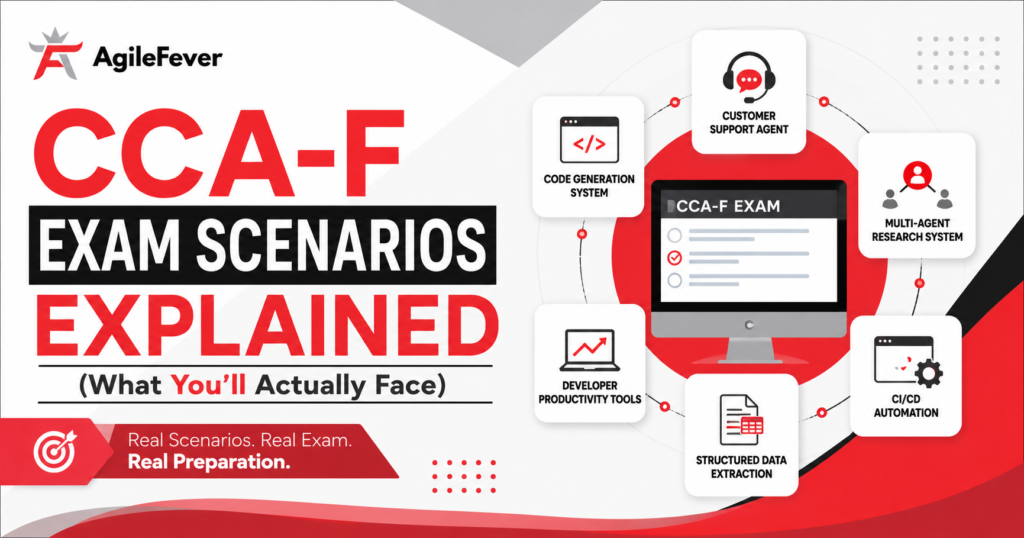
The exam shows you 4 scenarios, picked at random from a bank of 6, so you need to be ready for all six. Below are the six scenarios named in Anthropic’s official exam guide. The traps are our own study notes, not exam content.
Each scenario will represent a real use case, test multiple domains and require architectural thinking.
The 6 Core Scenarios – CCAF exam
1. Customer Support Agent
- Handling complex queries
- Escalation logic
- Context management
Trap: Using raw transcripts instead of structured summaries
2. Code Generation System
- Large codebase navigation
- Context handling
- Tool usage
Trap: Ignoring context degradation
3. Multi-Agent Research System
- Coordinator + subagents
- Task distribution
- Iterative refinement
Trap: Assuming agents share context
4. Developer Productivity Tools
- Claude Code workflows
- Configurations
- Execution modes
Trap: Using direct execution instead of plan mode
5. CI/CD Pipeline Automation
- Headless execution
- JSON outputs
- Automation pipelines
Trap: Running Claude interactively
6. Structured Data Extraction
- JSON schema
- Validation
- Retry loops
Trap: Relying only on prompts
Which Domains Each Scenario Tests
| Scenario | Primary domains (per the exam guide) |
|---|---|
| 1. Customer Support Resolution Agent | Agentic Architecture & Orchestration; Tool Design & MCP Integration; Context Management & Reliability |
| 2. Code Generation with Claude Code | Claude Code Configuration & Workflows; Context Management & Reliability |
| 3. Multi-Agent Research System | Agentic Architecture & Orchestration; Tool Design & MCP Integration; Context Management & Reliability |
| 4. Developer Productivity with Claude | Tool Design & MCP Integration; Claude Code Configuration & Workflows; Agentic Architecture & Orchestration |
| 5. Claude Code for Continuous Integration | Claude Code Configuration & Workflows; Prompt Engineering & Structured Output |
| 6. Structured Data Extraction | Prompt Engineering & Structured Output; Context Management & Reliability |
Study by scenario as well as by domain: Context Management & Reliability shows up in four of the six, and Agentic Architecture in three. The full exam facts are in our CCA-F guide to pass.
Sources: Anthropic’s Claude Certified Architect – Foundations Exam Guide (version 1.0, effective July 2026), the certification page, the certification FAQ and the eligibility page on the Anthropic Partner Academy. Anthropic can change these without notice, so confirm before you pay.
What Makes These Hard?
Each question:
- Combines multiple domains
- Includes realistic constraints
- Has multiple “almost correct” answers
You are solving systems, not questions.
Key Strategy for Scenarios
Always ask:
- What is the goal?
- What could break in production?
- What’s the most reliable solution?
- Why Practice Matters
Reading scenarios ≠ solving them.
You need:
- Pattern recognition
- Decision speed
- Practical exposure
- Where Structured Practice Helps
This is where most candidates feel stuck.
That’s why many choose guided training like the Claude Certified Architect Foundations (CCA-F) Course by Agilefever
Because:
- You work on real-world scenarios
- You learn decision frameworks
- You build confidence before exam day
Agilefever focuses on hands-on implementation, which is exactly what these scenarios test.
Refer the following references for foundations:
- What is Claude Certified Architect (CCA) Foundations Certification?
- CCA-F Certification: Cost, Eligibility, and Exam Details
- Claude CCA-F Syllabus Explained (Based on Actual Exam Domains)
- How to Prepare for CCA-F Exam (Step-by-Step Strategy Based on Real Exam Patterns)
- CCA-F Study Plan — 4-Week Execution Blueprint to Pass on First Attempt
If you are still struggling or having difficulties in understanding the concepts, do not forget to check our AgileFever course, which aligns with this curriculum perfectly.
Any questions regarding the concept, or about the course, comment them below and our AI experts will get back to you as soon as possible.
Happy Learning!