



















If you are trying to understand the CCA-F syllabus, you may have probably noticed something frustrating: that there is no clean “module list” like traditional certifications. And that is intentional. The exam isn’t structured around modules; it is built around competency domains + real-world scenarios.
Let’s break it down the right way, based entirely on the actual exam structure.
The 5 Competency Domains (Actual Exam Structure)
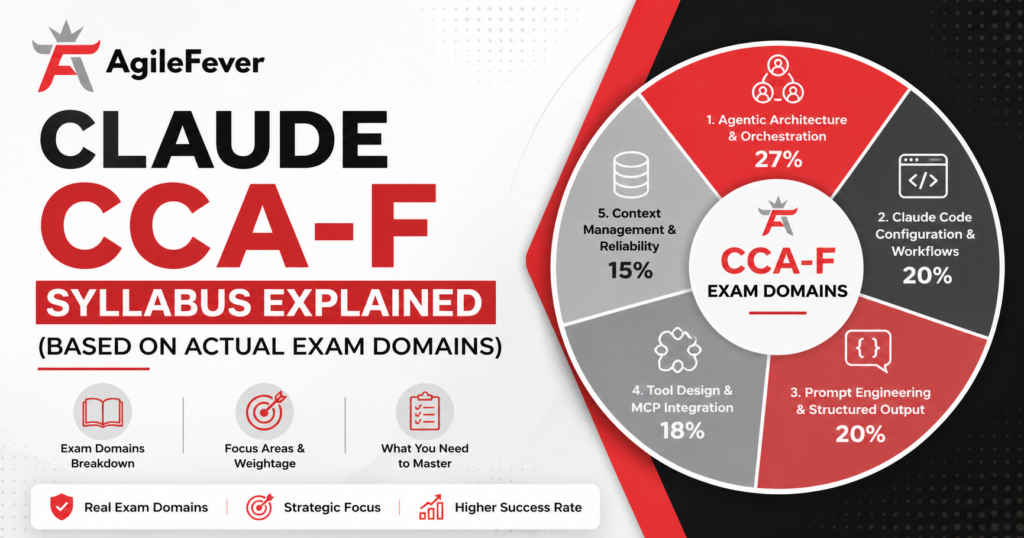
The CCA-F exam syllabus is divided into:
- Agentic Architecture & Orchestration — 27%
- Claude Code Configuration & Workflows — 20%
- Prompt Engineering & Structured Output — 20%
- Tool Design & MCP Integration — 18%
- Context Management & Reliability — 15%
Know all the details about CCA-F Certification: Cost, Eligibility, and Exam Details (2026)
Domain 1: Agentic Architecture & Orchestration (27%)
This is the highest-weight domain and where most people will struggle.
What you need to understand:
- Multi-agent systems (not single “super agents”)
- Coordinator → subagent pattern
- Task decomposition into smaller units
- Agent loop design (input → reasoning → tools → output)
- Session state management
- Escalation logic
Critical Insight:
Subagents do NOT inherit context automatically. This is one of the biggest traps in the exam.
Domain 2: Claude Code Configuration & Workflows (20%)
This domain tests whether you understand how Claude actually runs in production.
Key concepts:
- CLAUDE.md hierarchy (project vs user level)
- Slash commands and reusable workflows
- Plan mode vs direct execution
- CI/CD integration (especially –print flag)
- Structured JSON output (–output-format json)
Common Trap:
Running Claude interactively in CI/CD instead of using proper flags.
Domain 3: Prompt Engineering & Structured Output (20%)
This is not basic prompting.
What actually matters:
- JSON schema enforcement
- Structured outputs using APIs
- Validation-retry loops
- Few-shot prompting (limited role)
Most Important Rule:
Programmatic enforcement > prompt instructions
If you rely only on prompts, you will get questions wrong.
Domain 4: Tool Design & MCP Integration (18%)
This is where many candidates lose unexpected marks.
You need to know:
- MCP (Model Context Protocol) basics
- Difference between:
- Tools (actions)
- Resources (read-only data)
- Prompts (templates)
- Tool descriptions → how Claude selects tools
- Tool boundaries and usage decisions
Common Mistake:
Treating read-only data as a tool instead of a resource.
Domain 5: Context Management & Reliability (15%)
This domain looks smaller but it affects everything.
Key concepts:
- “Lost in the middle” effect
- Context window optimization
- Token economics
- Prompt caching vs batch API vs real-time API
- Escalation decisions
Important:
Poor context management impacts performance across multiple domains.
Official Task Statements by Domain
Anthropic’s exam guide lists the skills it tests as numbered task statements. Note the official numbering: Domain 1 is Agentic Architecture, Domain 2 is Tool Design and MCP, Domain 3 is Claude Code, Domain 4 is Prompt Engineering and Domain 5 is Context Management. The sections above are ordered differently, so use the names, not the numbers, when you compare notes with other candidates. Use this list as your study checklist.
Domain 1: Agentic Architecture & Orchestration (27%)
- Design and implement agentic loops for autonomous task execution
- Orchestrate multi-agent systems with coordinator-subagent patterns
- Configure subagent invocation, context passing, and spawning
- Implement multi-step workflows with enforcement and handoff patterns
- Apply Agent SDK hooks for tool call interception and data normalization
- Design task decomposition strategies for complex workflows
- Manage session state, resumption, and forking
Domain 2: Tool Design & MCP Integration (18%)
- Design effective tool interfaces with clear descriptions and boundaries
- Implement structured error responses for MCP tools
- Distribute tools appropriately across agents and configure tool choice
- Integrate MCP servers into Claude Code and agent workflows
- Select and apply built-in tools (Read, Write, Edit, Bash, Grep, Glob) effectively
Domain 3: Claude Code Configuration & Workflows (20%)
- Configure CLAUDE.md files with appropriate hierarchy, scoping, and modular organization
- Create and configure custom slash commands and skills
- Apply path-specific rules for conditional convention loading
- Determine when to use plan mode vs direct execution
- Apply iterative refinement techniques for progressive improvement
- Integrate Claude Code into CI/CD pipelines
Domain 4: Prompt Engineering & Structured Output (20%)
- Design prompts with explicit criteria to improve precision and reduce false positives
- Apply few-shot prompting to improve output consistency and quality
- Enforce structured output using tool use and JSON schemas
- Implement validation, retry, and feedback loops for extraction quality
- Design efficient batch processing strategies
- Design multi-instance and multi-pass review architectures
Domain 5: Context Management & Reliability (15%)
- Manage conversation context to preserve critical information across long interactions
- Design effective escalation and ambiguity resolution patterns
- Implement error propagation strategies across multi-agent systems
- Manage context effectively in large codebase exploration
- Design human review workflows and confidence calibration
- Preserve information provenance and handle uncertainty in multi-source synthesis
Sources: Anthropic’s Claude Certified Architect – Foundations Exam Guide (version 1.0, effective July 2026), the certification page, the certification FAQ and the eligibility page on the Anthropic Partner Academy. Anthropic can change these without notice, so confirm before you pay.
The Real Exam: Scenario-Based (Not Topic-Based)
Here is where it gets interesting. The exam includes 6 production scenarios, such as:
- Customer support agent
- Code generation system
- Multi-agent research system
- Developer productivity tools
- CI/CD automation
- Structured data extraction
Each scenario tests multiple domains at once.
Critical Mental Models (Most Important Part)
This is what separates people who pass vs fail.
1. Programmatic Enforcement > Prompts
Use code, not just instructions.
2. Subagents Don’t Share Context
You must pass context explicitly.
3. Tool Descriptions Drive Behavior
Bad descriptions = wrong tool usage.
4. “Lost in the Middle” Effect
Important info must be at start/end.
5. Match API to Use Case
- Real-time → Real-time API
- Batch → Batch API
- Repeated → Prompt caching
Anti-Patterns (What NOT to Do)
The exam heavily tests mistakes.
Examples:
- Using one “super agent” instead of multiple agents
- Relying only on prompts for JSON output
- Using Batch API for real-time workflows
- Passing full context blindly
The exam often gives you these as answer choices.
Time Allocation Based on Weight
Focus your effort like this:
- Domain 1 → Highest priority
- Domain 2 & 3 → Core understanding
- Domain 4 → Practice-heavy
- Domain 5 → Concept clarity
Our Thoughts
Now you can see why this exam feels different.
It is not testing: “Do you know AI?” It is testing: “Can you design real AI systems under constraints?”
And if you are starting out: CCA-F is not about memorizing topics. It is about thinking like an architect.