














Written by the AgileFever editorial team. Facts checked on November 10, 2026 against the official pages of the organizations named in this post. AgileFever sells training for some of the topics covered here, and we say so wherever it applies. Metric definitions come from DORA, and the guidance on agent permissions comes from the OWASP Top 10 for LLM Applications.
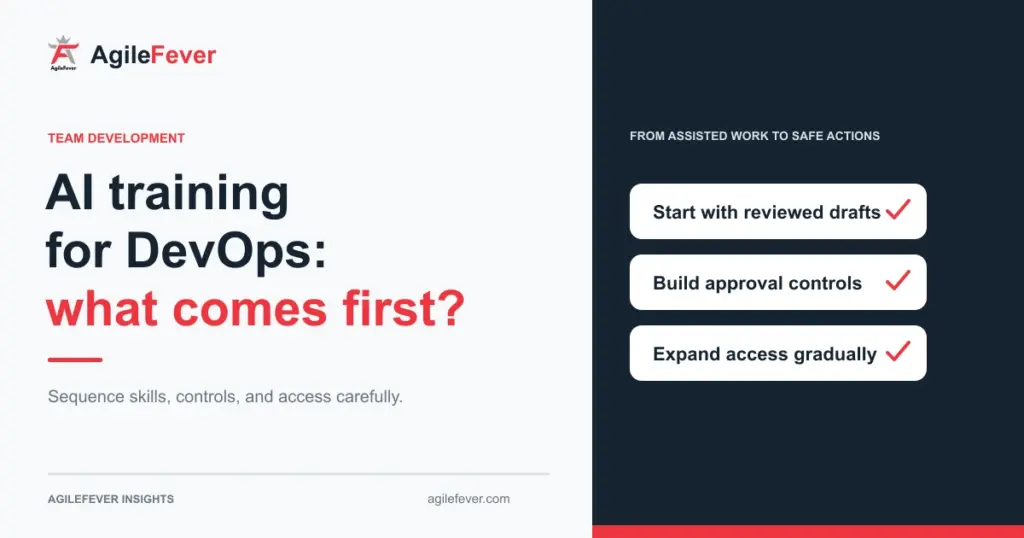
Engineering managers and platform leads often ask which AI skills a DevOps team should learn first. The order matters more than the topic list in AI training for DevOps teams. A team that starts with autonomous agents before it can review AI output gives an unreviewed system the keys to production. This post gives a sequence for AI training for DevOps teams of 8 to 40 people, what each sub-role learns first, the guardrails to teach before any agent can write, a pilot design and an honest list of reasons to wait. For the wider picture, read how to upskill an engineering team.
AI training for DevOps teams: what to teach first, second and last
Autonomy rises only as review skill and guardrails are in place.
Illustrative framework from AgileFever’s editorial team, not survey data.
First: assistants on read-only work
In AI training for DevOps teams, start where a mistake costs a review comment, not an outage. Engineers use an assistant to explain an unfamiliar error log, draft a Terraform module or pipeline file, write a first-cut runbook and summarize an incident timeline. Everything produced is read by a person before it touches a system. The skill being built is review: does the generated plan match what you asked, and what would it change that you did not expect? Run terraform plan on every draft, read the diff, and reject what you cannot explain.
Why first: the work is reversible, every engineer can start the same week, and it builds the review habit that stages two and three depend on. It also forces the data rule early: what may and may not be pasted into a tool.
Second: guardrails, then agents that propose
Teach the controls before the capability. Engineers learn what an agent may read, what it may change and who approves. Then they build a propose-only agent, for example one that reads a drift report and opens a pull request with the fix. A human merges, and the normal pipeline applies. The guardrails are covered in the next section.
Why second: it gives people real agent experience with an approval step between the model and your infrastructure. If the agent is wrong, the cost is a rejected pull request.
Last: write access
Give an agent write access to a narrow, well-understood action only after the first two stages work. Examples are restarting a stateless service, scaling a group within a fixed range, or rolling back a release the pipeline already tested. Start in staging, keep an approval step for anything with customer impact, and keep a switch that turns the agent off in seconds.
Why last: autonomy multiplies the effect of a wrong decision. OWASP names this risk Excessive Agency (LLM06 in the 2025 list), meaning damaging actions taken because of unexpected, ambiguous or manipulated model output. Hallucination and prompt injection are two causes, and the fix is limiting what the agent can do, not hoping the model is right.
What each sub-role needs first and what can wait
A platform engineer and a release engineer do not need the same first month of AI training for DevOps teams. Use the table to give each role a start that matches its daily work.
| Sub-role | Learn first (stage 1 and 2) | Can wait (stage 3) | Why this split |
|---|---|---|---|
| Platform engineer | Assistant-drafted IaC and modules, reading plans and diffs, policy checks on generated code, building the propose-only agent | Agents that apply infrastructure changes | Owns the shared paths every other team uses, so a bad change spreads |
| SRE | Log and alert summarization, runbook drafting, postmortem drafts, safe-action design for incident helpers | Auto-remediation in production | Highest value in triage, highest risk if an agent acts at 3 a.m. on a wrong diagnosis |
| Release engineer | Pipeline YAML drafts, release-note and change-risk summaries, approval-gate design | Agents that promote or roll back releases unattended | Pipeline files are code, so review works well; promotion is a production action |
| Cloud engineer | Cost and usage analysis, drafting cloud config, reading provider docs faster, tagging and cleanup reports | Agents that delete or resize resources | Deletes are hard to undo; report first, act later |
| Security-minded DevOps | Reviewing AI output for secrets and over-broad permissions, writing the agent permission standard, audit-log requirements | Agents with access to credentials stores | Should set the guardrails in stage 2 and sign off before stage 3 |
For roles outside DevOps, see the AI skills matrix for engineering teams.
Guardrails to teach before any agent gets write access
These are standard good practice for any automation that can change systems. The OWASP page on Excessive Agency (checked November 10, 2026) lists mitigations that map to the first three rows: minimize an agent’s functions and permissions, avoid open-ended tools such as a general shell, require approval for high-impact actions, and enforce authorization in the downstream system rather than trusting the model’s judgment. OWASP also says logging, monitoring and rate limiting do not prevent excessive agency; they only limit the damage. So treat audit logs as a way to investigate, not as protection.
| Guardrail | What to teach | A check the team can run |
|---|---|---|
| Least privilege | Give the agent its own identity with the minimum role for one task. Read-only first. No shared admin credentials | List every permission the agent identity holds and justify each line in review |
| Narrow tools | Offer named actions (restart service X) instead of an open shell or a general cloud API | Try to make the agent do something outside its list; it should fail |
| Change approval | High-impact actions need a named human approver, and the approver sees the exact command or diff, not a summary | Pick the last five agent actions and confirm who approved each |
| Authorization in the target system | The platform being changed enforces permissions itself. The model is never the only gate | Revoke the agent role in staging and confirm the action is refused |
| Audit logs | Record the prompt, tool calls, inputs, outputs and the approver, stored where the agent cannot edit them | Reconstruct one agent run from logs alone |
| Secrets handling | Never paste secrets into prompts. Give the agent short-lived, scoped credentials from your secrets store. Scan prompts, outputs and logs for leaked values | Run a secret scanner over a week of agent logs |
| Kill switch and limits | A documented way to disable the agent fast, plus caps on actions per hour | Practise the switch in a game day |
How to pilot: cohort, capstone and measures
A pilot of AI training for DevOps teams gives you evidence before you train everyone. The mechanics are in how to run an AI pilot cohort before training the whole team. For a DevOps team, three choices matter.
- Cohort size: 6 to 10 people, mixed across the sub-roles above, with at least one security-minded engineer. AgileFever’s corporate page caps its cohorts at 20 professionals, so a pilot fits well inside one.
- Capstone: one real backlog item, not a toy. Good candidates: a propose-only agent that opens pull requests for the noisiest drift category, or an alert-triage summary for the service that pages most. Pick something with a clear owner and a rollback.
- Time: about 2 to 4 hours a week of protected time, a shared weekly session and the rest on the capstone.
Measure with metrics you already track
Take the baseline from the last three months before week 1. DORA’s research programme defines its software delivery metrics, and the DORA’s official metrics guide (page last updated January 5, 2026) gives these definitions. Note that DORA has renamed time to restore as failed deployment recovery time and added a fifth metric.
| Metric | DORA definition (paraphrased) | What AI training might move | Caution |
|---|---|---|---|
| Change lead time | Time for a change to go from commit to deployed in production | Faster drafts and reviews of pipeline and IaC changes | Use medians; a few large changes skew averages |
| Deployment frequency | Number of deployments over a period, or time between them | Little in a 12 week pilot, because release cadence is usually set elsewhere | Do not set it as a target |
| Change fail rate | Ratio of deployments that need immediate intervention | Should not rise; watch it as a safety check on AI-assisted changes | Needs enough deployments for the ratio to mean anything |
| Failed deployment recovery time | Time to recover from a deployment that fails and needs immediate intervention | Faster diagnosis from log summaries and runbooks | Few failures in 12 weeks makes it noisy |
| Deployment rework rate | Ratio of unplanned deployments caused by a production incident | Unlikely to move in 12 weeks; track it anyway | Optional if you do not record it today |
A 12 week pilot is short and DORA metrics are noisy on small teams. Add two measures of your own that move quickly: hours spent on a defined chore (for example writing a postmortem draft) timed before and after, and the share of AI-drafted changes that reviewers reject. A high rejection rate in week 3 is useful data, not a failure. On cost and return, see how to measure corporate AI training ROI.
Weeks 1 to 12, one cohort of 6 to 10 people from a team of 8 to 40.
Illustrative example: a planning suggestion, not data from a real team. Stretch or shrink each block to fit your release calendar.
Training formats compared by effort and risk
Choose a format for AI training for DevOps teams by the stage you are in. The ratings below are our judgment and carry no survey data.
| Format | Manager effort | Learner time | Main risk | Best for |
|---|---|---|---|---|
| Live cohort (instructor-led, with labs) | Medium: schedule, sponsors, capstone selection | Fixed hours, protected from tickets | Content may not match your stack, so check the labs against your tools | Stages 2 and 3, where guardrails need practice and feedback |
| Self-paced courses | Low to start, high to keep people finishing | Flexible, easy to defer | Completion drops under on-call load; nobody checks the review habit | Stage 1 basics and prerequisites such as Python |
| Internal guild or study group | Medium: needs a convener and a topic list | Small, regular, on real work | Spreads one person’s habits, good or bad; no outside check on security practice | Keeping skills current after a cohort |
A common mix for corporate AI training for DevOps: self-paced Python and basics first, a live cohort for the guardrail and agent stages, and a guild afterward. Use a written checklist of data-handling and delivery questions when you assess any provider.
When not to train yet
Some teams should fix the basics before AI training for DevOps teams starts. Wait if any of these is true.
- There is no approved tool or written rule on what data may go into it. Engineers will paste logs and configs with secrets in them.
- Infrastructure is not in version control, or changes reach production by hand. Review and approval steps have nothing to attach to.
- The team is mid-migration or on a heavy on-call rotation. Protected learning time will not survive, and the cohort will stall.
- You cannot produce a baseline for any metric. You will not be able to tell whether the training helped.
- No senior engineer will own the guardrails. Stage 3 should not start without one.
None of these is permanent. Spend a month on the fix, then start stage 1.
Where AgileFever fits
We sell training for agentic AI for DevOps that overlaps with stages 1 to 3, so judge this section accordingly. Generative AI and Agentic AI for DevOps Engineer is a 12-hour live course in four modules: Gen AI for Infrastructure Automation, Agentic AI for Incident and Cost Automation, Security and Monitoring Integration, and Build and Deploy Your Project. It builds drift, incident and monitoring agents in labs, and its drift agent applies fixes with approvals. It has no formal exam; learners get a completion certificate from AgileFever. The prerequisite is the Python for AI course, which is free and takes 6 hours. The page says a one-time OpenAI API credit of about $10 covers all labs, and the AI Blueprint course (4 hours) comes free with enrollment. As listed on November 10, 2026, the course is $450 or ₹25,000 per seat, and the next listed batch is December 7 to 9, 2026. AgileFever adds 18% GST at checkout for buyers in India, and rupee prices are before GST.
Additional discounts are available. Contact us to know more.
Map it to your plan fairly, since AI training for DevOps teams needs more than one course: the course covers agent building and some security and monitoring work, while your own policy on permissions, approvals and secrets still has to be written by your team. For deeper operation of machine learning systems later, the MLOps, LLMOps and Agentic AI Ops BootCamp is a separate, longer step. On team delivery, our corporate page states that cohorts are capped at 20 professionals, with a free team skills diagnostic after the first call and a capability report by role that compares baseline and post-assessment results.
Questions people ask
What should AI training for DevOps teams cover first?
Start with assistants on read-only work: explaining logs, drafting IaC and runbooks, and summarizing incidents, with a person reviewing every output. This builds the review habit and sets the data rules before any agent can change a system.
When can an AI agent get write access to production?
After the team has working guardrails: a least-privilege identity, narrow named actions, human approval for high-impact changes, audit logs and a kill switch. Prove the agent in staging first, and start with one low-risk action.
How do we measure whether the training worked?
Take a three-month baseline of change lead time, deployment frequency, change fail rate and failed deployment recovery time, as defined by DORA. Add a timed chore and the rejection rate of AI-drafted changes, since the DORA metrics move slowly.
How big should the pilot cohort be?
Six to ten people across platform, SRE, release, cloud and security roles, working on one real backlog item with a clear owner. Small enough to support closely, mixed enough to show which roles benefit.
Do DevOps engineers need Python before learning agentic AI?
Basic Python helps because agents and API calls are scripted. AgileFever’s DevOps course requires its free 6-hour Python for AI course first. Your team may have other routes, but check everyone can read and run a short script.
What is the biggest risk when DevOps teams adopt AI agents?
Excessive agency: an agent with more tools, permissions or autonomy than its task needs, so a wrong or manipulated output causes damage. OWASP lists it as LLM06 in 2025. Limit functions and permissions and require approval.