
AI BootCamps (7 Courses)



























 Course Category
Course Category
Course Category
The session begins with an introduction to AgileFever as a global AI upskilling platform that helps working professionals and enterprises build production-ready AI skills through hands-on learning. With more than six years in the industry, over 150 live cohorts, 300 enterprise teams, and more than 16,000 learners trained, the goal of this masterclass is to explain what a Forward Deployed Engineer (FDE) is and how professionals can transition into this role.
The speaker starts by explaining that the term Forward Deployed Engineer has suddenly become popular. It appears in job descriptions, social media, and hiring discussions across technology companies. However, according to the speaker, the role itself is not new. Many professionals are already doing this work without calling themselves Forward Deployed Engineers. If you are already working with stakeholders, understanding business problems, designing solutions, writing code, deploying applications, and taking ownership until production, you are already performing many of the responsibilities of an FDE.
The speaker explains that a Forward Deployed Engineer is someone who understands the complete technology stack instead of specializing in only one area.
An FDE should understand Python, Machine Learning, Deep Learning, Generative AI, deployment, and production systems. They work directly with technical and non-technical stakeholders who present a business problem. Based on that problem, the engineer decides which technologies should be used, designs the architecture, develops the solution, writes the code, deploys it, and makes it production-ready.
The speaker summarizes this role by saying that a Forward Deployed Engineer is someone who can take a business problem and independently convert it into a working production solution.
The speaker starts by explaining that the term Forward Deployed Engineer has suddenly become popular. It appears in job descriptions, social media, and hiring discussions across technology companies.
However, according to the speaker, the role itself is not new. Many professionals are already doing this work without calling themselves Forward Deployed Engineers. If you are already working with stakeholders, understanding business problems, designing solutions, writing code, deploying applications, and taking ownership until production, you are already performing many of the responsibilities of an FDE.
Earlier, organizations hired different specialists for different responsibilities.
A Data Analyst analyzed data.
A Machine Learning Engineer built ML models.
A Generative AI Engineer created LLM applications.
Another engineer handled deployment.
According to the speaker, companies are now moving away from this model. Instead of hiring separate people for each responsibility, they increasingly prefer professionals who can perform all these tasks themselves.
The expectation today is that one engineer should be able to understand the business requirement, choose the correct technology, build the solution, deploy it, and support it in production.
The speaker attributes this shift mainly to modern AI coding tools.
With tools such as Microsoft Copilot and large language models generating code quickly, software development has become much faster than before. Projects that previously took four or five months are now expected to be completed within one sprint or even within a few weeks.
Since AI tools have increased developer productivity, companies expect engineers to contribute across the complete development lifecycle rather than focusing on only one technology.
Throughout the session, the speaker repeatedly emphasizes that companies are no longer looking only for developers.
Organizations want engineers who understand business problems.
The responsibility of an FDE is not simply to write Python code or create APIs. The responsibility is to understand the customer’s problem, evaluate different technology options, calculate business value, and deliver an end-to-end solution that provides a return on investment.
According to the speaker, this ability to bridge business teams, engineering teams, and AI teams is what makes the role unique.
The masterclass compares the Forward Deployed Engineer with several traditional roles.
The speaker explains that an FDE combines responsibilities from all these roles. An FDE should understand the problem, analyze the business requirements, design the architecture, build the application, deploy it, and ensure that the solution works successfully in production.
According to the session, FDE is not replacing these professions. Instead, it combines their strengths into a single cross-functional engineering role.
The session describes how enterprise software has evolved over the years.
Initially, applications simply interacted with databases.
Later, organizations began building applications using Large Language Models.
The next stage introduced Retrieval-Augmented Generation (RAG), allowing AI applications to access company-specific knowledge.
Today, companies are moving toward Agentic AI, where AI systems can make decisions, interact with enterprise applications, and automate workflows.
The speaker explains that Agentic AI does not replace engineers. Instead, it changes the kind of systems engineers are expected to build.
The speaker presents several business scenarios where Forward Deployed Engineers create value.
One example is customer support. Instead of human support teams manually responding to every request, AI-powered assistants can understand customer questions and respond automatically.
Another example comes from healthcare, where AI document assistants can search hospital documents and compliance policies, helping medical teams find accurate information much faster.
The speaker also discusses DevOps environments, where AI systems can analyze logs, identify failures, determine root causes, and recommend possible solutions without requiring engineers to manually inspect thousands of log entries.
Recommendation systems used by platforms like Amazon, Netflix, and AgileFever’s own course recommendation process are also presented as examples of AI solving business problems using intelligent algorithms.
One practical example discussed during the session is AI-powered incident response.
Instead of waiting for customers to report application failures, AI systems can automatically detect problems, identify root causes, create Jira tickets, notify engineering teams through Slack or Microsoft Teams, and recommend possible solutions.
The speaker points out that these systems are much more than simple chatbots. They become operational systems that actively monitor and improve enterprise applications.
An interesting idea presented during the masterclass is the concept of becoming an AI-powered professional.
Rather than introducing yourself only as a DevOps Engineer, Test Engineer, Sales Engineer, or Data Analyst, the speaker suggests becoming an AI-powered version of your current role.
According to him, adding AI capabilities to your existing skills significantly increases your value in the job market because organizations increasingly expect professionals to work alongside AI rather than separately from it.
The speaker introduces a framework that represents the lifecycle of an enterprise AI solution.
It begins by discovering the business problem, followed by defining the requirements, designing the technical architecture, developing a proof of concept, deploying it into production, demonstrating the business value, and continuously improving the application.
The speaker explains that AI projects are iterative. Once deployed, they require continuous monitoring and improvements because AI systems can produce incorrect or unexpected outputs over time.
According to the speaker, an FDE should understand multiple layers of technology.
The emphasis throughout the session is that understanding the complete stack is more valuable than becoming an expert in only one technology.
The speaker addresses a common concern from professionals who are worried about coding.
Although AI assistants now generate large amounts of code automatically, engineers still need to understand what the generated code is doing.
They must review it, validate it, improve it, and ensure it correctly solves the business problem.
According to the session, coding is becoming easier, but engineering judgment is becoming even more important.
Towards the end of the session, the speaker delivers what is arguably the central message of the masterclass.
Customers do not ask for LangChain.
They do not ask for LangGraph.
They do not ask for OpenAI.
Customers simply describe their business problems.
It is the engineer’s responsibility to choose the right technologies and build the correct solution.
For that reason, the speaker concludes that the most important skill for a Forward Deployed Engineer is not learning another framework but learning how to solve business problems using technology.
The session concludes by encouraging professionals to focus on practical implementation instead of simply collecting tutorials or notebooks. The speaker advises participants to build production-ready AI projects that solve real business problems because organizations ultimately invest in solutions rather than technologies. He closes with a simple message: don’t just learn AI, learn how to build AI solutions that businesses actually pay for.
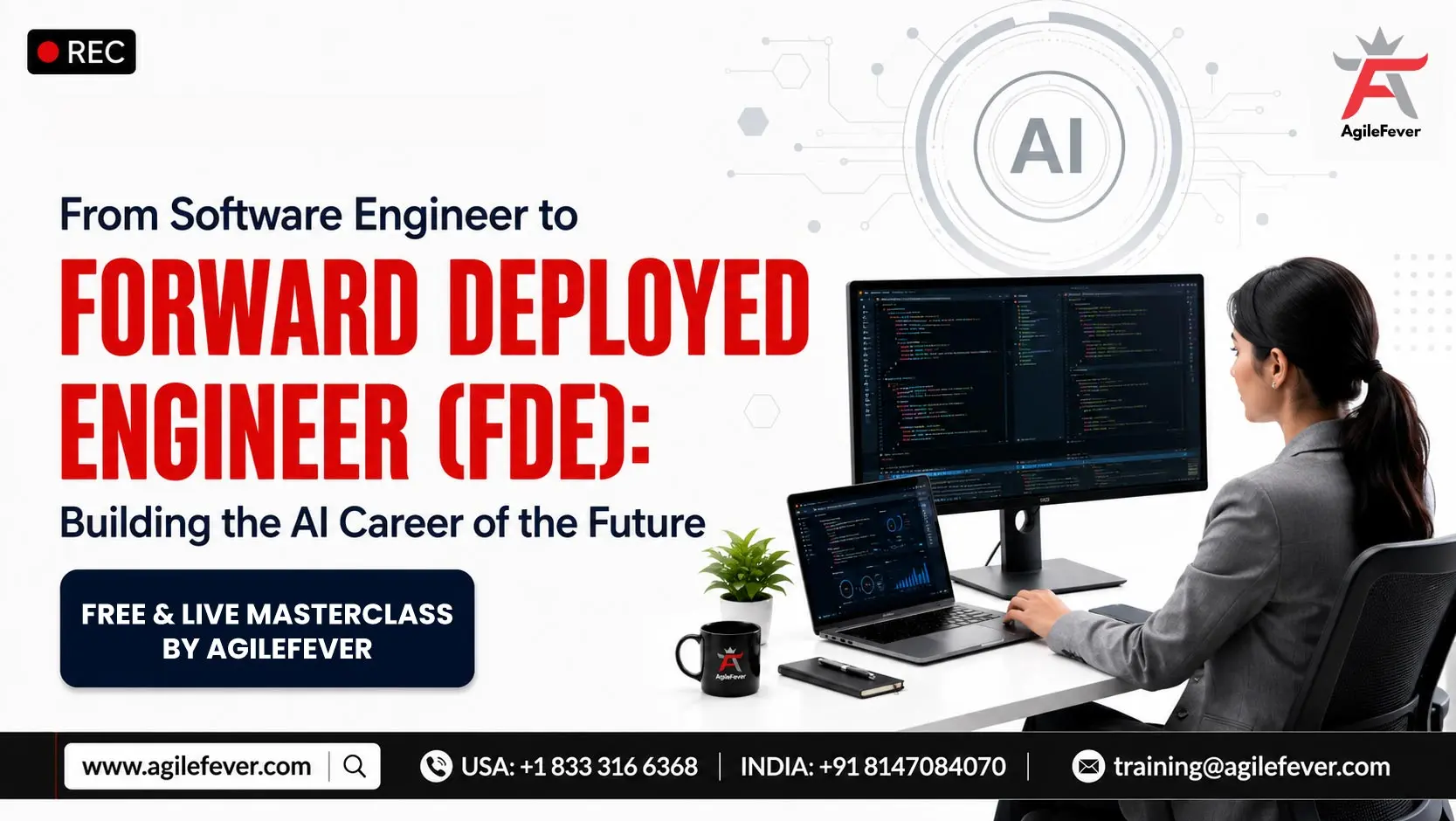

This masterclass is ideal for working professionals, developers, analysts, testers, who want to upskill in AI, switch to AI and beginners who want to understand AI concepts clearly and see how they’re applied in real projects.
No. The session is designed to be beginner-friendly while still valuable for experienced professionals. Concepts are explained from fundamentals and connected to real-world use cases.
Yes. The masterclass is completely free. You’ll get live expert instruction, practical insights, and learning resources at no cost. The recorded session and resources will be shared with the attendees.
It’s practical-first. Industry experts explain concepts using real examples, tools, workflows, and implementation approaches, not academic slides.
Yes. Registered participants receive session resources and, where applicable, access to recordings or follow-up materials shared by the instructor.
Absolutely. Live Q&A is a key part of the session. You can ask questions related to learning AI, career transitions, tools, or real implementation challenges.
This is a live, structured session led by industry practitioners. You get real-world context, actionable guidance, direct interaction, and clarity, something pre-recorded videos can’t offer.
Yes. The session provides clarity on where AI fits in your role, what skills to focus on next, and how professionals are practically moving into AI-driven roles.