































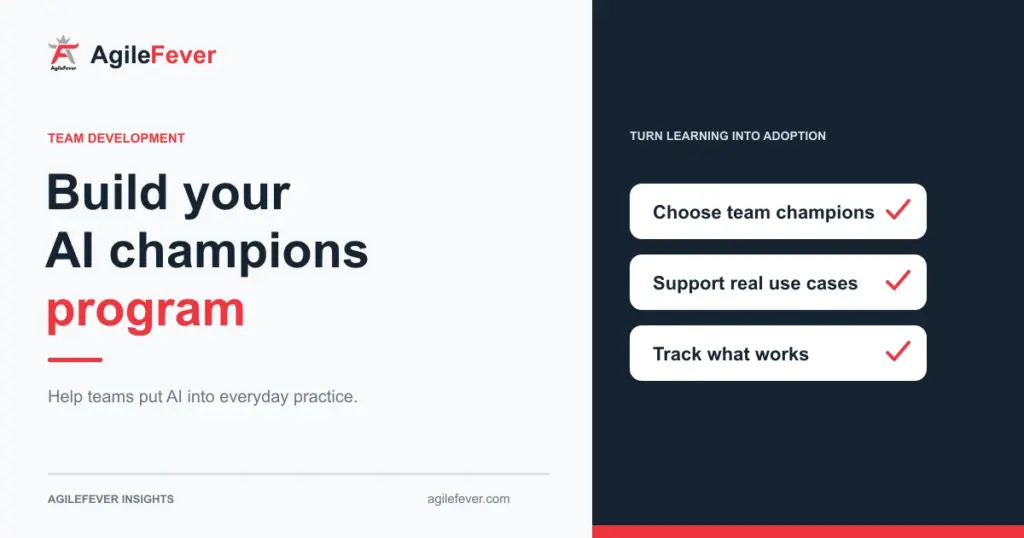
Rolling out AI tools is the easy part. Getting people to change how they work is where most companies stall. Usage spikes after launch, then falls off as people go back to what they know. An AI champions program is one of the most practical ways to prevent that: a small group of people inside each team who learn the tools early, help colleagues, and feed back what’s working.
This guide covers how to set one up, what champions actually do, and how to tell whether it’s working.
What an AI champion is, and isn’t
| An AI champion is… | An AI champion isn’t… |
|---|---|
| Someone respected in their own team, doing their normal job | A full-time AI specialist |
| The first person colleagues ask “how do I…?” | The person who builds every AI solution |
| A source of feedback to the people running the rollout | A cheerleader for every tool |
| Someone who knows the rules on what data can go into AI tools | A replacement for governance or IT support |
Why it works
People adopt new ways of working more readily from a colleague who does the same job than from a training deck. Change models such as ADKAR (awareness, desire, knowledge, ability, reinforcement) explain why: training covers knowledge, but ability and reinforcement happen in the weeks after, on real work. Champions are there for exactly that stretch.
Setting up an AI champions program, step by step
| Step | What to do | Tip |
|---|---|---|
| 1. Pick a focus | Choose one or two use cases per team, such as drafting, summarizing, or reporting | A narrow start beats “use AI for everything” |
| 2. Choose champions | Roughly one per team, nominated by managers and willing to do it | Pick credible people over the merely enthusiastic |
| 3. Give them time | Agree a few hours a month as part of their role | Without protected time, the program fades within a quarter |
| 4. Train them first | Train champions before the wider team, including what data can and can’t be used | They should have used the tools on real work before teaching others |
| 5. Set up a channel | A shared space where champions swap prompts, problems, and wins | Keep it practical; examples beat announcements |
| 6. Run regular check-ins | A short monthly meeting between champions and the rollout team | Ask what’s blocking people as well as what’s working |
| 7. Recognize the work | Count champion work in performance reviews | Otherwise it becomes invisible extra work |
A champion’s month
| Activity | Rough time |
|---|---|
| Answering colleagues’ questions | A few short conversations a week |
| A short demo or tip for their team | Once a month |
| Sharing examples in the champions channel | Ongoing |
| Monthly check-in with the rollout team | About an hour |
| Flagging risks: data misuse, over-reliance, bad outputs | As they come up |
How to tell if it’s working
| Measure | What good looks like | What it can hide |
|---|---|---|
| Active usage over time | Usage holds up three months after launch instead of dropping | High usage of the wrong things |
| Use cases in regular use | Each team has at least one workflow they use every week | One enthusiast doing it all |
| Time saved on target tasks | Measured against a baseline taken before launch | Self-reported estimates are usually optimistic |
| Issues raised | Champions flag problems early | Zero issues usually means nobody’s looking |
For converting time saved into a business case, see Corporate AI training ROI: how to measure it.
Common mistakes
- Choosing champions only from IT, so business teams don’t see them as one of their own
- Giving champions no time, then wondering why they stop
- Training everyone at once, before champions can support them
- Leaving out the rules on sensitive data, so champions spread risky habits
- Measuring logins instead of whether work actually changed
Where training fits
AgileFever provides training, so take this as one option.
Champions get most from role-specific training that uses the work they actually do. AgileFever’s role-based courses, for product owners and managers, project and program managers, architects, developers, DevOps, and QA engineers, are 12 to 16 hours each and focused on real use cases in each role. For leaders sponsoring the rollout, AI Transformation for Business Leaders includes a module on change management with ADKAR and AI champions. Private cohorts can be scheduled around your team’s delivery work.
Additional discounts are available. Contact us to know more.
FAQ
How many champions do we need?
Roughly one per team is a good start. Very large teams may need two.
Should champions be technical?
No. Champions in business teams are often more effective, because they understand the work their colleagues do.
How long should the program run?
At least through the first six months after rollout. After that, many companies keep a smaller group of champions to help with each new tool.
What to read next
For deciding who needs what training, read Corporate training needs assessment: a framework for L&D leaders.