















Written by the AgileFever editorial team. Program details were checked against the live program pages in October 2026. We teach this course. Skills and modules come from its program page, checked on October 26, 2026. We do not quote the time-saving figures on that page because we cannot verify them for your work.
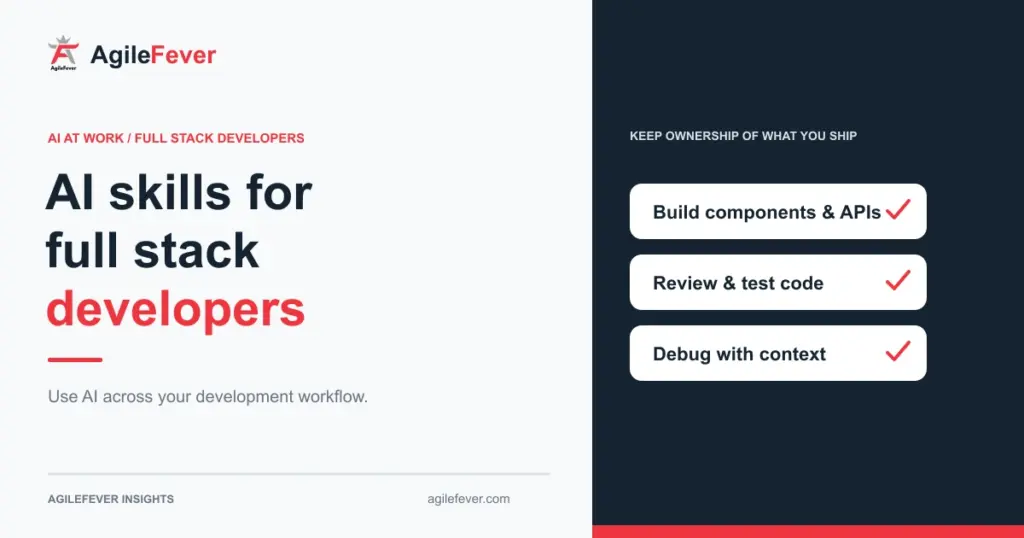
The page says it plainly: you are not learning to build AI products, you are learning to be a more productive full stack developer with AI. That shapes everything below. The skills are about shipping your own code faster while staying responsible for it, so each one comes with a review step, and the course lists review as part of the outcome.
The six skills and where they are taught
| Skill | What you do | Module | Type of AI | What stays your job |
|---|---|---|---|---|
| Frontend generation | Turn a UI requirement into a working component | 1 | GenAI | Review and refine the generated code |
| Backend, API and schema generation | Generate backend logic, OpenAPI contracts, schemas and queries from requirements | 2 | GenAI | Check logic, data access and edge cases |
| Documentation | Docstrings, READMEs, commit messages, PR descriptions, onboarding and design docs | 3 | GenAI | Make sure the document is true |
| Code review and security | AI review across a full diff, OWASP Top 10 detection, secrets management, standards enforcement | 4 | Agentic AI | Decide what to fix and what to ignore |
| Testing | Test generation across the codebase, edge-case discovery, integration tests, coverage analysis | 5 | Agentic AI | Judge whether the tests test the right thing |
| Debugging | Multi-step investigation across logs and stack traces, root cause reasoning, profiling and reproduction | 6 | Agentic AI | Confirm the cause before shipping the fix |
6 modules
The split is even. The first half uses a model to produce things from a prompt. The second half uses agents that take several steps across your code, logs and test results. Those need more oversight, because an agent that can change things can change the wrong thing.
What the course asks of you before you start
- Python for AI (6 hours), completed before joining.
- Working knowledge of at least one modern stack, in any language.
You do not need to use a particular framework. The examples follow a running feature built across the course, so the habits transfer to the stack you use.
How you are assessed
The final exercise is practical. You fix a seeded bug and extend the feature you built during the course. A short final test covers all six skills, and passing it earns the AgileFever Certificate of Completion. There is no external exam.
Where the course stops
- It does not teach you to build AI features for users, such as a retrieval chatbot inside your product. For that, look at the GenAI and Agentic AI BootCamp or the Gen AI BootCamp.
- It does not replace your team’s review process. The course trains you to review AI output, and your team still owns what ships.
- It does not choose a tool for you. Take the habits to whichever assistant your employer allows.
Course facts
| Item | Detail |
|---|---|
| Fee (US) | $450 |
| Monthly EMI | From about $19 a month through finance partners |
| Format | Live virtual, 12 hours over 4 days, Thursday and Friday |
| Next cohort listed | November 19 to 27, 2026, 9:30 AM to 2:30 PM Eastern |
| Role transitions on the page | Full stack developer to AI-augmented engineer; backend developer to AI-accelerated backend engineer; technical lead to AI-driven code quality owner |
Additional discounts are available. Contact us to know more.
If you are thinking about a broader career change, read Full Stack Developer to AI Solutions Engineer and Full Stack Developer vs Forward Deployed Engineer. The complete guide is here, and the program page is GenAI & Agentic AI for Full Stack Developers.
Questions people ask
Will I build AI applications in this course?
No. The page says you are learning to be more productive as a full stack developer with AI, not to build AI products.
Which language does it use?
The page asks for working knowledge of at least one modern stack in any language, plus Python for AI as the prerequisite.
Are sessions recorded?
Yes. Live sessions are recorded.