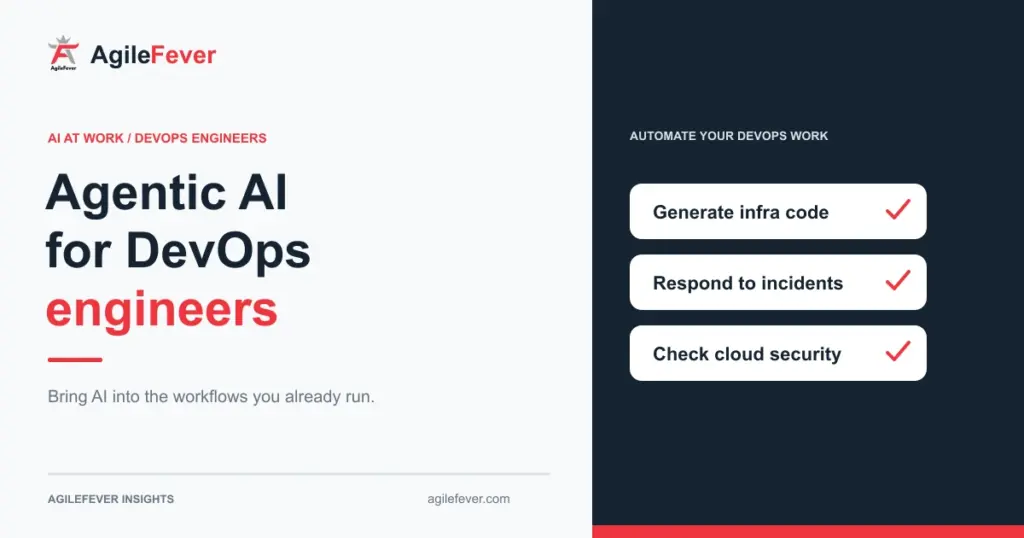
GenAI & Agentic AI for DevOps Engineers is a 12-hour course about using AI in the DevOps job you already have. It isn’t about becoming an ML engineer. You use generative AI to produce infrastructure code, then build agentic AI for DevOps, agents that watch for drift, respond to incidents, and check compliance, connected to the cloud and monitoring tools your team runs.
This guide walks through what you build, what you need first, and how it compares with the longer MLOps BootCamp.
The agentic AI for DevOps course at a glance
| Format | Live online with live coding and hands-on labs, three consecutive days |
| Hours | 12 |
| Modules | 4, ending with a project you design and deploy |
| Prerequisite | Python for AI (6 hours); familiarity with Git, CI/CD, Docker, a cloud platform, and infrastructure as code |
| Extra cost | About $10 of OpenAI API credit covers all labs |
| Bonus | The AI Blueprint (4 hours) is included free with enrollment |
| Assessment | No formal exam; certificate of completion from AgileFever |
| Current price | $450 or ₹25,000 |
Additional discounts are available. Contact us to know more.
What each module builds
| Module | What you build |
|---|---|
| Generative AI for infrastructure automation | Three scripts that turn requirements into Terraform, Dockerfiles, and CI/CD pipeline configs, then validate the output with tools like terraform fmt and validate |
| Agentic AI for incident and cost automation | Three agents: one that compares live cloud state with Terraform and flags drift, one that diagnoses alerts and runs safe runbooks, and one for cost optimization |
| Security and monitoring integration | A compliance agent that runs CIS checks, scans for exposed secrets and over-broad IAM permissions, and reports findings by severity |
| Build and deploy your project | A project of your own design that uses at least two agents and at least two cloud or monitoring tools, deployed and tested by the end of the day |
The agents connect to tools like Slack, Jira, and PagerDuty, and cover SRE work such as incident response, runbooks, and post-incident documentation as well as CI/CD and infrastructure as code.
Where the agents act, and where you approve
The course design keeps a person in the loop for changes that matter. The drift agent proposes fixes and applies them with approvals; the compliance agent auto-remediates only low-risk findings. That’s the right instinct, and it’s worth carrying into anything you build afterward.
| Task | Reasonable for an agent to do alone | Keep a human approval |
|---|---|---|
| Generating Terraform or pipeline config | Draft it and run validation | Merge and apply |
| Infrastructure drift | Detect and report it, draft the fix | Apply the fix to production |
| Incidents | Collect logs, suggest a root cause, run read-only checks | Restarts, rollbacks, or anything that changes state |
| Compliance findings | Fix clearly low-risk issues and report them | Anything touching IAM, networking, or data |
The real time commitment
Hours listed on the course pages
Source: AgileFever course pages, October 2026.
No machine learning background is needed. The course assumes you know pipelines, cloud infrastructure, and the terminal.
This course or the MLOps BootCamp?
| GenAI & Agentic AI for DevOps Engineers | MLOps BootCamp | |
|---|---|---|
| Goal | Use AI to automate your current DevOps work | Move into running ML and LLM systems in production |
| Hours | 12 | 60 |
| You’ll learn ML? | No | Yes, enough to deploy and monitor models |
| Price | $450 or ₹25,000 | $2,000 or ₹75,000 |
If you want to stay in DevOps or SRE and become faster at it, take this course. If you want a different job, operating machine learning platforms, take the bootcamp. We cover that choice in more detail in Is the MLOps BootCamp right for DevOps engineers?
Who it’s for
DevOps engineers, SREs, cloud and platform engineers, infrastructure engineers, and backend developers who carry DevOps duties. SREs tend to get most from the incident and monitoring work; pipeline-focused engineers from the CI/CD and infrastructure-as-code generation.
Upcoming dates
| 2026 | 2027 |
|---|---|
| November 9 to 11 | January 4 to 6 |
| December 7 to 9 | February 1 to 3 |
| – | March 1 to 3 |
| – | April 5 to 7 |
Check the course page for time zones.
Additional discounts are available. Contact us to know more.
FAQ
Is this AIOps?
Largely, yes. It covers the practical side of AIOps: log analysis, anomaly detection, and auto-remediation with tools available today, rather than building custom ML models.
Which cloud does it use?
Examples include AWS, and you can adapt the generated infrastructure code for AWS, GCP, or Azure.
Do I need OpenAI API experience?
No. API setup is covered in the course.
What to read next
For more ways to use AI in DevOps work, read GenAI and agentic AI use cases for DevOps engineers.