













































Written by the AgileFever editorial team. Facts checked on November 16, 2026 against the official pages of the organizations named in this post. AgileFever sells training for some of the topics covered here, and we say so wherever it applies. Exam facts come from PMI. The 4-step method, the time budget and the practice routine are ours, and we label them that way.
PMP situational questions give you a short story from a project and ask what the project manager should do. Four answers look sensible. One fits the situation better than the others. People who know the material still lose marks here, because they answer from their own workplace habits or pick the first option that sounds professional.
This post gives you a repeatable way to read and answer PMP situational questions, three worked examples, a table for choosing between two close options, a list of common traps and a practice routine. It pairs with our guide to agile and hybrid PMP questions, which covers the 60% of items that are not purely predictive.
What PMI says the exam contains
Everything in this section comes from PMI’s July 2026 Exam Content Outline, read November 16, 2026. PMI describes the exam as built from “a series of scenario-based questions”. So PMP situational questions are not one special type. They are the exam.
| Question type | What PMI says it is | Where it is offered |
|---|---|---|
| Case or scenario (new) | A detailed situation, sometimes with graphs or charts, followed by a series of questions that all rely on it | All modalities |
| Graphic-based (new) | You read a chart, graph, diagram or image, then answer from it | All modalities |
| Multiple choice, single response | Several choices, one correct | All modalities |
| Multiple response | Several choices, more than one correct | All modalities |
| Matching | Pair items from different lists by dragging | Test center only |
| Enhanced matching | Drag boxes to locations on an image or chart | Test center only |
| Point and click (hotspot) | Click the correct areas on an image | Test center only |
| Pull-down list | Pick the answer from a drop-down | Test center only |
Source: PMI Exam Content Outline, July 2026, exam question types section. PMI says the exact number of items per question type and approach may vary by form.
Three facts matter for your technique. First, PMI says that for the center-based exam the first break comes after the case-study section, so you meet case questions early. Second, in a case set every question depends on one situation, so reading it carefully pays several times. Third, if you take the exam online, only the all-modality types in the table apply, so check how you will sit the exam before you drill drag-and-drop items.
PMI’s published weights for the July 2026 exam. Situational items appear in all three.
Source: PMI Exam Content Outline, July 2026, read November 16, 2026.
PMI: about 40% predictive, the remaining 60% divided between agile and hybrid. PMI does not publish the agile and hybrid split.
- Predictive, about: 40
- Agile and hybrid together, about: 60
Source: PMI Exam Content Outline, July 2026. PMI says these approaches appear throughout all three domains and are not isolated to any task.
The time you actually have per question
PMI states 180 questions in 240 minutes. Divide and you get 80 seconds per question. PMI’s FAQ on the new exam says the 240 minutes include two 10-minute breaks. If the breaks come out of that total, 220 minutes remain for 180 questions, or about 73 seconds each. Plan on 73 to 80 seconds and you will not be caught short.
Ten of the 180 questions are unscored pretest items, placed at random, and you cannot tell which. Treat every question as scored.
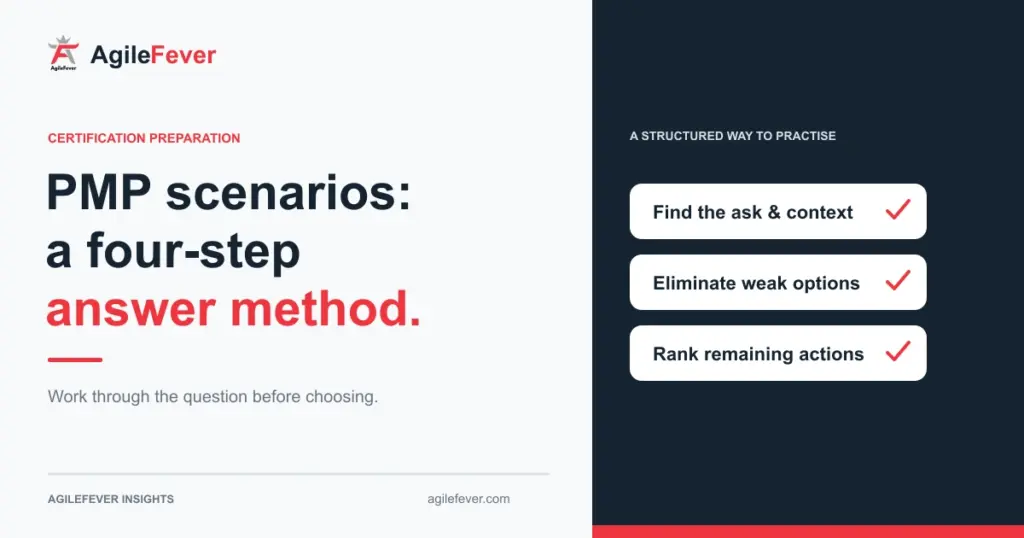
Our 4-step method for PMP situational questions
PMI does not publish a method for answering its questions. The steps below are ours, built from how scenario items are written. They work because they force you to read in a fixed order, which cuts rushed answers.
Read the last sentence first. Circle the question word: first, next, best, most likely, or what should NOT be done. Note who is acting. About 10 seconds.
Read the story once. Find three things: the approach (predictive, agile or hybrid), the domain (people, process or business environment), and whether the facts are known or still unclear. About 30 seconds.
Remove every answer that acts on missing facts, skips an agreed process, exceeds the project manager’s authority, or ignores the people affected. Usually two remain. About 25 seconds.
Use the decision table below to choose between the two survivors, then move on. About 15 seconds.
Our time budget in seconds. Illustrative example, not a PMI standard.
- Find the ask: 10
- Read the situation: 30
- Cut options: 25
- Rank the survivors: 15
Step 1: find the ask
Most PMP situational questions end with a short question like what should the project manager do first. That sentence decides everything. First asks for the earliest sensible action. Next asks what follows from what has already happened. Best asks you to compare actions that are all acceptable. Reading it before the story tells you which details to look for.
Step 2: read the situation
Look for approach cues. Words like sprint, backlog, product owner or iteration point to agile. A baselined plan, change control board or formal sign-off point to predictive. A mix points to hybrid. Then classify the problem: a person issue, a process issue or an outside-the-project issue. The three domains in PMI’s outline map to these.
Decide one more thing here: do you know the facts? Stems often say a stakeholder claims something, a report suggests a delay or a team member is unhappy. A claim is not a confirmed fact, and that changes the right answer.
Step 3 and 4: cut, then rank
Cutting is faster than choosing. An option that acts before anyone has assessed the problem goes. So does one that bypasses change control, and one that makes a decision the project manager does not own. What you keep usually splits into two sound options, one that acts now and one that checks first, or one that handles it directly and one that escalates. The next table handles that split.
Choosing between two options that both look right
| If the stem shows | Prefer the option that | Its common wrong twin |
|---|---|---|
| A claim, rumor or report with no confirmed detail | Assesses or verifies, then acts | Acts on the claim immediately |
| A change to scope, schedule or cost on a plan with a change process | Evaluates impact and follows the change process | Approves or rejects on the spot |
| A decision above the project manager’s authority, such as budget beyond tolerance | Escalates with analysis and response options | Escalates the bare problem, or decides alone |
| A conflict between two people or two stakeholders | Brings the parties together to reach agreement on the facts and roles | Reports it upward or sides with one |
| An agile team with a self-organizing signal | Facilitates and coaches the team to decide | Assigns tasks or overrides the team |
| A known risk that is about to occur | Uses the planned response or reserves, then updates the register | Starts a new analysis from zero |
| A question that asks what to do first and the facts are already clear | Takes the first concrete step in the process | Schedules a meeting to discuss |
This table is our decision aid, drawn from the pattern of scenario items. PMI publishes no such rule table, and individual questions can differ. The stem always wins over the table.
PMI’s own sample questions on its PMP certification page, read November 16, 2026, show the first row at work. In its three samples, the correct option evaluates the impact, meets the stakeholder to review roles and authority, or assesses the impact and response options with the team before acting. The options that reject, implement or escalate straight away are the wrong ones. Three samples do not make a law, but they show how PMI writes the first-or-next question.
Three worked examples
Each example is an illustrative example, not a real exam question. The options are ours.
Example 1: process domain, predictive
A data-migration project follows an approved plan. Testing shows the field mapping for one legacy system was wrong, and the customer’s finance lead wants the go-live date kept. What should the project manager do first?
| Option | Verdict | Reason |
|---|---|---|
| A. Move the go-live date and tell the steering group | Cut | Acts before the size of the problem is known |
| B. Assess how many records are affected and the effect on schedule, cost and quality | Best | The facts are unclear, so the first step is to find out |
| C. Ask the team to work weekends to fix it | Cut | Commits resources to an unmeasured problem |
| D. Log it as a risk and continue | Cut | The problem has occurred. It is an issue, not a risk |
Illustrative example, not a real exam question.
Example 2: people domain, agile
In a two-week sprint, the product owner adds new items almost every day. The team misses the sprint goal twice and morale drops. What should the project manager do next?
| Option | Verdict | Reason |
|---|---|---|
| A. Tell the product owner to stop adding items | Cut | Overrides a role instead of building agreement |
| B. Facilitate a discussion between the product owner and team on the sprint goal and how mid-sprint changes are handled | Best | Fits the agile cue and addresses the cause |
| C. Extend the sprint to three weeks | Cut | Agile approaches generally keep the timebox fixed |
| D. Escalate to the sponsor | Cut | The team and product owner have not tried to resolve it |
Illustrative example, not a real exam question.
Example 3: business environment domain
A product ships in eight weeks. A new privacy rule may make one planned feature non-compliant. The compliance officer is unsure. What should the project manager do next?
| Option | Verdict | Reason |
|---|---|---|
| A. Remove the feature now | Cut | Changes scope on an unconfirmed claim |
| B. Ask the compliance officer to confirm the requirement, assess the impact on scope and schedule, then use change control if needed | Best | Verifies first, then follows the process |
| C. Ship as planned and fix it later | Cut | Ignores a compliance duty |
| D. Ask the sponsor to decide | Cut | Escalates before the analysis exists |
Illustrative example, not a real exam question.
Notice that Example 1 and Example 3 share a shape: the stem contains an unconfirmed fact, and the best option verifies it before acting. That is the most common shape. It is not the only one. If Example 3 had said the compliance officer confirmed the feature is illegal, the best option would move straight to a change request.
Common traps in PMP situational questions
| Trap | How it looks | How to avoid it |
|---|---|---|
| Answering from your own job | You pick what your employer would do | Answer for the project in the stem, with the roles and process it describes |
| Jumping to the fix | The option solves the problem fast | Check whether the facts are confirmed |
| Escalating too early | Sounds responsible | Ask if you own the decision, and escalate with options if you do not |
| Missing the approach | A predictive reflex in an agile story | Look for sprint, backlog or product owner words in step 2 |
| Ignoring the question word | You pick a good action that is not the first one | Reread the ask before you lock in |
| Missing NOT or EXCEPT | You pick the best action when asked for the worst | Mark the negative word in step 1 |
| Treating the first plausible option as final | Option A sounds right so you stop | Read all four. Two often fit |
A practice routine for PMP situational questions
Our routine takes 20 questions per session. At 80 seconds each, 20 questions take about 27 minutes. Add 30 minutes of review and the session is under an hour. It fits inside the daily blocks of our 8-week PMP study plan and the fast-track 4-week plan.
| Part | Time | What to do |
|---|---|---|
| Timed set | About 27 minutes | 20 questions, 80 seconds each, no pausing, using all four steps |
| Mark your reasoning | During the set | Write the ask and the one fact that decided your answer, in a few words |
| Review every miss and every guess | About 30 minutes | Name the cause: missed the ask, missed the approach, acted on an unconfirmed fact, authority, rushed |
| Write one rule | 2 minutes per miss | One sentence, such as: check whether the fact is confirmed |
| Weekly count | 10 minutes | Count causes. Fix the most common one first |
Guesses that landed correctly count as misses, because the exam will find the same gap again. Choose question sources that explain why each wrong option fails, not only which letter is right. Run one full timed mock in a single sitting before you book, because stamina is part of PMP situational questions. For what a score does and does not mean, read our post on the PMP passing score, since PMI publishes no passing mark to aim for.
Where courses fit, and what to check first
You need 35 hours of training to apply. Our guide to the PMP 35 contact hours explains what counts. PMI says live classes completed on or after December 1, 2026 count only if an authorized training partner or eligible academic program delivers them. Training completed before that date stays eligible under the current rules, per PMI’s new-exam page, read November 16, 2026. Search PMI’s directory before you pay any provider.
AgileFever lists a PMP course on its PMP training page. Check the page for current details and confirm eligibility with PMI before you rely on any live class. For a broader view of difficulty, see how hard the PMP exam is and how to crack it.
Questions people ask
What are PMP situational questions?
They are scenario items that describe a project problem and ask what the project manager should do. PMI’s outline says candidates answer a series of scenario-based questions and apply concepts and experience to on-the-job situations. Several options look reasonable, and you choose the best one.
How many PMP situational questions are on the exam?
PMI does not publish a separate count. The exam has 180 questions, 170 scored and 10 unscored, and PMI describes it as scenario-based. Plan to treat nearly every item as a situation to read, not a fact to recall.
How much time do I get for each question?
PMI allows 240 minutes for 180 questions, an average of 80 seconds. PMI’s FAQ says the 240 minutes include two 10-minute breaks, so if breaks come out of that total you have about 73 seconds. Case sets share one story across several questions.
What if two answers both look correct?
Reread the question word first, then check whether the facts are confirmed and whether the action belongs to the project manager. Our decision table above covers common splits, such as assess versus act and handle versus escalate. Choose and move on.
Are the PMP situational questions mostly agile now?
PMI says about 40% of items represent predictive approaches and the remaining 60% are divided between agile and hybrid. They appear across all three domains. Practise reading the approach cue before choosing.
Do I need to memorize ITTOs for these questions?
PMI’s outline lists domains, tasks and enablers, not a list of inputs and outputs to memorize. It says the exam assesses your ability to think critically and apply practices from experience leading projects. Know the concepts well enough to judge a situation, then practise applying them under time.
