












Written by the AgileFever editorial team. Program details were checked against the live program pages in October 2026. We run this program. The details come from its published curriculum, and we say where LLM and agent operations get less depth than the rest.
People searching for LLMOps skills usually want to know one thing: after the course, can I run an LLM application in production without it falling over? This post breaks the relevant part of the program into skills, says where each is taught, and is plain about what is only introduced.
The skills and where they sit in the program
| Skill | What you do | Program module | What is left for you to practise |
|---|---|---|---|
| Tracing and evaluation | Evaluate LLM answers and trace agent steps | 16 and 17 | Building your own evaluation set for your domain |
| Retrieval pipelines (RAG) | Build a RAG chatbot and deploy it as an API | 16 | Chunking and index tuning on messy company documents |
| Prompt basics | Write and test prompts for repeatable behaviour | 16 | Prompt versioning across teams |
| Agent design and tool calling | Build an agent that calls tools and runs multi-step workflows | 17 | Larger multi-agent systems and memory |
| Guardrails and human review | Add limits and human-in-the-loop checks | 17 | Policy and compliance review in your company |
| Delivery pipeline | Automate training, tests and deployment with CI/CD | 7 | Release approvals in your own pipeline |
| Runtime and scale | Containerise, orchestrate and monitor services | 11 to 14 | Cost and capacity planning at your traffic |
| Experiment and data tracking | Track runs and datasets with MLflow, DVC and DagsHub | 8 to 10 | Governance of who can promote a model |
Out of 17 modules
Additional discounts are available. Contact us to know more.
What this means in practice
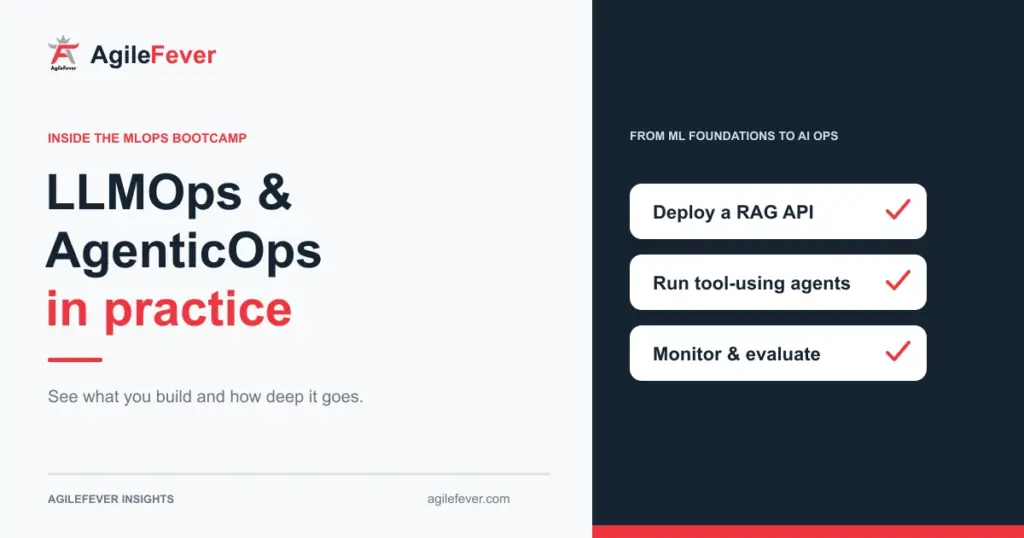
The program is MLOps first. Module 16 covers introduction to LLMs, prompt basics, retrieval, evaluation and deployment, with a lab that builds a RAG chatbot and deploys it as an API. Module 17 covers agent architecture and tool calling, workflows and multi-agent systems, tracing and evaluation, deployment and guardrails, with a lab that builds a tool-using agent. Together they are two modules of seventeen, so treat them as a solid first pass, not a specialisation.
How it compares with the other AgileFever programs
| If you want | Look at | Why |
|---|---|---|
| To run LLM apps and ML models in production | The MLOps, LLMOps and Agentic AI Ops BootCamp (60 live hours, $2,000) | Operations, CI/CD, containers and monitoring come first |
| To build agents in depth: memory, planning, multi-agent systems | The GenAI and Agentic AI BootCamp (74 hours, $2,000) | Eight modules on agent building |
| A short look at AI on one cloud | Enterprise AI Agents courses on Azure, AWS or Google Cloud (12 hours, $199 each) | Focused on a single platform |
It needs basic Python, and DevOps experience helps. For the full module list with labs, see the curriculum breakdown. Related reading: LLMOps vs MLOps and the complete guide.
Questions people ask
Do I need to know MLOps before the LLM modules?
The program teaches MLOps first, so no. If you already run CI/CD and containers, the early modules will be review and you can spend your effort on modules 16 and 17.
Is this enough to run LLM apps at work?
It gives you the operating pattern: build, deploy, trace and evaluate. Production at your company also needs your own data, policies and cost limits, which you apply after the course.
Are sessions recorded?
Yes. Live sessions are recorded.