















Written by the AgileFever editorial team. Program details were checked against the live program pages in October 2026. We run this program. Skills, modules and projects come from its program page, checked on October 28, 2026.
A list of topics does not tell you what you will be able to do afterwards. This post pairs each skill with the module that teaches it, the project that proves it, and the part you would still have to practise on your own work.
Eight skills and where they are taught
| Skill | What you do | Module | Project on the page | Still yours to practise |
|---|---|---|---|---|
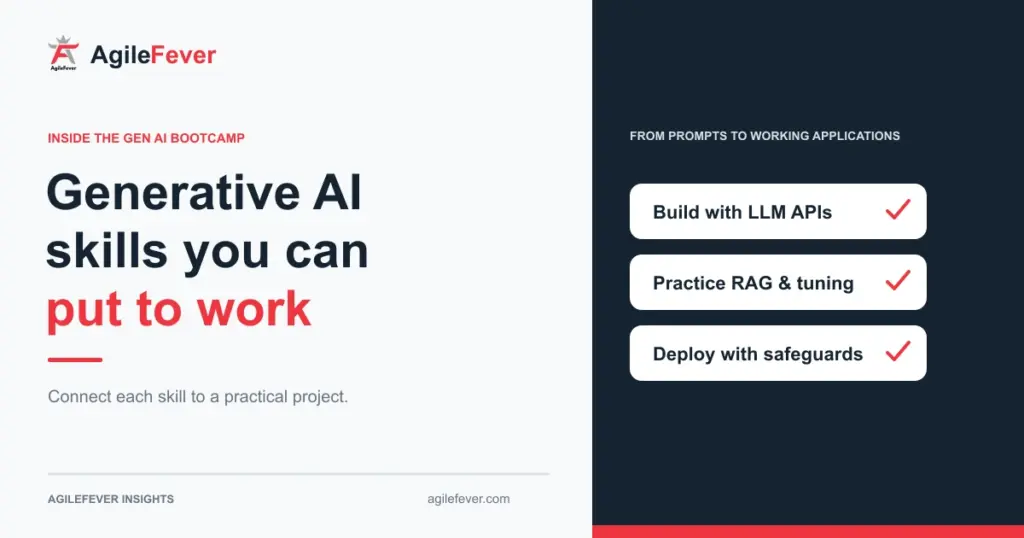
| Prompt engineering | Zero-shot, few-shot and chain-of-thought prompts, templates, testing and evaluation | 5 | Question-answering and summaries with chain-of-thought | Prompts tuned to your own domain and data |
| Working with LLM APIs | Tokenisation, attention, comparing GPT, LLaMA, Claude and Gemini, calling OpenAI and Claude APIs | 6 | A text generator built on an LLM API | Rate limits, retries and cost control in production |
| Retrieval (RAG) | Vector databases (FAISS, Pinecone, Weaviate), embeddings, LangChain and LlamaIndex pipelines | 7 | A knowledge-based chatbot with a vector database | Chunking and access control on messy company documents |
| Fine-tuning | LoRA, QLoRA and PEFT on Hugging Face, quantisation, training data preparation | 8 | A support-ticket classifier from an open-source model | Collecting and cleaning your own training data |
| Multimodal generation | Text-to-image and text-to-video tools, image prompting and ControlNet basics | 9 | Art and video generated from prompts | Brand and licensing review for real use |
| Productivity automation | Code assistants, task automation, document summarisation and report generation | 10 | A tool that generates code, reports or documentation | Fitting it to your team’s review process |
| Deployment | LangChain orchestration, Streamlit, Gradio, Docker, Hugging Face Spaces | 11 | An app launched with Streamlit, Docker or Hugging Face | Monitoring, scaling and authentication |
| Safety and ethics | Prompt injection, bias, hallucination control, copyright, moderation filters | 12 | A moderation filter for safe outputs | Your organisation’s own policy and review rules |
12 modules in total
Additional discounts are available. Contact us to know more.
How the skills build on each other
The first four modules cover Python, deep learning, NLP and the foundations of generative models. Prompting comes next because everything after it, retrieval and fine-tuning included, starts with a prompt that has to work. Retrieval and fine-tuning are the two ways to make a model know something it does not. Retrieval keeps the knowledge outside the model and is easier to update. Fine-tuning changes the model itself and is better for style or a narrow task. Deployment and safety come last because they apply to whatever you built before.
The capstone
You choose one of three full-stack GenAI applications: a legal assistant (LegalBot) that returns context-aware answers, an AI tutor that adapts its explanations, or a resume screener that parses, scores and ranks resumes against job requirements. Each one asks you to combine retrieval, prompting and deployment, so it tests how the skills fit together more than any single module does.
Assessment and prerequisites
| Item | What the page says |
|---|---|
| Assessment | A practical exam, lab assessment or project at the end of every module, and a capstone after the 72 hours |
| Prerequisite | Anyone can register. Basic Python is described as beneficial, and the audience list names Python developers, ML engineers, data scientists, data analysts and AI engineers |
| Hours | 72 listed in the headline and 70 in one FAQ. Confirm the current figure with an advisor |
| Price | No list price is shown on the page. Monthly EMI is listed as low as $125 |
What it does not teach
- Agents with memory and multi-agent systems. For those, look at the GenAI and Agentic AI BootCamp.
- Classical machine learning in depth. The AI and ML BootCamp covers statistics and models first.
- Cloud-specific services. The Azure, AWS and Google Cloud courses cover those.
For the module list with topics, read the curriculum breakdown. If you are not sure your Python is ready, this post helps you decide. The program page is the Gen AI BootCamp.
Questions people ask
What is the difference between retrieval and fine-tuning?
Retrieval keeps knowledge outside the model, so you can update it by changing the documents. Fine-tuning changes the model itself, which suits a narrow task or a particular style.
Do I build a project for every skill?
The page lists nine projects across the modules. Safety, deployment and multimodal generation each have one, and the capstone combines several skills.
Are sessions recorded?
Yes. Live sessions are recorded.