






Written by the AgileFever editorial team. Program details were checked against the live program pages in October 2026. We run this course. Module content, labs and exam coverage come from its program page, checked on October 26, 2026.
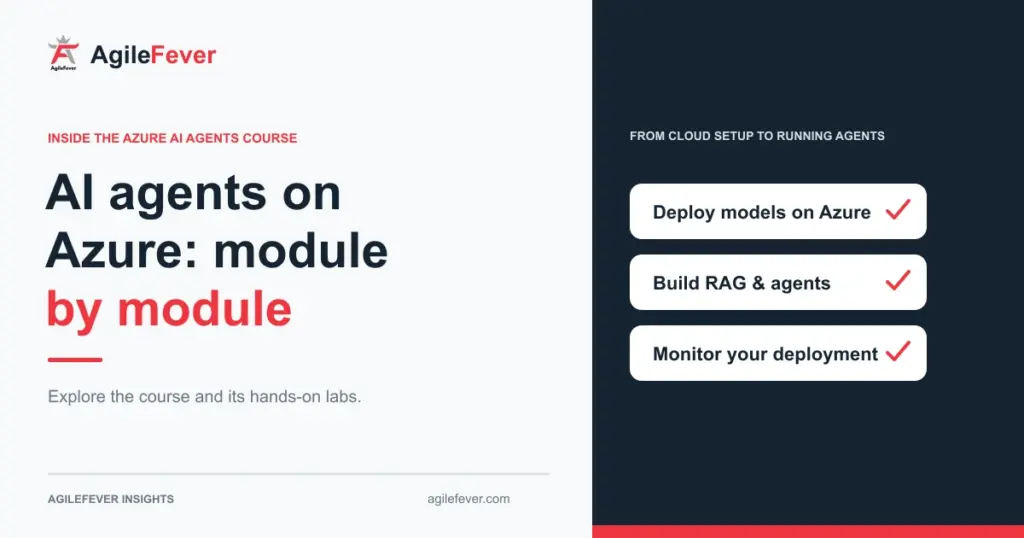
A 12-hour course has to be selective. This walkthrough shows what the six modules cover, which lab belongs to which module, and what the course deliberately leaves out, including the parts of the AI-103 exam that it does not teach.
The six modules
| # | Module | What you do | Outcome listed on the page |
|---|---|---|---|
| 1 | Azure and Foundry setup | Subscriptions, resource groups, Entra ID and managed identity, quotas and budgets; create a Foundry project and connect VS Code; set a budget alert | A working Foundry project connected to Python, with identity, quota and cost controls |
| 2 | Deploy ML and foundation models | Register a model in Azure Machine Learning and deploy a managed online endpoint with autoscaling and a blue-green split; deploy a foundation model and call it from Python | One ML model and one foundation model live on managed endpoints |
| 3 | Build LLM applications | Structured output and function calling; RAG with Azure AI Search; content safety, prompt-injection shields and evaluators | A RAG application over your own documents, with guardrails and evaluation scores |
| 4 | Build agents on Foundry | A single agent in the portal and in VS Code; function tools, code interpreter, MCP servers with approval controls | A working agent with tools, knowledge and memory |
| 5 | Multi-agent systems | Orchestration patterns (sequential, concurrent, handoff, group chat), shared state, human approval, the A2A protocol | A multi-agent system with an orchestrator, specialist agents and human approval |
| 6 | Deploy, monitor and operate | Deploy to Foundry Agent Service, tracing with Application Insights, evaluation, governance and cost controls | The multi-agent system running with tracing, guardrails and cost controls |
10 labs in total, as listed on the page
What you build
Three projects are deployed by the end: an ML endpoint, a RAG application and a production-oriented multi-agent system. The agents are written both in the Foundry portal and in Python with the Microsoft Agent Framework, which is a useful distinction. The portal is quick for prototypes. The code is what a team can review, test and put in a pipeline.
How it maps to the AI-103 exam
The page says the course covers the generative AI and agent skills in Microsoft’s AI-103 exam, which leads to the Azure AI Apps and Agents Developer Associate certification. It is specific about the limits.
| AI-103 area | Covered by this course? |
|---|---|
| Generative AI and agentic solutions (30 to 35% of the exam) | Yes |
| Planning and managing an Azure AI solution (25 to 30%) | Partly |
| Computer vision (10 to 15%) | No |
| Text and speech analysis (10 to 15%) | No |
| Information extraction (10 to 15%) | No |
Treat the course as preparation for the agent half of the exam, not the whole of it. The page points to an exam-prep add-on for anyone who intends to sit AI-103. Our certificate is a course completion certificate, issued after all six modules and the final demo. It is not a Microsoft certification.
Prerequisites
- The GenAI and Agentic AI BootCamp, or equivalent experience building agents.
- Working Python, including calling APIs and using SDKs.
- An Azure subscription with permission to create resources.
The Azure subscription matters. The labs run on live Azure resources, so you need an account where you are allowed to create them. Module 1 sets a budget alert for this reason, and module 6 returns to cost controls.
Dates and cost
| Item | Detail |
|---|---|
| Fee (US) | $199 |
| Monthly EMI | From about $9 a month through finance partners |
| Next cohort listed | November 16 to 19, 2026, Monday to Thursday, 3 hours a day, 9:30 AM to 12:30 PM Eastern |
| Format | Live virtual, 12 hours |
Additional discounts are available. Contact us to know more.
Who should look elsewhere
- If you have not built agents before, start with the GenAI and Agentic AI BootCamp. This course assumes you have.
- If your cloud is AWS or Google Cloud, we teach the same pattern on those platforms. See Azure vs AWS vs Google Cloud for AI agents.
- If you want one course across all three clouds, look at the Multi-Cloud AI Agents BootCamp.
For help deciding whether the course suits a cloud engineer, read is the Enterprise AI Agents course right for cloud engineers. The program page is Enterprise AI Agents on Azure (Microsoft Foundry).
Questions people ask
Is this a Microsoft certification?
No. You receive an AgileFever course completion certificate. The course is aligned to Microsoft’s AI-103 exam but does not replace sitting it.
Do I need an Azure account?
Yes, with permission to create resources. The labs run on live Azure resources.
Does the course cover LangGraph or CrewAI?
Module 5 shows how to bring a LangGraph or CrewAI agent onto Azure and connect it to others through the A2A protocol.
Are sessions recorded?
Yes. Live sessions are recorded.