

















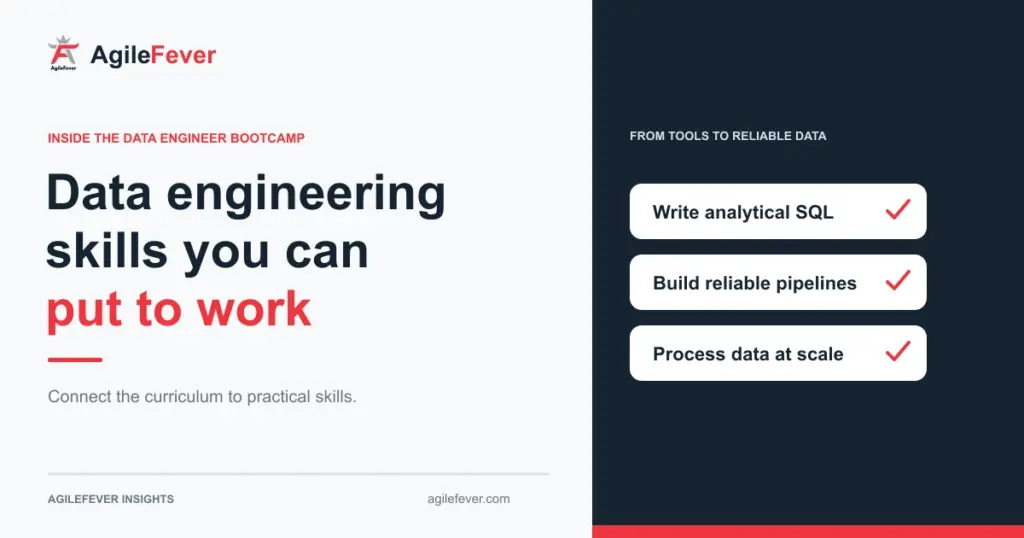
A data engineering curriculum lists tools: Spark, Airflow, Kafka, Snowflake. Employers hire for data engineering skills: can you build a pipeline that doesn’t break, model data so analysts can trust it, and keep costs under control? This post translates the Data Engineer BootCamp’s ten modules into the skills you’ll build, where they show up at work, and how to prove them.
Data engineering skills, module by module
| Skill | Where it’s taught | Where it shows up at work |
|---|---|---|
| Processing files and data in code | Python for data engineering | Reading CSV, JSON, and text files, cleaning them, and writing them out reliably |
| Writing analytical SQL | SQL for data engineering | Joins, window functions, and CTEs that answer business questions efficiently |
| Processing data at scale | Spark and PySpark | Transformations across millions of rows that won’t fit on one machine |
| Working on a shared codebase | Git and GitHub | Branching, merging, and resolving conflicts in pipeline code |
| Building reliable pipelines | Pipelines and orchestration | ETL and ELT jobs with retries, alerts, and logging in Airflow and Azure Data Factory |
| Working on modern data platforms | Databricks and Snowflake | Running workloads on clusters and warehouses your company already pays for |
| Handling real-time data | Kafka and streaming | Producers, consumers, topics, and partitions for event data |
| Shipping safely | CI/CD for data engineering | Automated tests and deployments for data jobs with GitHub Actions and Docker |
| Running in the cloud securely | Cloud platform (Google Cloud) | Storage, access control with IAM, and deploying compute jobs |
| Choosing the right architecture | Data architecture | Deciding between a warehouse, a data lake, and a lakehouse for a use case |
Where the effort goes
Number of modules per skill area
Source: AgileFever Data Engineer BootCamp curriculum, October 2026. Grouping is ours.
The skills that separate junior from mid-level
Knowing the tools gets you through an interview. These habits are what get you trusted with production pipelines:
| Habit | What it looks like |
|---|---|
| Idempotent jobs | Rerunning a failed job doesn’t create duplicate rows |
| Data quality checks | A pipeline fails loudly on nulls, duplicates, or a sudden drop in row counts, instead of loading bad data quietly |
| Cost awareness | Choosing partitions and cluster sizes so a query doesn’t scan the whole table every time |
| Clear ownership | Every table has an owner, a description, and a known refresh schedule |
| Backfills | Being able to reprocess last month’s data safely after a bug fix |
The bootcamp’s pipelines and CI/CD modules cover the tooling behind these. Making them habits takes practice, which is what the capstone is for.
How to show these skills to an employer
| Skill | Evidence that works |
|---|---|
| Pipeline design | Your capstone’s architecture diagram, with the reason you chose each component |
| SQL | Two or three queries using window functions, with a sentence on the business question each answers |
| Reliability | The retry, alerting, and data-quality checks you built into a pipeline |
| Streaming | A small Kafka example and an explanation of when you’d use streaming rather than batch |
| End-to-end ownership | The capstone: a data platform covering ingestion, transformation, warehouse, streaming, and CI/CD |
What this bootcamp doesn’t focus on
- Training machine learning models. The AI and ML BootCamp covers this
- Deploying and monitoring models in production. The MLOps BootCamp covers this
- AWS and Azure data services in depth. The cloud module focuses on Google Cloud
Dates and pricing
The Data Engineer BootCamp is 80 hours of instructor-led training with recorded sessions. Upcoming dates and pricing weren’t listed on the program page at the time of writing, so contact the team for the next batch.
Additional discounts are available. Contact us to know more.
What to read next
For the full program, read Data Engineer BootCamp: The Complete Guide. If you’re coming from backend development, see Is the Data Engineer BootCamp right for backend developers?