















Written by the AgileFever editorial team. Program details were checked against the live program pages in October 2026. We run this program. Module names and projects come from its published curriculum.
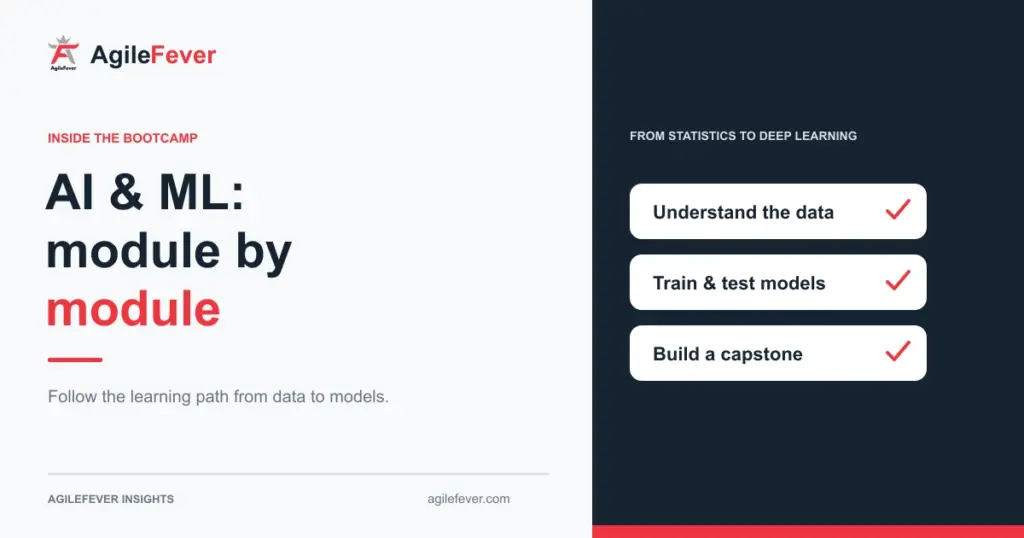
The order matters in a machine learning course. Statistics comes before models, and models come before deep learning. This walkthrough shows each module, what it covers and where the projects fall, so you can judge whether the sequence suits what you already know.
The nine modules
| # | Module | What it covers | Projects and labs |
|---|---|---|---|
| 1 | Fundamentals of data analytics | Analytics across domains, types of analytics, AI vs ML vs deep learning vs data science | Lab |
| 2 | Statistics basics | Population and sample, central limit theorem, central tendency and spread, descriptive and inferential statistics | Lab |
| 3 | Advanced statistics | Distributions, hypothesis testing, t and z tests, ANOVA, chi-square, probability | Lab |
| 4 | Python essentials for data science | Python fundamentals, OOP, NumPy and Pandas, Matplotlib | Lab |
| 5 | Data science with Python | Data science life cycle, EDA, cleaning, feature engineering, scikit-learn | Project 1: data science fundamentals |
| 6 | Supervised learning | Linear and logistic regression, evaluation metrics, classification algorithms | Includes a sales revenue prediction project |
| 7 | Unsupervised learning | Hierarchical clustering, K-means, choosing K, PCA | Clustering and PCA projects |
| 8 | Deep learning | Neural networks with TensorFlow and Keras, CNNs, OpenCV and image processing | CNN project |
| 9 | Natural language processing | Stop words, stemming and lemmatisation, TF-IDF, sentiment analysis, embeddings, topic models | NLP project |
Count of the 9 modules
Additional discounts are available. Contact us to know more.
Where experienced engineers would find review or new material
| If you already | Mostly review | Mostly new |
|---|---|---|
| Write Python for backend or data work | Module 4 | Modules 2, 3 and 6 to 9 |
| Work as a data analyst | Modules 1, 2 and 4 | Modules 6 to 9 |
| Build ML models already | Modules 1 to 6 | Deep learning and NLP depth, if you have not used them |
| Have never used statistics beyond averages | None | Modules 2 and 3 are the foundation for everything after |
What it does not cover
- Large language models and agents. For those, see the Gen AI BootCamp or the GenAI and Agentic AI BootCamp.
- Operating models in production. The MLOps BootCamp does that.
- Large-scale data engineering.
The page says no prior Python or ML background is required, and the 6-hour Python for AI course is suggested for people earlier in their career. For a choice between this and generative AI, read AI and ML BootCamp vs Gen AI BootCamp, and see the skills you build. The program page is the AI and ML BootCamp.
Questions people ask
Is the statistics heavy?
Two of nine modules are statistics, with hypothesis testing, ANOVA and chi-square. They set up the rest, and you apply them in Python in module 5 onward.
What is the capstone?
You choose between computer vision and customer churn prediction and build it from development to a working solution.
Are sessions recorded?
Yes. Live sessions are recorded.