













We run AgileFever, so we have an obvious interest in this comparison. We’ve tried to be fair to self-paced courses, which are the right choice for a lot of people.
You can learn most AI topics from a self-paced course for a fraction of what live cohort based learning costs. Many of the best ones are free. So the question isn’t whether the material is available. It’s whether you’ll finish, and whether what you finish with will help you at work.
This post explains what an AgileFever cohort does differently, what you pay for it, and when a self-paced course is the better choice.
The finishing problem
Self-paced courses have a well-documented completion problem. Researchers at Harvard and MIT tracked six years of their own courses on edX and found that among everyone who enrolled in 2017 to 2018, only about 3% completed. People who paid for a verified certificate did much better, but still often didn’t finish.
That doesn’t mean self-paced learning doesn’t work. It means it works for people who already have strong structure in their week. Most working professionals learning AI in the evenings don’t, and that’s the gap a cohort is designed to fill.
What cohort based learning changes
| Typical self-paced course | AgileFever cohort | |
|---|---|---|
| Schedule | Whenever you choose | Fixed live sessions with a start and end date |
| Questions | Discussion forum, if anyone’s answering | Asked live, answered by the instructor during the lab |
| Projects | Usually guided exercises with a known answer | Capstones built on business scenarios, reviewed in the session |
| Peers | Thousands of people at different points | One group moving through the same material together |
| Recordings | The course is the recording | Available for review after each live session |
| Career support | Rarely included | Resume, LinkedIn, and GitHub reviews plus mock interviews in the bootcamps |
| Cost | Free to a few hundred dollars | $199 to $2,200 in the US, depending on the program |
Additional discounts are available. Contact us to know more.
How much of each program is live
Our bootcamps are mostly live, with a small self-paced component for pre-work. The role-based courses are entirely live and much shorter.
Hours taught live with an instructor, excluding self-paced pre-work
Source: AgileFever program pages, October 2026.
What live time is actually for
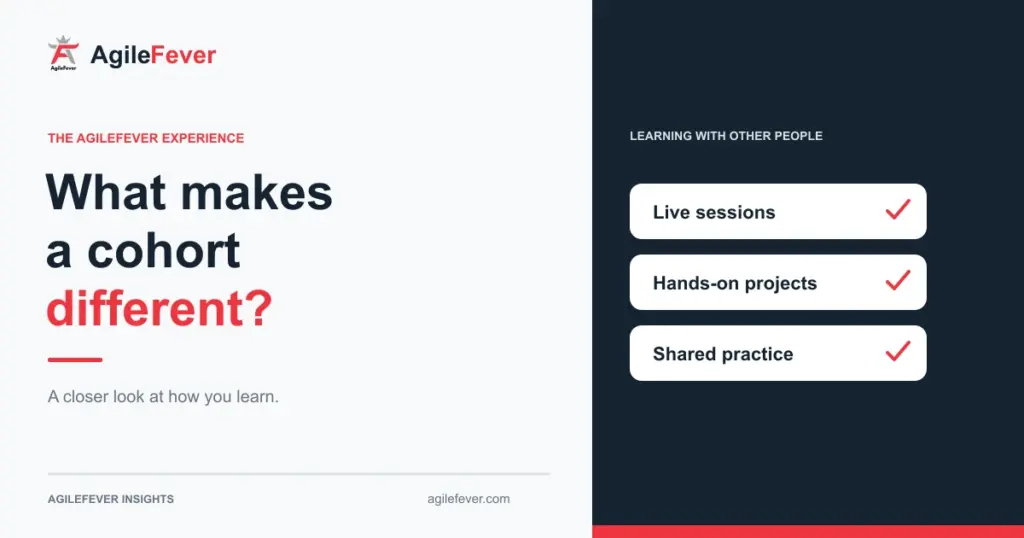
Live hours only matter if they’re used for something a video can’t do. In our sessions, most of that time goes to three things:
- Building alongside the instructor, so when your code breaks, someone sees it break and helps you fix it on the spot
- Working through capstones based on business scenarios, like claims processing or IT service desk resolution, rather than exercises with a single correct answer
- Questions about your own work, which is often where the most useful discussion happens
If a live program spends its sessions reading slides, you’re paying cohort prices for a self-paced course. That’s worth asking about before you enroll anywhere, including with us.
When a self-paced course is the better choice
- You want to explore a topic before committing money or evenings to it
- Your schedule changes too much to attend fixed sessions
- You already have the habit of finishing courses on your own
- You need one narrow skill, like a specific library, rather than a career change
- Your budget doesn’t stretch to a cohort right now
Plenty of people do a free course first, find out they like the subject, and then join a cohort to go deeper. That’s a sensible order.
Questions to ask any cohort provider
| Question | What a good answer sounds like |
|---|---|
| How many hours are actually live? | A specific number, separate from self-paced hours |
| Who teaches, and what have they built? | Named instructors with work you can look up |
| What happens if I miss a session? | Recordings, plus a way to get questions answered later |
| What will I have to show at the end? | Projects you can put on GitHub and explain in an interview |
| What exactly does career support include? | Specific services, not a promise of a job. We explain why we don’t offer job guarantees here |
Further reading
The completion data comes from Justin Reich and José A. Ruipérez-Valiente, The MOOC pivot, Science, 2019. For a wider look at the choice between formats, see AI courses vs bootcamps: which one to choose.