






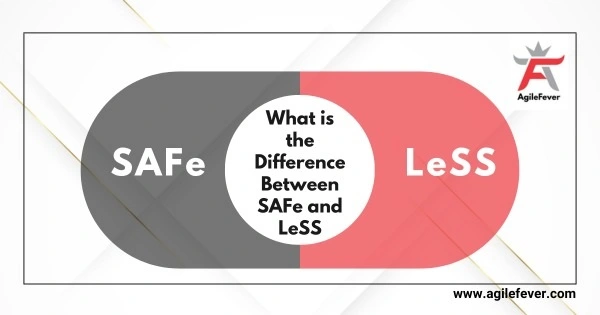
The challenge of scaling Agile development teams is today’s main focus of many software engineering conversations. While there are dozens of approaches to doing this, two popular, outcome-focused frameworks are the Scaled Agile Framework (SAFe) and Large-Scale Scrum (LeSS). Each approach has its own set of advantages, which can help organizations understand how best to structure their agile team for success. In this blog post, we’ll look at the differences between SAFe and LeSS, including the pros and cons of each framework so that you can make an informed decision on which one is the right fit for your organization.
What is SAFe® (Scaled Agile Framework)
SAFe (Scaled Agile Framework) is an approach that enables organizations to scale their agile methodologies across the enterprise. It is a knowledge base for proven and integrated principles for Lean-Agile development at the enterprise scale. SAFe guides how to structure and staff teams, plan and coordinate work, measure progress and effectively build large systems.
It promotes collaboration between agile teams across multiple levels of the organization.
By leveraging the existing Lean/Agile principles, practices, tools and technologies within an enterprise context, organizations can create a powerful platform for sustainable improvement. By guiding how to scale Agile throughout an organization’s operations—from product management to engineering to operations—SAFe® offers a comprehensive framework that enables enterprises to take advantage of all aspects of Agile development.
With SAFe, organizations can scale Lean-Agile practices across teams, programs and portfolios, with guidance on planning, roles and measurement.
The framework site organises SAFe into five Disciplines: Lean Portfolio Management, Team and Technical Agility, Product Development Flow, Large Solution Integration and Delivery, and Leadership and Culture. Two pieces matter most when you compare SAFe with LeSS:
- The Agile Release Train (ART). An ART is a long-lived team of Agile teams that develops, delivers and often operates one or more solutions in a development value stream. Scaled Agile says ARTs generally have 50 to 125 people. Teams are cross-functional and use SAFe Scrum and SAFe Kanban. Key ART roles include Product Management, the System Architect, the Release Train Engineer (RTE) and Business Owners.
- PI Planning. The ART plans in Planning Intervals (PIs). PI Planning is a cadence-based event for the whole train that aligns teams and stakeholders to a shared mission and vision. It is typically a two-day event held every 8 to 12 weeks, led by the RTE, and the teams that will do the work plan it. Each PI ends with an Inspect and Adapt event: a system demo, a review of what actually happened in the PI, and a retrospective with a problem-solving workshop.
Large-Scale Scrum (LeSS) framework
Large-Scale Scrum (LeSS) is an organisational design approach that scales one-team Scrum to many teams. According to less.works, it comes in two forms: LeSS, for up to eight teams, and LeSS Huge, for larger product groups of up to a few thousand people.
In LeSS, one Product Owner is responsible for the whole product, as in one-team Scrum, and many complete, cross-functional teams work together in one shared Sprint toward one shippable product. The Product Owner takes part in the multi-team events, and LeSS adds an Overall Retrospective.
A few more details from the LeSS site help in a comparison:
- Roles. There is one Product Owner and two to eight teams, with one Scrum Master for every one to three teams. LeSS has no project manager or team lead. Teams are self-managing, cross-functional, co-located and long-lived.
- One backlog. There is one Product Backlog for the whole product and no team backlogs. All prioritization goes through the Product Owner, and the Product Owner should not refine the backlog alone: teams work directly with customers and users on clarification. Each team still keeps its own Sprint Backlog.
- Feature teams. Teams are cross-functional feature teams of about three to nine people. They work in a shared code environment and do everything needed to produce a done item.
- Events. Sprint Planning One is common to all teams; Sprint Planning Two is usually held per team, with multi-team sessions for closely related items. There is one product-level Sprint Review. Each team holds its own Sprint Retrospective, followed by the Overall Retrospective, which deals with cross-team and system-wide issues and produces improvement experiments.
- LeSS Huge. The LeSS site calls eight teams an empirical upper limit rather than a fixed rule. LeSS Huge adds two or more Area Product Owners, who together with the Product Owner form the Product Owner Team. Each Requirement Area has four to eight teams.
- Principles and adoption. LeSS lists ten principles, including Large-Scale Scrum is Scrum, Systems Thinking, Lean Thinking, Empirical Process Control, Transparency, Whole Product Focus and Customer-Centric Thinking. Its adoption pages treat the change as an organizational design problem: culture follows structure, so adopting LeSS without changing structure, roles and policies does not give its full benefits. The same pages say a LeSS adoption has no change initiative, change group or change managers; change comes through continuous experiments.
Difference between SAFe and Large-Scale Scrum (LeSS) framework
SAFe and LeSS both facilitate large-scale agile software development for organizations of different sizes. However, there are some distinct differences between the two approaches. One commonly cited difference is that SAFe provides a more detailed set of roles, events and practices, while LeSS is a more minimal design built on one-team Scrum.
SAFe organises multiple agile teams into Agile Release Trains. LeSS has many cross-functional teams working from one product backlog with one Product Owner.
The table compares the two as each vendor describes itself. It leaves out judgments about which is better.
| Topic | SAFe | LeSS |
|---|---|---|
| Starting point | An operating model for applying Lean and Agile across an organization, with five Disciplines | One-team Scrum scaled to many teams; an organizational design approach |
| Grouping of teams | Agile Release Train, generally 50 to 125 people | Two to eight teams in LeSS; more in LeSS Huge, split into Requirement Areas of four to eight teams |
| Product ownership | Product Management and Product Owners, with Business Owners on the train | One Product Owner for the whole product; Area Product Owners in LeSS Huge |
| Backlog | An ART backlog | One Product Backlog, no team backlogs |
| Cadence | Planning Intervals, with PI Planning typically every 8 to 12 weeks | One common Sprint across all teams |
How to Choose Between Them
Neither framework is a drop-in answer, so start from your own situation. These questions help:
- How many people build the product? A group of around 50 to 125 people matches the size of one ART. A few teams working on one product match the LeSS starting point.
- Are you willing to change structure and roles? LeSS asks you to reorganize around feature teams and one Product Owner, and says its benefits depend on it. SAFe gives you named roles and events to add around existing teams, though the Implementation Roadmap still expects significant organizational change.
- Do you need portfolio-level funding and governance? SAFe covers it under Lean Portfolio Management. The LeSS pages we reviewed focus on product groups rather than portfolio funding.
Ultimately, both SAFe and LeSS provide organizations with viable options for scaling their software development practices. Organizations should evaluate which approach best fits their needs before deciding which framework to adopt. By understanding the differences between the two frameworks, organizations will be better equipped to choose the optimal framework for their development process.
Best Courses to Learn SAFe® (Scaled Agile Framework) Implementation
Anyone interested in implementing SAFe® for their organization should begin by familiarizing themselves with the concept of the Scaled Agile Framework. To benefit from that understanding and make optimal use of it, the next step is to enroll in a course designed to help individuals learn the basics of scaling agile principles. There are a range of courses available, such as SAI’s Leading SAFe®, which provides expert instruction from certified SAFe Practice Consultants as well as guidance on earning a SAFe certification.
Furthermore, various self-paced courses offer flexibility on every budget, with offerings that can provide foundational knowledge or targeted learning resources for experienced professionals. With so many opportunities to access quality education, there are some SAFe courses by AgileFever to meet your unique needs and provide an in-depth look at how to implement SAFe successfully within your organization.
- Implementing SAFe® (SPC Certification)
- SAFe® Release Train Engineer Training (RTE Certification)
- SAFe Scrum Master Training (SSM Certification)
- Leading SAFe for Government Certification Training
- SAFe® DevOps Certification Training
- SAFe for Architects Certification Training
- SAFe Agile Software Engineering Certification Training
- SAFe Advanced Scrum Master Certification Training
- Lean Portfolio Management Training (LPM Certification)
Scaled Agile has dropped version numbers from course and certification names; these courses are now part of AI-Empowered SAFe, certifications renew every year, and certified members get the SAFe CoPilot AI assistant.
For those looking to implement the Scaled Agile Framework (SAFe®) properly, courses featuring insights and advice from experts are essential. Learning how to put SAFe’s Lean-Agile principles into practice effectively is important for successfully scaling the framework.
The best courses to learn SAFe implementation offer extensive instruction in concepts, such as Agile release trains and PI planning, as well as real-world scenarios that provide insight into alignment between team members from different departments. All of this culminates in a blended learning experience that covers all areas required to apply SAFe principles effectively.
Conclusion
If you are looking for a comprehensive course to learn how to implement SAFe, look no further. The courses we’ve highlighted will give you the skills and knowledge you need to get started with SAFe. With this training, you can help your organization move towards agile development and scaling practices.