
AI BootCamps (7 Courses)






















 Course Category
Course Category
Course Category
Building a proof-of-concept AI model or typing an intuitive prompt into a chat interface is incredibly easy; anyone can spin up a prototype in an afternoon. However, moving that prototype into a secure, reliable, and cost-effective enterprise ecosystem is an entirely different battle.
According to recent enterprise tech surveys, over 75% of organizations are actively deploying artificial intelligence within their workflows. Yet, the vast majority of these initiatives stall during deployment.
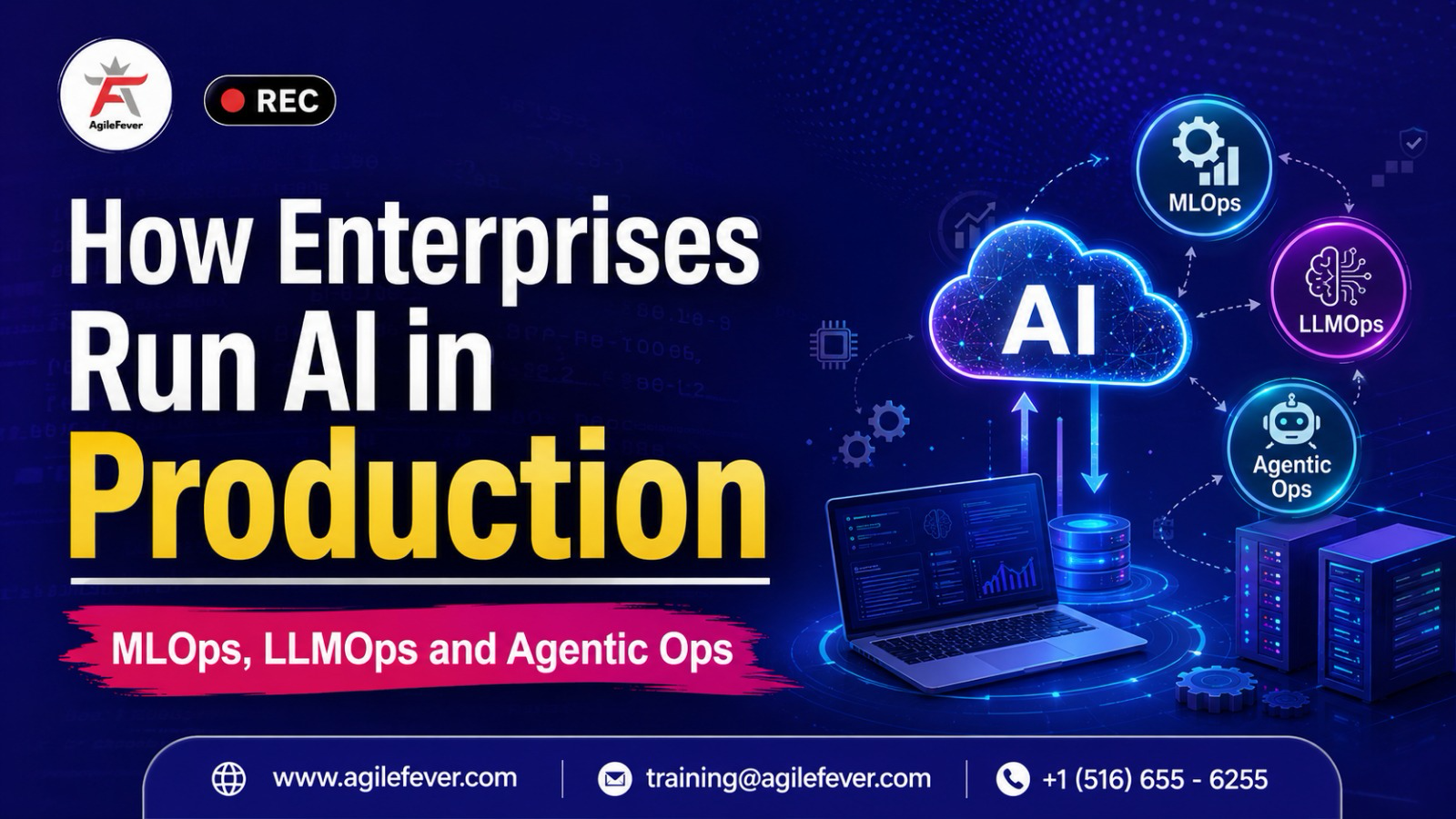
To scale artificial intelligence successfully without breaking infrastructure budgets or exposing sensitive data, engineering teams must master three distinct evolutionary pillars of software infrastructure: MLOps, LLMOps, and the emerging frontier of Agentic Ops.
Before the explosion of Generative AI, traditional Machine Learning Operations (MLOps) served as the standard framework for handling classical, predictive statistical models. If your enterprise builds or maintains fraud detection algorithms, churn prediction metrics, recommendation engines, or risk assessment software, you are operating within the classical MLOps lifecycle.
[ Data Ingestion ] ──► [ Feature Store (Feast) ] ──► [ Custom Training (PyTorch) ] ──► [ Model Registry (MLflow) ]
Traditional MLOps is heavily deterministic and relies on internal, proprietary data. The pipeline generally adheres to a strict sequence:
The primary risk in traditional MLOps is data drift and concept drift. Because predictive models rely on static historical data patterns, changes in real-world user behavior cause the model’s accuracy to degrade rapidly over time.
The Solution: Maintaining rigid Continuous Integration and Continuous Deployment (CI/CD) pipelines via GitHub Actions or GitLab CI. Automated testing monitors real-time data inputs and triggers automated retraining loops the moment model accuracy dips below a baseline threshold.
The massive rise of foundation models—such as GPT-4, Claude, and open-weights alternatives like Llama—completely changed enterprise infrastructure needs. Instead of spending months training models from scratch, software engineers began consuming massive pre-trained systems via APIs or local weights. This operational shift created LLMOps.
[ User Input ] ──► [ Vector Database (Pinecone) ] ──► [ Contextual Prompt ] ──► [ Foundation Model API ]
In LLMOps, infrastructure priorities pivot from training loops to prompt management, context injection, and complex data retrieval. The gold standard for enterprise LLM deployment is a Retrieval-Augmented Generation (RAG) pipeline:
Engineering forums on Reddit and Quora highlight a common set of complaints when running LLMs at scale: extreme API latency, model hallucinations, data privacy leaks, and unpredictable cloud compute bills.
To protect budgets and data integrity, modern LLMOps uses framework orchestration engines like LangChain or LlamaIndex paired with efficient fine-tuning techniques like LoRA (Low-Rank Adaptation). This setup allows teams to deploy highly targeted, smaller open-source models that perform specific data-handling tasks at a fraction of the cost of cloud-based frontier APIs.
We are rapidly moving past the era of passive, chat-based interfaces. Enterprise applications now utilize autonomous multi-agent systems. When you build an AI agent using advanced state-management engines like LangGraph or CrewAI, you give that system a high-level goal, a specific toolkit, and the operational independence to choose its own path.
An autonomous agent works in non-linear execution trees. It constructs a plan, calls an internal tool or external corporate API, analyzes the resulting data, and dynamically corrects its strategy if it encounters an unexpected error.
┌────────────────┐
│ Agent Core Goal │
└────────┬───────┘
▼
┌────────────────┐
│ Devise Plan │
└────────┬───────┘
▼
┌────────────────┐
┌─────►│ Execute Tool │
│ └───────┬───────┘
│ ▼
│ ┌───────────────┐
│ │ Evaluate Result │
│ └─────────┬─────┘
│ ▼
└────── Error Detected?
While highly capable, autonomous agents introduce unique production challenges. If an agent hits an unhandled exception on step 4 of a 10-step reasoning loop, a standard application server log cannot tell you why it diverged. Furthermore, without rigid execution boundaries, a malfunctioning agent can fall into an infinite loop—repeatedly querying internal APIs or external LLMs and racking up thousands of dollars in cloud costs in a matter of minutes.
Agentic Ops introduces specialized tooling built for non-linear auditing:
To help your architectural team choose the right tooling, this matrix visualizes how the three operational layers compare across the enterprise software ecosystem:
| Operational Layer | Core Production Focus | Industry Standard Tool Stack | Primary Operational Risks |
| MLOps | Model training, continuous validation, & deterministic predictions | Docker, Kubernetes, MLflow, Kubeflow, Feast Feature Store | Data drift, pipeline breaks, and high compute maintenance costs |
| LLMOps | Context orchestration, prompt management, & RAG accuracy | LangChain, LlamaIndex, Pinecone, vLLM, Weights & Biases | Model hallucinations, data privacy leaks, token costs, & high latency |
| Agentic Ops | Multi-agent coordination, tool execution tracking, & autonomy boundaries | LangGraph, CrewAI, LangSmith, Arize Phoenix, Model Context Protocol (MCP) | Infinite execution loops, non-linear tracing failures, & tool-use security risks |

This masterclass is ideal for working professionals, developers, analysts, testers, who want to upskill in AI, switch to AI and beginners who want to understand AI concepts clearly and see how they’re applied in real projects.
No. The session is designed to be beginner-friendly while still valuable for experienced professionals. Concepts are explained from fundamentals and connected to real-world use cases.
Yes. The masterclass is completely free. You’ll get live expert instruction, practical insights, and learning resources at no cost. The recorded session and resources will be shared with the attendees.
It’s practical-first. Industry experts explain concepts using real examples, tools, workflows, and implementation approaches, not academic slides.
Yes. Registered participants receive session resources and, where applicable, access to recordings or follow-up materials shared by the instructor.
Absolutely. Live Q&A is a key part of the session. You can ask questions related to learning AI, career transitions, tools, or real implementation challenges.
This is a live, structured session led by industry practitioners. You get real-world context, actionable guidance, direct interaction, and clarity, something pre-recorded videos can’t offer.
Yes. The session provides clarity on where AI fits in your role, what skills to focus on next, and how professionals are practically moving into AI-driven roles.